
Georgia moves from post-Soviet turmoil to tourism prominence
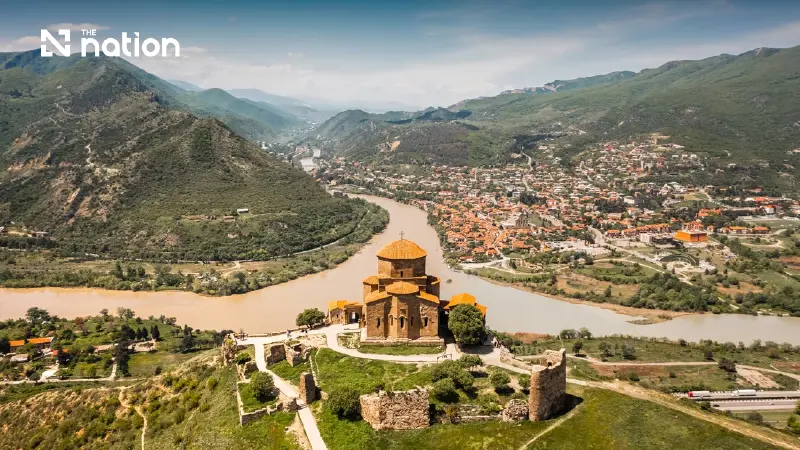


Once associated with post-Soviet disorder, Georgia rebuilt public confidence before online travel content and international campaigns broadened interest in its culture.
- Following its 1991 independence from the Soviet Union, Georgia was plagued by political turmoil, civil war, and widespread crime, making it an unlikely tourist destination.
- A critical turning point occurred in 2003 with sweeping government reforms, including a complete overhaul of the corrupt police force, which significantly improved public safety.
- The country's international image was later transformed by social media, as travel creators and influencers showcased its scenic mountains, unique cuisine, and ancient winemaking culture to younger audiences.
Georgia, a country of about 69,700 square kilometres at the crossroads of Eastern Europe and Western Asia, now appears frequently in social-media travel content.
Its area is roughly comparable in size to Chiang Mai, Nakhon Ratchasima and Kanchanaburi combined.
Images of its capital, mountain landscapes, vineyards and cuisine have helped establish the relatively small country as a sought-after destination among younger travellers.
Georgia was one of 15 states to emerge from the Soviet Union, declaring independence on April 9, 1991.
Tbilisi, its capital, combines historic old-city architecture with modern buildings, but the country’s image during its early post-Soviet years was markedly different.
Political turmoil, civil war, crime and corruption followed independence, while fighting spread into central Tbilisi.
Under those conditions, Georgia had little scope to present itself as a tourism destination.
The capital also faced extensive street crime and failures in policing and the justice system.
A US State Department report noted that a 1994 crackdown reduced some random violence, although police corruption and violence remained widespread and mafia groups in Tbilisi had links to some senior officials.

The World Bank reported that, in 2003, applicants for traffic-police posts could pay bribes of US$2,000 to US$20,000 before recovering the money through roadside demands.
Economic decline, violent crime and a police force widely regarded as part of the problem left Tbilisi with a reputation for disorder and insecurity.
A major turning point came in 2003, when the government led by Mikheil Saakashvili began reforming the police and intensifying action against criminal groups.
About 16,000 traffic officers were dismissed within a short period, before a new patrol force of roughly 2,300 officers was established.
Recruitment, salaries, uniforms and patrol cars were overhauled to reduce opportunities for bribery.
The changes were credited with weakening criminal influence and restoring confidence in public officials.
They also drew criticism over police violence, hard-line punishment policies and human-rights problems in prisons.
Even so, the familiar image of officers demanding money on the streets and criminal groups wielding greater power than the state gradually receded.
Travel creators later played a central role in changing how Georgia was seen abroad.


In 2016, the New East Digital Archive reported that Tbilisi was becoming a popular destination among young Russians interested in fashion, art, food and contemporary culture.
Bloggers, journalists, stylists, models and other creative professionals travelled there and shared their experiences on Instagram and Facebook.
Their posts showed tables laden with food, mountains that appeared to need little colour enhancement and ageing buildings with distinctive character.
As one traveller posted, others wanted to follow, helping Georgia move from a relatively niche destination into wider discussion among younger audiences.
Unlike conventional tourism advertising, much of this content reflected personal experience.
Followers could view it as advice from people they trusted rather than as an attempt to sell a tour package.
Images of influencers eating local food, staying at hotels in the mountains or walking through Tbilisi’s old lanes also made it easier for viewers to imagine making the same trip.
Georgian authorities also used this form of word-of-mouth promotion. For a period in 2015, visitors arriving by air received a bottle of Saperavi wine as a welcome gift.
The gesture was widely shared and discussed on social media, allowing a single bottle to communicate both Georgia’s wine culture and the hospitality associated with the country.
In 2022, the Georgian National Tourism Administration worked with Alpha Agency, an international marketing and advertising company, on a campaign in Latvia, Lithuania and Estonia.
Leading influencers from each country were used alongside television, digital and out-of-home advertising and public-relations work.
After the campaign, visits to Georgia’s tourism website from the target countries rose by 63%, while Georgia became one of the three most popular destinations among Baltic travellers.
The result cannot be attributed to influencers alone because several forms of media were used, but it indicates that they made a substantial contribution to the country’s international profile.
Georgia’s tourism appeal also suits the visual formats of social media.
The Caucasus Mountains, sometimes described as the “Switzerland of the Caucasus”, are among its best-known attractions, along with Gergeti Trinity Church against the backdrop of snow-covered Mount Kazbek.
Mountain scenery, old churches, vineyards, local food, wooden balconies and narrow streets in Tbilisi can all be presented readily through photographs and short videos, giving the country a fresh and distinctive image compared with more familiar European destinations.
Georgia is also described as the birthplace of the world’s oldest winemaking tradition, dating back about 8,000 years.
Its traditional qvevri method ferments wine in clay vessels buried underground and is recognised by UNESCO as cultural heritage.
Local dishes include khachapuri, a boat-shaped baked bread filled with cheese and topped with a raw egg, and khinkali, a large dumpling resembling xiaolongbao.
Food, accommodation and transport costs are described as broadly comparable with those in Thailand.
Georgia’s international profile also includes figures beyond tourism.
It was the birthplace of Joseph Stalin, the former Soviet leader whose rule oversaw the Soviet Union’s transformation from an agrarian society into an industrial and military power.
In the contemporary era, footballer Khvicha Kvaratskhelia has emerged as the country’s most prominent international figure after moving from Napoli to European champions Paris Saint-Germain for about €70 million in 2025.
UK travel guidance assesses general crime in Georgia as low, but identifies pickpocketing and political demonstrations as risks and advises visitors to avoid disputed territories.
Travellers are also advised to consult official information, respect local culture and monitor conditions in each area, particularly in highland locations without mobile coverage and places still affected by conflict.

