
Why China insists on selecting the next Dalai Lama: Bloomberg
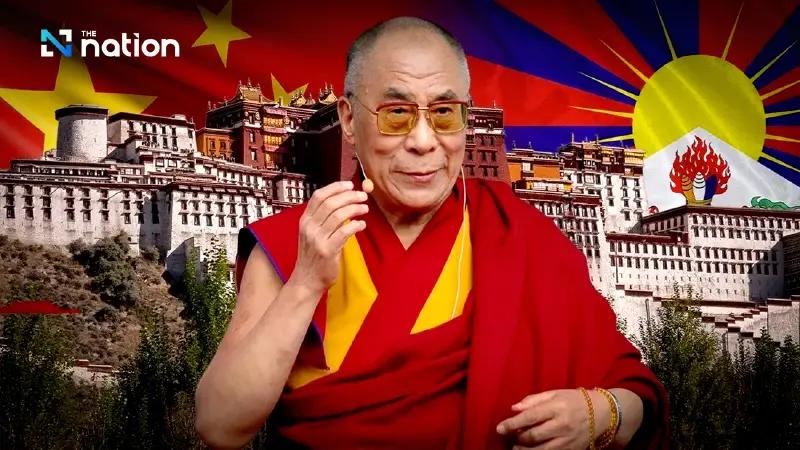


The selection of the next "Dalai Lama" remains a contentious issue in the region, as the Chinese government insists on appointing the next Dalai Lama itself.
According to a Bloomberg opinion column by Karishma Vaswani, the current Dalai Lama, Tibet's spiritual leader, will turn 90 on July 6. This marks not only his birthday but also a significant opportunity to reveal his successor.
China is determined to control the succession of the Dalai Lama in order to prevent any erosion of Tibet, which it annexed in the 1950s. During that time, the current Dalai Lama was forced to flee, disguising himself as a Chinese soldier and escaping on foot with his family and ministers to India, where he established a government in exile in Dharamshala, northern India.
At the heart of this struggle is the Chinese Communist Party (CCP), which desires control over everything, with Beijing insisting that it will approve the next religious leader. Many Tibetans view this as an undermining of their faith for political purposes.
Tibetan Buddhists believe this is a spiritual matter, with the Dalai Lama, or the living Buddha, expected to reincarnate.
The Dalai Lama has strategically suggested that his successor would be born outside Tibet, beyond the reach of the Chinese authorities, to prevent CCP from appointing a puppet leader.
Tibet is strategically important to China, bordering India, Nepal, and Bhutan, regions often referred to as the "roof of the world," and situated at high altitudes along the Himalayan mountain range.
The region is home to about 90% Tibetans, with a language completely different from Chinese. Most Tibetans follow Buddhism and continue to regard the exiled Dalai Lama as their spiritual leader, even though he is no longer their political leader, having formally relinquished political power in 2011.
Beijing, therefore, seeks to diminish the Dalai Lama's influence, as it still holds significant sway.
Ian Johnson, a former senior China fellow at the Council on Foreign Relations, remarked, “Even though the region no longer has a theocracy, the Dalai Lama remains an immensely symbolic figure. He is widely revered, and the CCP has even refrained from banning his images in ordinary homes because they know it would provoke a strong public backlash."
Johnson added that even in a tightly controlled dictatorship like China, the use of force to achieve its objectives comes at a high cost. The CCP seeks to win over Tibetans and their political loyalty, which explains why the selection of the next Dalai Lama is so critical.
The issue of the "successor" has been a long-standing point of conflict between the Dalai Lama and the Beijing government. Both sides have previously appointed young boys to hold the important spiritual position of the "Panchen Lama," the second most significant figure in Tibetan Buddhism.
Gedhun Choekyi Nyima, the 6-year-old boy selected by the Dalai Lama as the 11th Panchen Lama, was taken into custody by Chinese officials in 1995 and has not been seen since.
Meanwhile, the Panchen Lama chosen by Beijing has pledged loyalty to the CCP during a meeting with Chinese President Xi Jinping in January.
The Dalai Lama has warned that China may attempt to do the same with his successor after his death, strengthening its control over Tibet and diminishing the significance of the government-in-exile in India.
Any threat to Beijing's power in the region has consistently been suppressed, with these efforts intensifying since the 2008 anti-China protests. Human rights groups report that Beijing is attempting to suppress local culture, destroy monasteries, nunneries, and cultural relics, and suppress adherence to Tibetan Buddhism.
Beijing has been able to control regions of unrest, primarily in Xinjiang, where it has implemented mass incarcerations and political indoctrination of Uyghurs, who are mostly Muslim, along with other ethnic and religious minorities.
Although China denies these accusations, it has later defended its actions, claiming that necessary measures must be taken to combat terrorism, while also stating that many of the detention facilities have since been closed.
China has also praised its economic management in Xinjiang as an example of its policy's success, though this is seen as a tool of control. The same approach has been applied in Tibet, with controversial plans to construct a hydroelectric project on a major river in the region, potentially building a large dam.
These efforts have not helped the local population. A 2024 report from the Jamestown Foundation, a Washington-based think tank, revealed that Chinese government measures to stimulate Tibet's economy and improve its business environment have greatly benefited the Chinese there, while Tibetans face economic neglect.
However, Tibet has received support from previous US administrations, including the first term of President Donald Trump. During that time, Congress passed a significant bill targeting Chinese officials who sought to interfere with the succession process, imposing sanctions. Since then, Washington has reduced its support, severely affecting the future stability of Tibet’s institutions.
The Indian government has fully supported the Tibetans while carefully maintaining a balance in its relations with its Chinese neighbour. However, New Delhi’s response to the Dalai Lama’s succession will be closely monitored by China, as the two nations have only recently begun to develop ties. This can be seen from Indian pilgrims returning to sacred Tibetan sites for the first time in five years.
The ideal Dalai Lama for Beijing is one who remains under CCP control, not one chosen by the Tibetan people. This would be a tragedy for the Tibetans, who are struggling to preserve their identity.
