
Air India CEO says investigation into Ahmedabad crash raises new questions
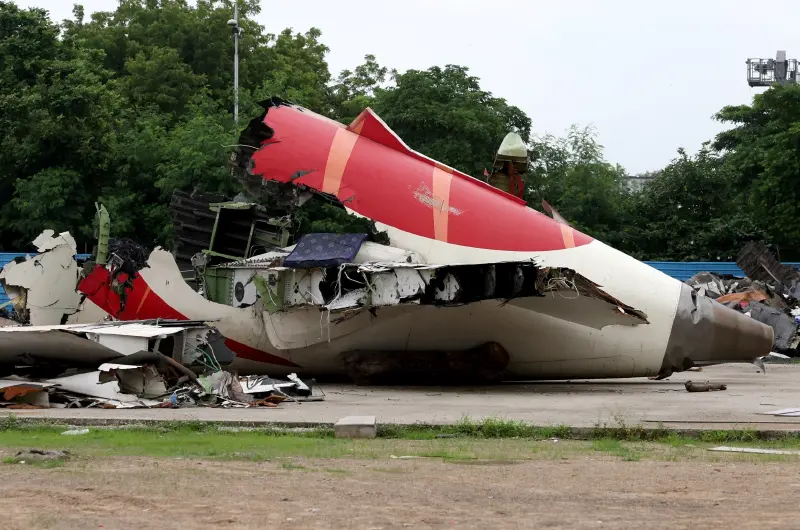


A preliminary investigation into the crash of an Air India passenger jet last month that killed 260 people raises additional questions about the incident, and the investigation is far from over, Air India's CEO said in a memo on Monday.
The preliminary investigation released by India's Aircraft Accident Investigation Bureau on Saturday depicted confusion in the cockpit shortly before the crash of the Boeing Dreamliner.
In a staff memo reviewed by Reuters, Air India CEO Campbell Wilson said the report had "triggered a new round of speculation in the media ... Unsurprisingly, it provided both greater clarity and opened additional questions."
He added: "The preliminary report identified no cause nor made any recommendations, so I urge everyone to avoid drawing premature conclusions as the investigation is far from over."
The memo said the preliminary report found no mechanical or maintenance faults and that all required maintenance had been carried out.
The Boeing 787 Dreamliner bound for London from the Indian city of Ahmedabad began to lose thrust and sink shortly after takeoff. All but one of the 242 people on board and 19 others on the ground were killed.
According to the AAIB report, in the flight's final moments, one pilot was heard on the cockpit voice recorder asking the other why he cut off the fuel.
"The other pilot responded that he did not do so," the report said. It added that the plane's engine two fuel cutoff switches flipped almost simultaneously, but did not say how.
The preliminary report suggested no immediate action for Boeing or GE, whose engines were fitted on the aircraft.
ALPA India, which represents Indian pilots at the Montreal-based International Federation of Air Line Pilots’ Associations, has rejected any presumption of pilot error and called for a "fair, fact-based inquiry".
"The pilots had passed their mandatory pre-flight breathalyser and there were no observations pertaining to their medical status," Campbell said in his memo.
The commanding pilot of the Air India plane was Sumeet Sabharwal, 56, who had a total flying experience of 15,638 hours and, according to the Indian government, was also an Air India instructor. His co-pilot was Clive Kunder, 32, who had 3,403 hours of total experience.
Air India has come under heightened scrutiny on multiple fronts following the crash.
On July 4, the European Union Aviation Safety Agency said it would investigate budget unit Air India Express, after a Reuters report revealed the airline failed to promptly replace engine parts on an Airbus A320 as mandated, and falsified records to indicate compliance.
India orders its airlines to check fuel switches on Boeing jets
India on Monday ordered its airlines to examine fuel switches on several Boeing models, while South Korea said it would order a similar measure, as scrutiny intensified of fuel switch locks at the centre of an investigation into a deadly Air India crash.
The moves by India and South Korea came despite the planemaker and the U.S. Federal Aviation Administration telling airlines and regulators in recent days that the fuel switch locks on Boeing jets are safe.
The locks have come under scrutiny following last month's crash of an Air India jet, which killed 260 people. A preliminary report found that the switches had almost simultaneously flipped from run position to cutoff shortly after takeoff.
The report noted a 2018 advisory from the U.S. Federal Aviation Administration (FAA), which recommended, but did not mandate, operators of several Boeing models, including the 787, to inspect the locking feature of fuel cutoff switches to ensure they could not be moved accidentally.
India's Directorate General of Civil Aviation said it had issued an order to investigate locks on several Boeing models, including 787s and 737s, after several Indian and international airlines began making their own inspections of fuel switches.
The regulator oversees the world's third-largest and fastest-growing aviation market, and its move raises the stakes for Boeing, whose aircraft are used by three of the country's four largest airlines.
A spokesperson for the South Korean transport ministry said checks there were in line with the 2018 advisory from the FAA, but did not give a timeline for them.
Boeing referred Reuters' questions to the FAA, which was not immediately available to comment outside regular hours. The company's shares were up 1.4% in U.S. premarket trading.
Some other global airlines were weighing their own inspections or had begun their own checks.
In a statement, Japan's JAL said safety was its top priority, adding, "We are closely monitoring the investigation into the incident and will implement any necessary inspections based on its findings."
Over the weekend, Air India Group started checking the locking mechanism on the fuel switches of its Boeing 787 and 737 fleets and has discovered no problems yet, a source familiar with the matter told Reuters.
About half the group's 787s have been inspected and nearly all its 737s, the source added, speaking on condition of anonymity. Inspections were set to be completed in the next day or two.
On Sunday, citing a document and sources, Reuters reported that the planemaker and the FAA had privately issued notifications to airlines and regulators that the fuel switch locks on Boeing planes were safe and checks were not required.
The Air India crash preliminary report said the airline had not carried out the FAA's suggested inspections, as the FAA's 2018 advisory was not a mandate.
It also said maintenance records showed that the throttle control module, which includes the fuel switches, was replaced in 2019 and 2023 on the plane involved in the crash.
In an internal memo on Monday, Air India CEO Campbell Wilson said the investigation into the crash was far from over and it was unwise to jump to premature conclusions, following the release of the preliminary report.
Reuters
