
Decoding Trump’s ‘illegal tariffs’: what it means and what comes next
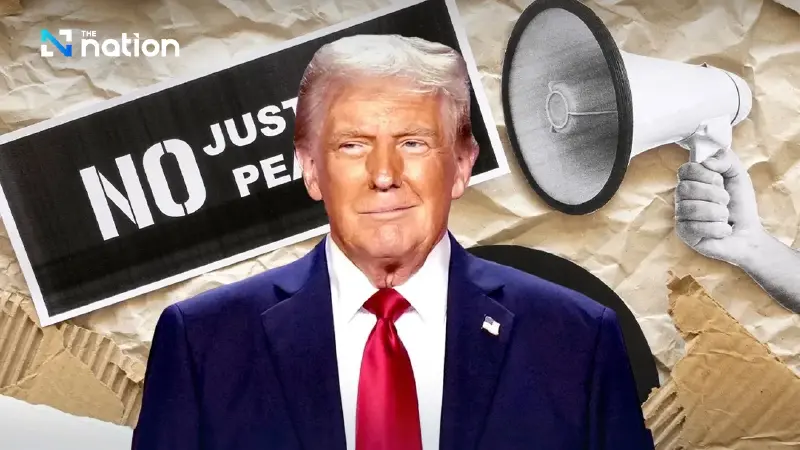


US courts have twice ruled Trump’s reciprocal tariffs unlawful, but duties remain in force pending a Supreme Court showdown that could reshape global trade.
US President Donald Trump has suffered his second courtroom defeat after a federal appeals court ruled that the majority of his import tariffs on foreign goods were illegal, finding that he exceeded his authority by invoking emergency economic powers.
The ruling echoed a lower court’s decision in late May, raising fresh hopes among countries affected by the levies that the case may ultimately be struck down at the Supreme Court.
The controversy centres on Trump’s reciprocal tariffs, which have now been rejected by both the trial court and the appeals court. The legal battle highlights the limits of presidential powers in trade policy and sets the stage for a decisive ruling by the nation’s highest court.
How Trump first lost in court
In May, the US Court of International Trade in Manhattan invalidated tariffs Trump had imposed on 2 April, as well as earlier duties on Canada, Mexico, and China. The judges found that Trump acted beyond his constitutional remit by implementing tariffs under the International Emergency Economic Powers Act (IEEPA), a 1977 law allowing the president to regulate international economic transactions only in genuine national emergencies.
While IEEPA gives the president broad authority to impose sanctions or economic measures in response to threats to national security, the court stressed that tariff-setting and trade regulation fall under the powers of Congress, not the president.

By bypassing a congressional vote and declaring an “economic emergency,” Trump was deemed to have overstepped.
Although he lost at the trial level, Trump immediately filed an appeal. The federal appeals court temporarily allowed his tariffs to remain in effect while the case proceeded.
What the appeals court ruled
The US Court of Appeals for the Federal Circuit, in a 7–4 decision, upheld the earlier judgment of the Court of International Trade. The panel found that while the law grants the president broad powers to act in response to declared national emergencies, “those powers do not expressly include the authority to set customs duties, tariffs, or taxes.”
Tim Brightbill, a trade lawyer at Wiley Rein who was not involved in the case, explained that the court effectively ruled that although the IEEPA provides certain tariff-related authority, the Trump administration “overstepped by applying such sweeping, global measures.”
The appeals court also directed the lower court to reconsider its earlier ruling and to bar tariff collections across the board, rather than limiting relief to the plaintiffs who brought the lawsuit.
The tariffs deemed unlawful by both the trial court and the appeals court include Trump’s reciprocal tariffs as well as levies imposed on Canada, Mexico, and China in February. However, the ruling does not apply to sector-specific tariffs imposed under Section 232 of US trade law.

Tariffs remain in force pending Supreme Court appeal
Although Trump lost in the appeals court, the judges allowed his tariff regime to remain in place until October 14, 2025, giving the administration time to petition the US Supreme Court.
Trump’s reaction
“All tariffs remain in effect!” Trump declared on Truth Social shortly after the ruling. He dismissed the decision as “wrongly decided by a partisan appeals court,” but insisted that “in the end, America will win.” He warned that removing the tariffs would be “a total disaster for the country.”
Ahead of the ruling, Trump’s legal team had warned the court that striking down the measures would cause “serious consequences,” pointing to trade agreements already struck with the EU, Indonesia, the Philippines, and Japan. Even if the tariffs were judged unlawful, they argued, enforcement of that ruling should be suspended.
“The United States cannot afford to repay trillions of dollars that other countries have already agreed upon, as this could trigger financial catastrophe,” the government’s lawyers wrote, suggesting that cancelling the agreements risked a collapse similar to the 1929 Wall Street crash, which led to the Great Depression.
Meanwhile, US tariff revenues have surged. In July alone, customs duties generated US$142 billion (about 4.5 trillion baht), more than double the amount collected in the same month last year.
Where Trump’s tariffs go from here
The case now appears destined for the US Supreme Court, where nine justices will ultimately decide its fate. Of these, six were appointed by Republican presidents, including Chief Justice John Roberts, while three were appointed under Democratic administrations.
Although the Supreme Court has in the past upheld several of Trump’s second-term policy initiatives, it has also in recent years shown reluctance to interpret older statutes in ways that would significantly expand presidential authority.
Should Trump lose again at the Supreme Court, his administration could pivot to other legal tools. These include Section 122 of the 1974 Trade Act, which permits tariffs of up to 15% for 150 days on imports from countries with large trade surpluses, or Section 301 of the same law, which allows retaliatory tariffs against unfair trade practices. Trump previously relied on Section 301 to wage his first-term trade war with China.
With trillions of dollars in global trade entangled in the dispute, a final ruling striking down Trump’s measures would have profound consequences. It could unravel several of the trade agreements Trump has touted as political victories and may also expose the administration to claims for the refund of tariffs already paid by foreign governments and companies.
