
China's Xi projects power at military parade with Putin and Kim
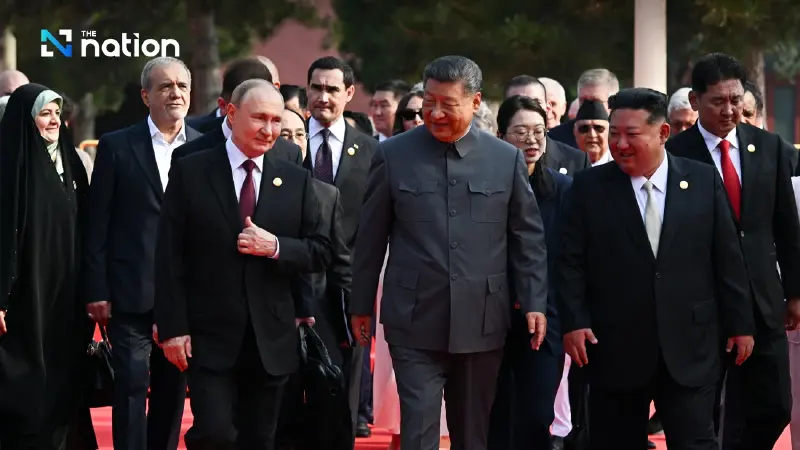


Chinese President Xi Jinping on Wednesday delivered a stark message to the world, warning that humanity must choose between peace and conflict, as he presided over Beijing’s largest military parade in decades.
For the first time, Russian President Vladimir Putin and North Korean leader Kim Jong Un joined the event, highlighting China’s growing diplomatic influence amid global tensions.
Marking 80 years since Japan’s World War Two defeat, the parade was largely ignored by Western leaders. Xi inspected thousands of troops and advanced weaponry, including hypersonic missiles, underwater drones, and a robotic “wolf” system, while helicopters and fighter jets flew in precision formation. The display concluded with the release of 80,000 symbolic doves.
Xi, dressed in a Mao-style tunic, mingled with more than 25 attending leaders, including Indonesia’s Prabowo Subianto, while seated between Putin and Kim. Observers note the gathering offered opportunities to cement defence and energy ties, following recent Russia–North Korea and China–North Korea agreements.

The parade coincided with Xi promoting a vision of a new global order. Speaking earlier at a regional summit, he called for unity against “hegemonism and power politics,” a veiled critique of U.S. policy, which has been increasingly unpredictable under President Donald Trump.
Analysts say the event serves multiple purposes: demonstrating China’s modern military capabilities, reinforcing patriotic sentiment at home, and signalling to regional powers and potential partners that Beijing is asserting its influence. Civil servants across China were reportedly instructed to observe the parade and submit reflections, underscoring its domestic political significance.

Observers also highlighted the broader context: the People’s Liberation Army has undergone significant leadership purges over the past two years, and the parade allowed Xi to showcase the military’s modernisation while diverting attention from ongoing internal challenges.
Xi framed the country’s 20th- and 21st-century history as a narrative of national rejuvenation, presenting China’s rise as “unstoppable” and positioning Beijing as a decisive player on the global stage.
Reuters


