
Venezuela's Maria Corina Machado wins 2025 Nobel Peace Prize
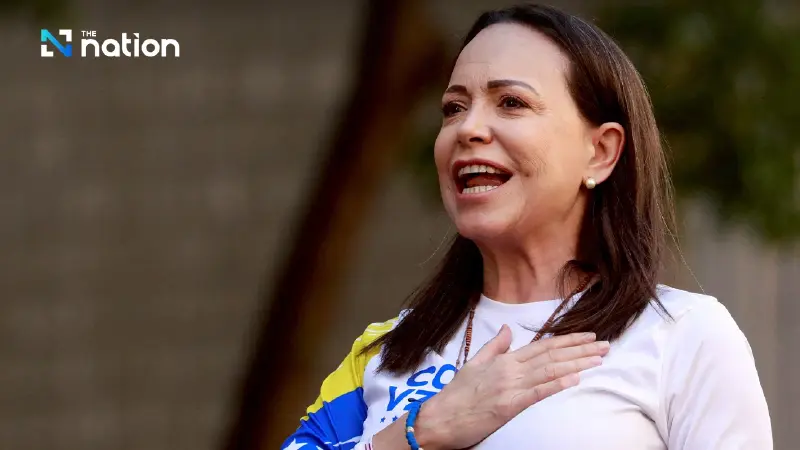


Venezuelan opposition figure Maria Corina Machado has been awarded the 2025 Nobel Peace Prize for her tireless efforts to advance democratic rights and lead her country toward a peaceful transition to democracy, the Norwegian Nobel Committee announced on Friday.
“When authoritarian regimes seize control, it is vital to honour those who courageously stand up for freedom and resist oppression,” the committee said in its statement.
This year’s decision brings global attention to the political crisis in Venezuela, where Machado has become a symbol of non-violent resistance. The announcement also comes amid growing debate over US President Donald Trump’s repeated claims that he deserves the prize for his role in brokering peace agreements in the Middle East.
Analysts had predicted that Trump would be overlooked for the award, arguing that his foreign policy approach has undermined the international order that the Nobel Committee seeks to uphold.
The Nobel Peace Prize, valued at 11 million Swedish kronor (approximately US$1.2 million), will be formally presented in Oslo on December 10, the anniversary of Alfred Nobel’s death, who established the awards in his 1895 will.

Machado has long stood at the forefront of her country’s struggle for democracy, defying intimidation, political bans, and state persecution.
Born on October 7, 1967, in Caracas, Machado studied industrial engineering at Venezuela’s Universidad Católica Andrés Bello and later attended programmes at Yale University in the United States. Her early career in the private sector shaped her belief in institutional reform and civic participation.
In 2002, she co-founded Súmate, a civil society organisation that promotes electoral transparency and citizen engagement. The group became instrumental in monitoring Venezuela’s referendum on President Hugo Chávez’s rule in 2004, a move that made Machado a central figure in the democratic opposition.
Elected to the National Assembly in 2010, Machado quickly emerged as one of the government’s most vocal critics, pushing for accountability, free elections, and respect for human rights. Her fearless criticism of Chávez and later Nicolás Maduro made her a target of political repression.
In 2014, she was stripped of her parliamentary seat after representing Venezuela as a guest delegate at a meeting of the Organisation of American States (OAS), a move the government claimed violated constitutional provisions. Since then, she has faced travel bans, political disqualification, and harassment by state authorities, yet she continues to advocate for non-violent democratic transition.
Despite being barred from holding public office for 15 years by Venezuela’s comptroller general in 2023, Machado’s popularity surged. She won the opposition’s primary election for the 2024 presidential race, symbolising both defiance and resilience in the face of authoritarian power.
Machado’s movement has inspired a new generation of Venezuelans and drawn global attention to the regime’s suppression of dissent. Her message remains steadfast: “Freedom is not negotiable. Democracy is the only path to peace.”
