
Hong Kong police arrest three as apartment fire death toll rises to 44, hundreds missing
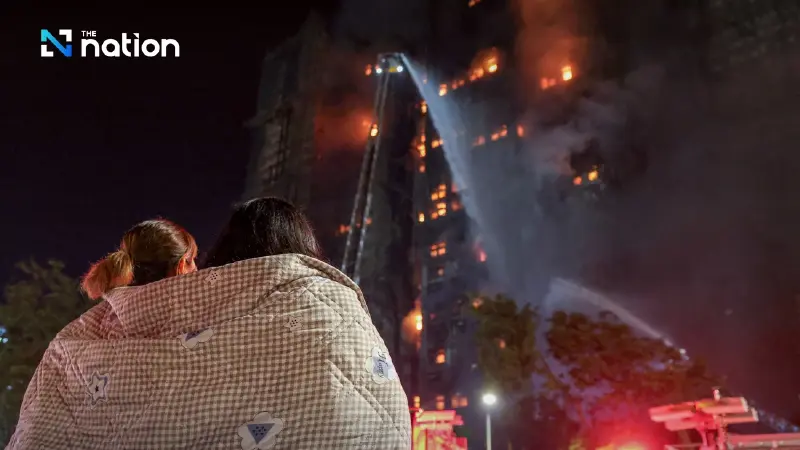


A devastating fire still raging at a Hong Kong apartment complex has claimed at least 44 lives, with almost 300 people still missing.
The blaze, which erupted on Wednesday afternoon, is believed to have spread due to unsafe scaffolding and foam materials used during ongoing maintenance work, authorities reported on Thursday.
Firefighters worked through the night to rescue residents potentially trapped on the upper floors of the Wang Fuk Court housing complex in the Tai Po district. However, the intense heat and thick smoke made it difficult to access certain areas.
The complex, which comprises 2,000 apartments across eight blocks, has been a site of extreme devastation. By early Thursday, firefighters had managed to control the flames in four of the blocks, while operations continued in the remaining three after more than 15 hours.
Despite their efforts, footage from the scene showed flames still consuming at least two of the 32-storey towers, with heavy smoke billowing from several others.
Police revealed that some of the buildings had been covered with plastic mesh and protective sheeting that may not have met fire safety standards. Additionally, they found that windows in one unaffected building had been sealed with foam material as part of the maintenance, a move that is now under scrutiny.


Eileen Chung, a Hong Kong police superintendent, indicated that the construction company responsible for the materials and methods may have been grossly negligent, exacerbating the disaster. Three individuals from the company—two directors and an engineering consultant—have been arrested on suspicion of manslaughter.
The fire’s scale and the resulting casualties are now considered the deadliest in Hong Kong since World War II, surpassing the 41 fatalities in a 1996 commercial building fire. The tragedy has also drawn comparisons to the 2017 Grenfell Tower fire in London, which was similarly caused by flammable cladding and systemic failures.
Hong Kong’s Chief Executive, John Lee, stated that the priority was to extinguish the fire, rescue the trapped residents, and support the injured. He also confirmed that a thorough investigation into the cause of the blaze would be launched. By Thursday, around 279 people remained unaccounted for, and over 900 individuals were sheltered in eight evacuation centres.

One emotional resident, 71-year-old Wong, tearfully described how his wife was still trapped inside the building. Meanwhile, others, like Harry Cheung, a long-time resident of Block Two, spoke of the horror and confusion as the fire broke out. The Philippine consulate in Hong Kong has also confirmed that it is investigating reports of Filipino domestic workers possibly being trapped in the complex.
Chinese President Xi Jinping has called for an "all-out effort" to extinguish the fire and reduce casualties. His appeal for urgent action was broadcast on Chinese state media as fire crews continued their battle against the blaze.

The tragic event comes amid long-standing social unrest in Hong Kong over sky-high property prices. The fire has further fueled public dissatisfaction, particularly ahead of the city’s legislative elections set for December.
Bamboo scaffolding, traditionally used in Hong Kong’s construction sector, is now under scrutiny following the fire. Although fire hazards were not cited as the primary reason for phasing it out, the government began replacing bamboo scaffolding with metal frames earlier this year, citing safety concerns after a series of fatalities involving bamboo scaffolders.
Wang Fuk Court, a subsidised housing development, has been undergoing renovations for a year at a cost of approximately HK$330 million (US$42.43 million). However, the residents, many of whom have spent years contributing to this renovation project, now face the heartbreaking consequences of a tragedy that has wiped out lives, homes, and their sense of security.
As the situation continues to unfold, the tragedy has sparked a critical conversation about building safety, regulatory enforcement, and the safety of materials used in construction across Hong Kong.
Reuters
