
Sihasak ‘disappointed’ with US leader, insists Thai troops hit by mines in deliberate Cambodian attack
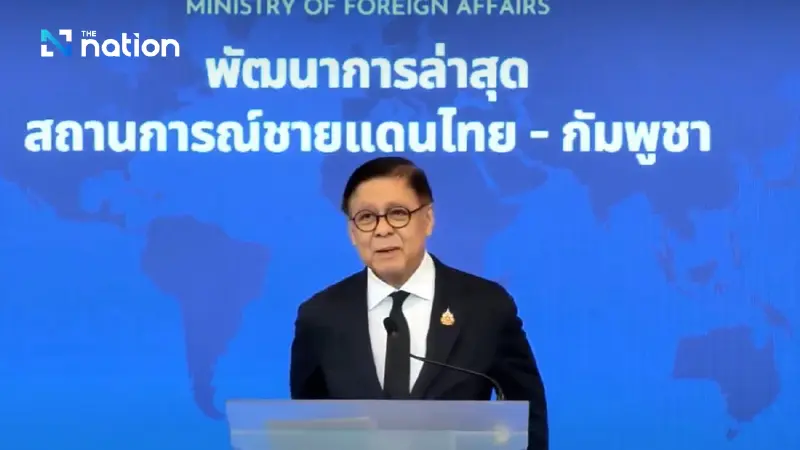


Foreign Minister Sihasak Phuangketkeow says Thailand is disappointed by comments from US President Donald Trump, stressing that Thai soldiers were maimed by landmines deliberately laid by Cambodia, not by accident, and calling for any satellite-based investigation to also probe mine use and cross-border rocket attacks.
Foreign Minister Sihasak Phuangketkeow on Saturday addressed the media on the current Thai-Cambodian border situation, following the widely discussed December 12 telephone call between Prime Minister Anutin Charnvirakul, who also serves as Interior Minister, and US President Donald Trump.
Sihasak noted that the Thai side, led by the Prime Minister, had already given a full briefing at Government House on the night of December 12.
He said that after President Trump posted his message on social media, Thailand had several points it wished to clarify.
Sihasak began by thanking President Trump for his concern over the border situation and his desire to see peace. “Thailand also wants peace, but peace cannot come from one side alone. It must come from both sides,” he said.
The Foreign Minister went on to stress that beyond the landmine incident, Cambodia fired BM-21 rockets into a civilian area in Sisaket province that very day, an act he described as clearly not an accident but a deliberate action.
He noted that President Trump had characterised Thailand’s response as harsh retaliation against Cambodia. “We wish to state that Thailand’s response has not been excessive,” Sihasak said.
He emphasised that Thailand remains a friend and ally of the United States, and expressed disappointment that the President’s comments had hurt the feelings of the Thai people:
“We are proud to be one of the United States’ oldest treaty allies in this region, and a non-NATO ally. Thailand and the US have stood side by side through many security challenges, and our partnership is based on shared security interests — past, present and future. That is why we are disappointed.”
Sihasak also referred to Cambodian Prime Minister Hun Manet’s call for the border clashes to be reviewed via satellite imagery to establish the facts.
He said Thailand had no objection to this proposal — and in fact welcomed it — but insisted that any such investigation should also include the landmine issue:
“When I travelled to Geneva, Switzerland for the Ottawa Convention meeting, I already called for an independent fact-finding mechanism. So if facts are to be verified, by any method, they should cover both the clashes and the use of landmines.”
The Foreign Minister added that threats along the Thai-Cambodian border today do not come only from Cambodian military operations, but also from scammer networks operating in the area. “These involve serious harm, including human trafficking and victims across the region and beyond. This is something the entire international community must recognise in the broader fight against online crime,” he said.
Sihasak stressed that Thailand is already taking strong action within its jurisdiction.
He announced that on December 17, Thailand will host a ministerial-level meeting on building partnerships to combat online scams, aimed at strengthening regional and international cooperation in tackling this growing cross-border threat.
Sihasak also thanked the US President for stating that talks at the working level on trade should continue, because trade matters are separate from the Thailand-Cambodia border situation and should not be linked to it.
He added:
“Another issue we are very concerned about is that there are currently more than 6,000 Thai nationals at the Poipet checkpoint in Cambodia who wish to return to Thailand due to concerns about their safety. On the Thai side, we have already allowed all Cambodian nationals who wanted to go home to return, but Cambodia has refused to open the border, even though this issue has nothing to do with the conflict and is purely a humanitarian matter.
“It is regrettable because we had already discussed and agreed that the border would be opened this afternoon (December 13) between 13.00-16.00 hrs, but the Cambodian side asked to postpone. At the same time, Hun Sen, President of the Cambodian Senate and former Prime Minister, posted that all cross-border travel would be suspended. This clearly amounts to a violation of human rights and humanitarian principles under various international instruments, particularly international human rights law.”
When asked whether the wording used by the US President, which was seen as disrespectful to Thai soldiers, could still be considered well-intentioned and constructive in the current Thai-Cambodian situation, Sihasak replied that the statement did not reflect reality, because it was certainly not an accident. It resulted from Cambodia’s deliberate decision to lay new landmines — something that has already been confirmed by the ASEAN observers.
Nevertheless, he said, that post or comment by President Donald Trump, describing it as an “accident”, has undoubtedly affected the feelings of the Thai people and of Thailand as a whole.
Regarding the question of whether President Trump’s indication of a ceasefire period amounted to boxing Thailand into a corner, Sihasak said:
“On a ceasefire, we must ask whether Cambodia is ready to cease fire. A ceasefire does not simply happen because someone wishes it; it must be based on the readiness of all parties. And given what happened this morning, we must ask: is that the behaviour of a party ready to cease fire?
“In this context, talk of a ceasefire is meaningless. So how can we speak of a ceasefire when the Cambodian side has not stopped firing? This is the same pattern as before: the Cambodian side says one thing and does another, diverting attention from the real issues, creating incidents to gain advantage on the international stage.
“Thailand therefore has no choice but to clarify and respond — because this is not only a fight along the border, but also a fight in the international arena.”
Asked about reports that the Prime Minister had said the phone conversation between Anutin and President Trump included discussion of a ceasefire and a return to the Peace Declaration, and what President Trump’s purpose was in posting his statement — and whether Thailand would seek another telephone discussion — Sihasak replied:
“It is likely the expectation of President Donald Trump himself. He has invested a great deal in the ceasefire agreement and, understandably, would like to see a ceasefire. But as I have said, a ceasefire can only happen when both sides are ready.
“In last night’s phone call between the two leaders, there was no agreement on a ceasefire. In my own conversation with the US Secretary of State, we discussed how a ceasefire cannot occur instantly, because the military on both sides must assess the situation and hold discussions.
“A ceasefire declared when no one is ready is not a sustainable ceasefire. So, in the Prime Minister’s discussion, the focus was on the idea of a ceasefire and, more importantly, on how a durable ceasefire would require many detailed steps that need to be discussed with the military on both sides.”
