
Nicolás Maduro: from bus driver to president, then detained by US
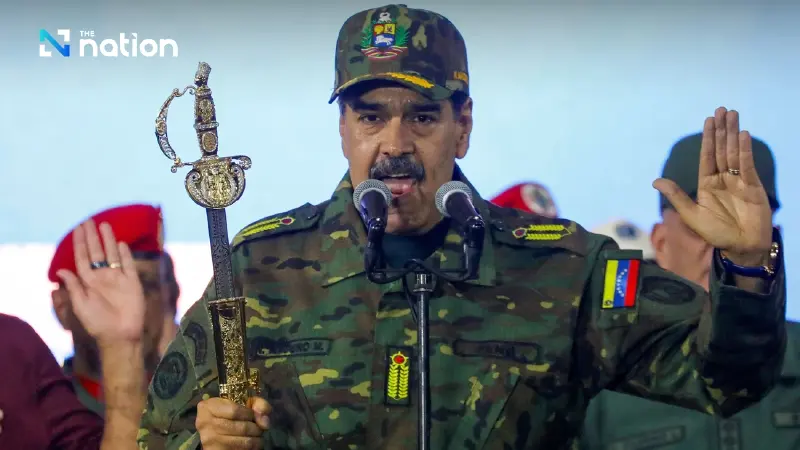


Nicolás Maduro rose from bus driver and union activist to lead Venezuela for over 13 years, before US special forces detained him and took him out of the country.
Nicolás Maduro, a former bus driver and trade union activist, rose from an ordinary background to rule Venezuela for more than 13 years and eight months, before being informally removed from power on Saturday, when US special forces detained the 63-year-old leader and took him out of the country.
According to Thansettakij, Maduro has for years accused the US government of trying to destroy what he described as the socialist revolution launched in 1999 by his mentor and former president, Hugo Chávez. He is now being held by US officials and is expected to face drug-related charges carrying a potentially lengthy prison sentence.
Venezuelans, too, will judge him. Maduro’s rule has been blamed for Venezuela’s economic collapse, driving millions to flee abroad to escape what critics describe as an inept, corrupt, oppressive and often brutal government.
Maduro was born on November 23, 1962. He began his political path as president of the student union at José Ávalos secondary school in El Valle, a working-class area near Caracas. Records suggest he did not finish secondary education, but he was remembered as poised and capable of compromise.
In 1986, he travelled to Cuba for his only period of higher education after school. After returning to work as a bus driver in the Caracas metro system, he quickly emerged as a trade union leader—like his father—and became an enthusiastic follower of Chávez.
In the mid-1990s, he joined the political movement Chávez formed after receiving a presidential pardon following a failed and violent coup attempt. When Chávez took office in 1998, Maduro’s loyalty, political skill and ideological commitment helped him rise rapidly within Venezuela’s governing party.
After six years in the National Assembly, he became foreign minister, and six years later he was appointed vice-president.
When Chávez died of cancer in 2013, he named Maduro as his successor. Many mocked Maduro’s working-class roots and dismissed him as a figure who merely echoed Chávez’s grand rhetoric.
While Maduro lacked his mentor’s charisma, he won that year’s election by a narrow margin and began his first six-year term.
Almost immediately, Maduro’s government plunged into crisis. Political opponents, including today’s Nobel Peace Prize laureate María Corina Machado, called for street protests in Caracas and other cities. Security forces responded with a crackdown that left 43 people dead and dozens arrested.
In 2015, Venezuela’s United Socialist Party lost control of the National Assembly for the first time in 16 years. Maduro then set up a pro-government Constituent Assembly in 2017 to neutralise the opposition’s power—prompting another wave of protests that were also violently suppressed.
Hundreds were arrested, and the International Criminal Court opened an investigation into Maduro and members of his administration over alleged crimes against humanity. More than 100 people were killed and thousands injured during the unrest.
Then, in 2018, Maduro survived an assassination attempt when an explosive-laden drone detonated near him as he delivered a speech at a nationally televised military parade in Caracas.
At the time, the economy was in steep decline, battered by hyperinflation and shortages of basic goods. Oil production fell to below 400,000 barrels per day—once an unthinkable figure.
In the 2018 presidential election, Maduro ran with virtually no meaningful competition and was declared the winner, but dozens of countries did not recognise the result. Opposition parties were blocked from participating, some opposition lawmakers were jailed, and others went into exile.
The US closely monitored developments. During Donald Trump’s first administration, Washington imposed economic sanctions on Maduro, his allies and state-owned companies in an effort to force political change.
The measures had limited impact on a support base described as including the armed forces, irregular armed groups and a well-entrenched party machine—while also underscoring the risk of violent confrontation.
Under mounting pressure, Maduro pursued economic reforms and offered concessions to a US-backed opposition, raising hopes of a free and democratic presidential election in 2024.
Those hopes did not materialise. In 2023, the government barred Machado, a key challenger, from running. In early 2024, repression of opposition figures and human rights defenders intensified.
Just hours after polls closed in 2024, the National Electoral Council declared Maduro the winner but did not release detailed results. Opposition tally sheets collected from more than 80% of electronic voting machines indicated a heavy defeat for the longtime leader. Protests were suppressed, and the National Assembly swore Maduro in for a third term in January 2025.
Trump’s return to the White House that same month rapidly escalated tensions. By the summer, the US had built up military forces in the Caribbean, pushing Venezuela onto high alert, and launched intensified actions against what it called “narco-terrorism”, including the destruction of vessels suspected of trafficking drugs—operations that reportedly left more than 100 people dead.
Throughout his political career, Maduro was often accompanied by his wife, Cilia Flores, who has held several senior roles, including attorney general and parliamentary speaker. She has often been seen as wielding influence comparable to her husband’s, and it is believed she, too, was detained by the US.
