
Xi and Merz Call for ‘Strategic Trust’ as Berlin Rebalances Ties Amid Trump Tariff Threats
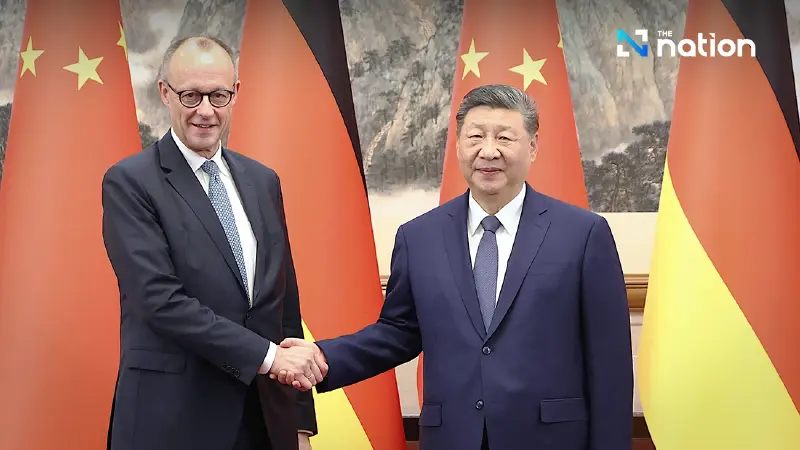


German Chancellor Friedrich Merz meets President Xi Jinping in Beijing to address a €89bn trade deficit and navigate a volatile new era of US protectionism
- German Chancellor Friedrich Merz and Chinese President Xi Jinping met in Beijing, calling for greater "strategic trust" and communication to act as a stabilizing force amid global turbulence.
- The visit is driven by Germany's effort to re-evaluate its international ties and protect its economy from the threat of unpredictable US trade policies and tariffs.
- While seeking cooperation, Chancellor Merz is also aiming to "rebalance" the relationship by addressing Germany's significant €89bn trade deficit with China and calling for a fairer partnership.
German Chancellor Friedrich Merz meets President Xi Jinping in Beijing to address a €89bn trade deficit and navigate a volatile new era of US protectionism.
President Xi Jinping has called for a strengthening of "strategic communication" and mutual trust between China and Germany, warning that the world is currently grappling with "changes unseen in a century".
Meeting in Beijing on Wednesday, the Chinese leader told the visiting German Chancellor, Friedrich Merz, that the two industrial powerhouses must act as a stabilizing force in an international landscape marked by "turbulence and intertwined crises".
"The more turbulent and complex the world becomes, the more China and Germany need to strengthen strategic communication," Xi said, adding that he intended to take the bilateral "comprehensive strategic partnership" to new levels.

The visit marks Merz’s first trip to China since assuming office in May last year. It comes at a pivotal moment for European diplomacy, as the Continent attempts to insulate its economy against the "unpredictable" trade policies of US President Donald Trump.
Washington’s renewed threats of global levies, alongside the US leader’s unconventional geopolitical manoeuvres—including a persistent push to acquire Greenland—have unsettled European capitals.
Merz is the latest in a flurry of Western leaders to seek audience in Beijing this winter, following visits by British Prime Minister Keir Starmer, Canadian PM Mark Carney, and French President Emmanuel Macron.

The Economic Imbalance
While the rhetoric in the Great Hall of the People was diplomatic, the subtext of the visit remains a "yawning" trade imbalance. Provisional figures show bilateral trade reached €251.8 billion (£210bn) last year, but the gap is widening: German imports from China totalled €170.6 billion, while exports stood at just €81.3 billion.
Earlier in the day,Merz met Chinese Premier Li Qiang, where he stressed that while Germany values its largest trading partner, the relationship must evolve.
"We have very specific concerns regarding our cooperation, which we want to improve and make fair," Merz told reporters.
In a move widely interpreted as a critique of the Trump administration’s protectionism, Premier Li urged both nations to "safeguard multilateralism and free trade" and to resist the fragmentation of global supply chains.

Strategic Competition
Despite the signing of new accords on climate change and food security, Merz remains clear-eyed regarding Beijing’s ambitions. Before departing for China, he warned his Christian Democratic Union (CDU) colleagues that China is "systematically exploiting the dependencies of others" and seeks to redefine the international order on its own terms.
The Chancellor is accompanied by a high-level delegation of 30 senior executives from Germany’s industrial vanguard, including the automotive, chemical, and pharmaceutical sectors.
The itinerary includes a visit to a Mercedes-Benz plant in Beijing and a trip to the eastern tech hub of Hangzhou to visit Siemens Energy and the robotics firm Unitree.
Beyond trade, Merz is expected to press President Xi to use Beijing’s influence with Moscow to help broker an end to the war in Ukraine—a request previously echoed by German Foreign Minister Johann Wadephul during his visit to the capital in December.
As the meeting concluded, Merz underscored the weight of the relationship: "We are two of the world's three largest industrial nations. This is a great responsibility, but it is also a great opportunity."
Reference: Reuters, BBC, CGTN, South China Morning Post
