
Iran hardliners lash out at Pezeshkian over Gulf apology
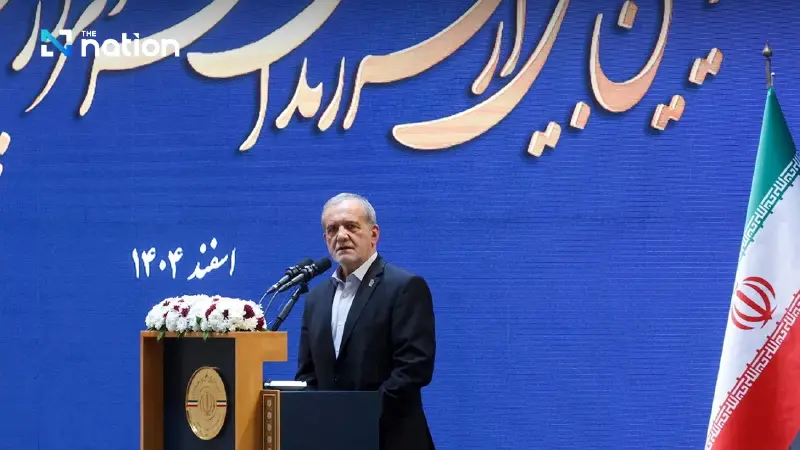


Iranian hardliners have turned on President Masoud Pezeshkian after he apologised to neighbouring countries and pledged to halt attacks on them unless they are used to strike Iran, exposing deeper splits in Tehran’s leadership after Ayatollah Ali Khamenei’s death.
Iranian hardliners have mounted a sharp backlash against President Masoud Pezeshkian after he apologised to neighbouring countries hit during Tehran’s regional strikes and said Iran would suspend attacks on them unless those states were used as launchpads for attacks on Iran. The row has laid bare widening fractures inside the Islamic Republic just days after the killing of Supreme Leader Ayatollah Ali Khamenei.
Apology to neighbours triggers backlash from hardliners
In a televised address, Pezeshkian said he personally apologised to neighbouring countries affected by Iran’s actions and urged them not to join US-Israeli attacks on Iran. He said the interim leadership council had agreed to stop attacks on nearby states unless strikes on Iran originated from their territory.
The remarks quickly drew criticism from hardliners. Reuters reported that hardline cleric and lawmaker Hamid Rasai called the president’s position “unprofessional, weak and unacceptable”. Reuters also said Pezeshkian later repeated his message on social media but omitted the apology, suggesting a partial retreat under pressure.
The split was reinforced by judiciary chief Gholamhossein Mohseni-Ejei, a fellow member of the three-man interim leadership council, who said some regional states had allowed their territory to be used for attacks on Iran and that “heavy strikes” on such targets would continue. Hours after Pezeshkian’s address, the Revolutionary Guards said they had struck a US air combat centre at Al Dhafra Air Base near Abu Dhabi, although Reuters said it could not independently verify that claim.
Other conservative critics were even harsher. Iran International reported that some hardline voices described the apology as humiliating, while others branded any talk of ceasefire or rollback as betrayal of wartime strategy. Those claims have not been independently confirmed by Reuters.
Leadership rifts deepen as succession pressure grows
Reuters reported that the dispute reflects genuine divisions between hardliners, especially within the Revolutionary Guards, and more pragmatic factions around Pezeshkian. Those differences had often been contained under Khamenei’s rule, but his death has allowed them to spill into public view as Iran faces sustained US-Israeli bombardment.
The leadership vacuum has also intensified pressure to choose a new supreme leader quickly. Reuters reported on March 7 that clerics were accelerating the succession process and that a decision could come as early as Sunday, though it remained unclear whether any successor would command enough authority to contain factional disputes. Mojtaba Khamenei is seen as a frontrunner, but Reuters did not report that he had already been formally chosen.
Taken together, the backlash against Pezeshkian’s apology and the contradictory signals from the Revolutionary Guards and judiciary suggest that Iran’s civilian leadership has limited room to steer policy while military and clerical hardliners push for a tougher course.
