
JR East's freight-only Shinkansen train goes into service
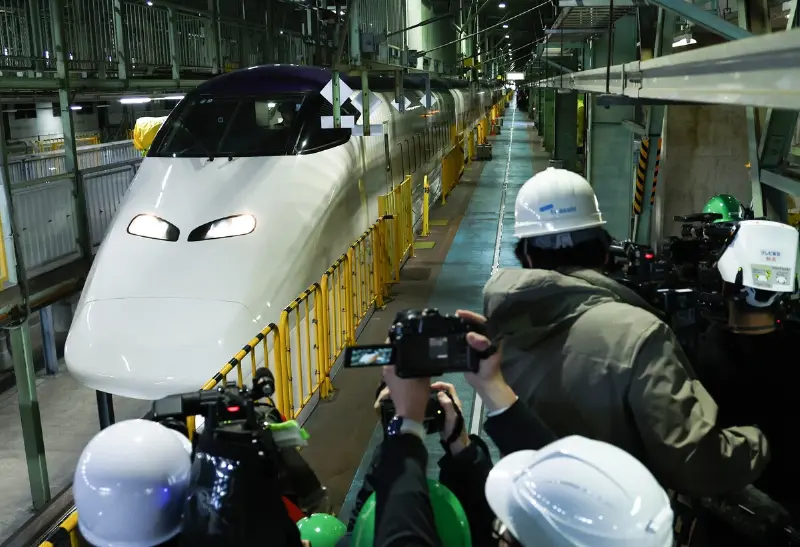


JR East has begun weekday cargo runs between Morioka and Tokyo using a converted bullet train, aiming to ease driver shortages and cut emissions.
- East Japan Railway Co. (JR East) has begun operating a dedicated freight-only Shinkansen bullet train service.
- The train, a converted E3 series passenger model, runs on weekdays between Morioka and Tokyo, a journey of about three hours and 15 minutes.
- It was introduced to meet increasing demand driven by challenges like truck driver shortages and the need to reduce CO2 emissions.
- The seven-car train has a maximum capacity of 17.4 tons and transports goods such as regional specialities and precision equipment.
East Japan Railway Co., or JR East, started operating a freight-only Shinkansen bullet train on Monday (March 23), transporting goods from Morioka, the capital of Iwate Prefecture, northeastern Japan, to Tokyo.
The seven-car train, converted from an E3 series passenger train that had been used for the Yamagata Shinkansen line, will be operated on weekdays and carry up to about 1,000 containers of goods on each trip.
It has a maximum loading capacity of 17.4 tons.
On Monday, the freight-only train, coupled with a Yamabiko train, left Morioka Station on the Tohoku Shinkansen line shortly after noon.
It arrived at Tokyo Station three hours and 15 minutes later.

Loading and unloading work takes place at rail yards, and unmanned vehicles are used to transport cargo within the yards.
JR East has so far transported cargo together with passengers on Shinkansen trains under the "Hakobyun" brand service, delivering specialities from regions including the northernmost prefecture of Hokkaido, the Tohoku northeastern region, and the Hokuriku and Shinetsu central regions, as well as medical equipment, precision machinery and other goods.
The company decided to introduce a cargo-only Shinkansen because demand is expected to increase amid challenges such as shortages of truck drivers and a need to reduce carbon dioxide emissions.
Just before 4pm on the day, the train, loaded with about 800 containers, including those for scallops produced in Iwate and precision equipment, arrived at a train base in Tokyo.
Workers unloaded the containers and put them in trucks.
"We would like to carry as much cargo as possible by leveraging our capability to transport goods on time and smoothly," Yosuke Mitsui, a JR East official in charge of cargo transport, said.

[Copyright The Jiji Press, Ltd.]
