
Taiwan opposition leader meets Xi Jinping to ease military tensions
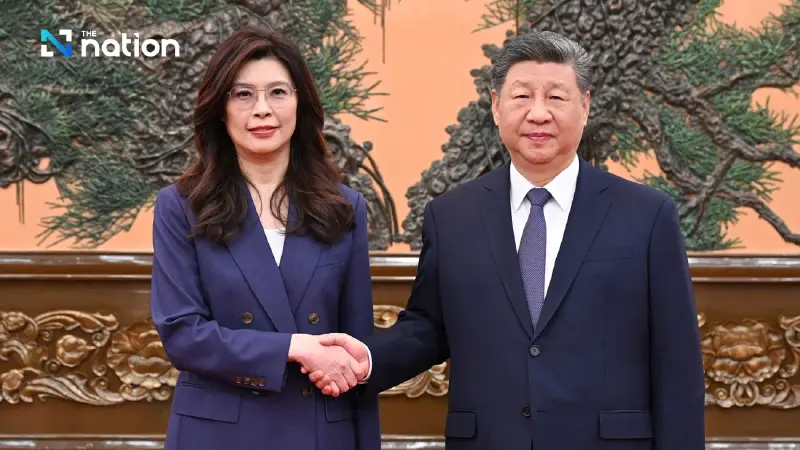


Cheng Li-wun visited Beijing on what she called a peace mission, while Xi pushed dialogue and Beijing maintained military pressure on Taiwan.
- Taiwan's main opposition party (KMT) leader, Cheng Li-wun, met with Chinese President Xi Jinping in Beijing on a "peace mission" to de-escalate military tensions.
- Xi Jinping stated that China is open to dialogue with Taiwanese parties that adhere to the "1992 Consensus" (which acknowledges "one China") and oppose Taiwan's independence.
- Cheng Li-wun proposed creating a "cross-strait peace mechanism" and establishing systematic dialogue to remove the root causes of conflict.
- The meeting underscores the KMT's differing approach from Taiwan's ruling party, as Cheng supports the 1992 Consensus and has argued against competing with China on military spending.

President Xi Jinping of China said during a meeting with Taiwan opposition leader Cheng Li-wun on April 10 that people on both sides of the Taiwan Strait share the same homeland, and that the future of cross-strait relations depends on the Chinese people.
Cheng Li-wun is chairperson of the Kuomintang, or KMT, Taiwan’s largest opposition party. She is currently visiting China on what she has described as a peace mission to “reduce tensions”, as Beijing steps up military pressure on Taiwan, which it regards as a province of China.
Xi also said China was willing to strengthen exchanges and dialogue with political parties in Taiwan, including the KMT, on the shared political basis of adhering to the 1992 Consensus and opposing Taiwan independence.
Meanwhile, Cheng said she hoped both sides could work together to promote the building of a cross-strait peace mechanism.
“They should continue to plan and build sustainable and systematic mechanisms for dialogue and cooperation, so that the root causes of all conflict can be completely removed.”
The historic meeting took place at the Great Hall of the People in Beijing, where the Chinese leader shook hands with the Taiwan opposition leader and posed with her for photographs.


Cheng, a female politician nicknamed “the reformer”, rose to the KMT chairmanship after her election victory and received congratulations from Xi. Her rise came amid allegations that China had interfered in the election by backing Cheng while seeking to undermine her rival, Hau Lung-bin, the 73-year-old former mayor of Taipei. What was described as evidence included more than 1,000 TikTok videos posted about the KMT leadership election, with half of them originating from outside Taiwan and believed to be part of an operation from the mainland.
Cheng, 55, comes from a family with roots in Yunnan, China. She holds a bachelor’s degree in law from National Taiwan University and a doctorate in international relations from the University of Cambridge.
She has vowed to turn the KMT from “sheep” into “lions” and restore the party’s true spirit in order to take on the Democratic Progressive Party, or DPP, which currently leads a minority government.
She has also stood out for positions seen as supportive of mainland China, including backing the 1992 Consensus, which emphasises the “one China” principle, and campaigning to encourage people in Taiwan to say openly: “I am Chinese.” She has also opposed President Lai Ching-te’s policy of raising military spending by 5%, arguing that Taiwan would always lose if it tried to compete on that front.

