
Pentagon abruptly removes US Navy secretary amid Iran war tensions
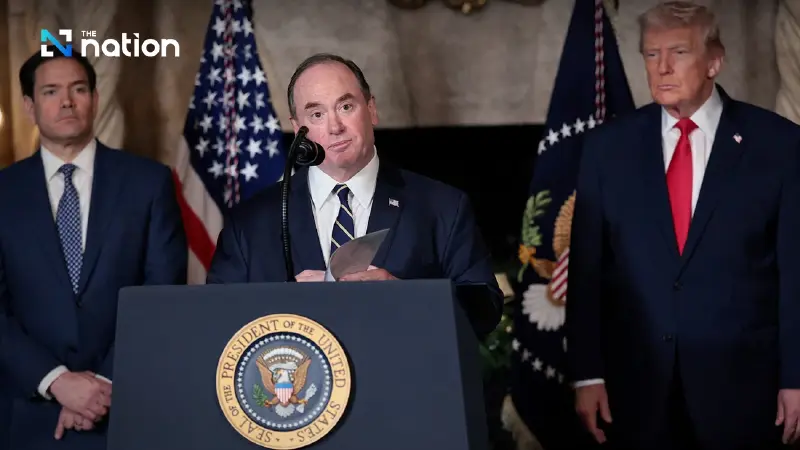


The Pentagon has ousted US Navy Secretary John Phelan with immediate effect, naming Hung Cao as acting replacement amid mounting Iran war tensions
The Pentagon has abruptly removed US Navy Secretary John Phelan from office, in a sudden move that adds fresh turbulence to Washington’s defence leadership at a time of heightened military tension involving Iran.
Pentagon spokesman Sean Parnell said Phelan was leaving his post “effective immediately”, while Hung Cao, the under secretary of the Navy, will serve as acting secretary. No official explanation was given in the initial announcement.
In its brief public statement, the Pentagon thanked Phelan for his service to the department and the US Navy, but stopped short of spelling out why he had been forced out. That silence only deepened the sense of a sudden rupture at the top of the naval leadership, especially as the change comes during a period of acute regional strain in the Middle East.
NBC News reported, citing a senior administration official, that President Donald Trump and Defense Secretary Pete Hegseth had concluded that the Navy needed new leadership. According to that report, Hegseth informed Phelan of the decision before it was made public.

Reuters, citing sources familiar with the matter, reported that Phelan’s removal was driven in part by frustration over the slow pace of his efforts to reform and accelerate US shipbuilding. Those same sources also pointed to strained relationships with key Pentagon figures, including Hegseth, Deputy Defense Secretary Steve Feinberg and Hung Cao, who is now stepping in on an acting basis. Reuters also said an ethics investigation involving Phelan’s office was among the issues mentioned by sources.
The departure makes Phelan the first military service secretary appointed by Trump to be dismissed since Trump returned to office. It also extends a broader pattern of upheaval inside the Pentagon under Hegseth. Only weeks earlier, the Army’s top officer, General Randy George, was also removed, in what Reuters said was tied to tensions involving senior Pentagon leadership.
Phelan’s exit comes at a particularly fraught moment for the US Navy. According to Associated Press reporting, the sea service has been enforcing a blockade of Iranian ports and targeting ships linked to Tehran around the world during a fragile ceasefire tied to the Iran war. That has placed naval leadership under even sharper scrutiny, as operational decisions in the region carry both military and diplomatic consequences.
Phelan, a billionaire businessman and Trump ally, had also attracted attention earlier through moves seen as aligning closely with the administration’s political interests, including announcing a new US warship programme he said would be called the “Trump-class battleships” during a speech at Trump’s Mar-a-Lago resort last December.
The sudden leadership change is likely to raise fresh questions about stability at the Pentagon just as the United States faces growing pressure overseas and a mounting strategic challenge at sea, including the long-running push to revive US naval shipbuilding capacity. For now, the Pentagon has offered only a bare-bones explanation. But the timing and the reporting that followed point to a dismissal rooted not in one single flashpoint, but in a broader breakdown of confidence at the top.
