
US Justice Department eases restrictions on cannabis products
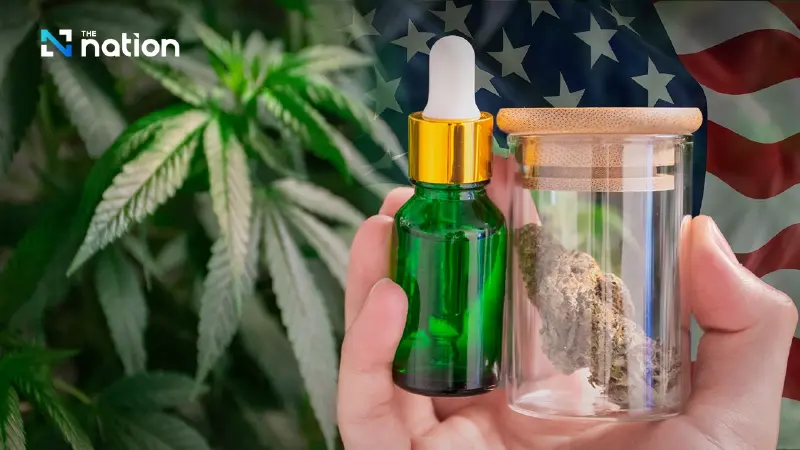


Washington’s cannabis reclassification may ease research, tax and funding hurdles, but nationwide legalisation remains off the table.
- The US Justice Department is reclassifying marijuana from the most restrictive federal drug category to a less dangerous one, acknowledging it has medical uses and a lower potential for abuse.
- This policy change eases federal rules for state-regulated medical and FDA-approved cannabis products but stops short of legalising the substance for recreational use across the country.
- The move is expected to benefit the cannabis industry by making research easier, reducing tax burdens for companies, and improving access to financing.
- This significant shift in US drug policy follows a December executive order from President Donald Trump directing the Justice Department to relax federal marijuana restrictions.
The US Justice Department has moved to ease federal restrictions on some marijuana products, marking one of the most significant shifts in American drug policy in decades, while stopping short of legalising cannabis across the country.
The department said on Thursday (April 23) that some cannabis products would immediately face looser controls, and that the federal government would move quickly to reclassify marijuana as a less dangerous drug.
The decision could reshape the US cannabis market, now valued at around US$47 billion, by reducing long-standing federal barriers that have continued to weigh on the industry even as marijuana has been legalised in some form across most US states.
Under the new approach, state-regulated medical marijuana products will be moved out of the most restrictive federal drug category, which includes highly addictive substances such as heroin. They will instead be placed in a less restrictive category for products considered to have a low to moderate potential for abuse, including common painkillers, ketamine and testosterone.
Marijuana products approved by the US Food and Drug Administration will also be placed in the same lower-risk category.
Acting Attorney General Todd Blanche said the government would also fast-track a broader review aimed at reclassifying all uses of the psychoactive plant as less dangerous.
“This rescheduling action allows for research on the safety and efficacy of this substance, ultimately providing patients with better care and doctors with more reliable information," Blanche said in a statement.
The policy shift follows a December executive order from President Donald Trump directing the Justice Department to relax marijuana restrictions.
The measures are expected to make cannabis research easier, reduce tax burdens for companies and improve access to financing. They are also likely to benefit major cannabis businesses such as Canopy Growth, Tilray Brands and Trulieve Cannabis.
Several companies in the sector sell medical marijuana and consumer cannabis products, while also researching possible pharmaceutical uses linked to pain management, cancer symptoms, anxiety and other disorders.
Shares of US-listed cannabis companies initially jumped between 6% and 13% after the announcement, but later reversed those gains as investors weighed the limited scope of the federal government’s immediate action.
Irwin Simon, chief executive of Tilray Brands, welcomed the move as a major turning point for the industry.
“Today marks a pivotal moment for the United States. With President Trump’s action to reschedule cannabis, federal policy is finally aligning with science, medicine, and most importantly, patient needs," Simon said.
Marijuana’s current status as a Schedule I drug has long been criticised as outdated. The classification means the drug is considered to have a high potential for abuse and no accepted medical use, even though legal access has expanded sharply at the state level.
According to the Congressional Research Service, 24 states and the District of Columbia have legalised marijuana for recreational use. Forty states have fully legalised it for medical purposes, while another eight allow some medical use. Only Idaho and Kansas do not permit any legal use of marijuana.
Legal cannabis sales in the United States are expected to exceed US$47 billion in 2026, according to market researcher BDSA.
After Trump’s December order, the Centres for Medicare and Medicaid Services began allowing some eligible Medicare beneficiaries to use hemp-derived products, including cannabidiol, or CBD, under clinician guidance.
Trump said on Thursday that further legislative action was still needed. In a Truth Social post, he called on Congress to update the law to ensure access to the “full-spectrum” of CBD products, while preserving Congress's intent to restrict the sale of products that pose Health risks.
Marijuana remains the most widely used illicit drug in both the United States and globally. The US Centres for Disease Control and Prevention says nearly one in five US residents uses it in a year.
Millions of Americans have been arrested for marijuana possession, even as listed companies have built businesses around cannabis-related products.
The Biden administration pursued a similar reclassification effort in 2024, but it was not finalised before Trump returned to office. The US Drug Enforcement Administration later scrapped that effort.
The Justice Department said it would begin proceedings on June 29 to gather evidence and expert opinion on the proposed reclassification.
Critics of marijuana legalisation argue that looser rules could increase drug use among minors, weaken workplace productivity and create greater traffic safety risks.
Dozens of Republicans in Congress objected in December when Trump ordered the Justice Department to ease regulations. Reaction was more muted on Thursday, although Senator Tom Cotton, a Republican from Arkansas, warned that the change would make it easier for Americans to use what he described as a still-dangerous drug.
"Marijuana today is much more potent than just ten or twenty years ago, leading to increased psychosis, anti-social behaviour, and fatal car crashes," Cotton said in a social media post. "A change to marijuana’s drug classification is a step in the wrong direction."
Reuters
