
Japan Boosts US Crude Intake Amid Hormuz Transport Disruption
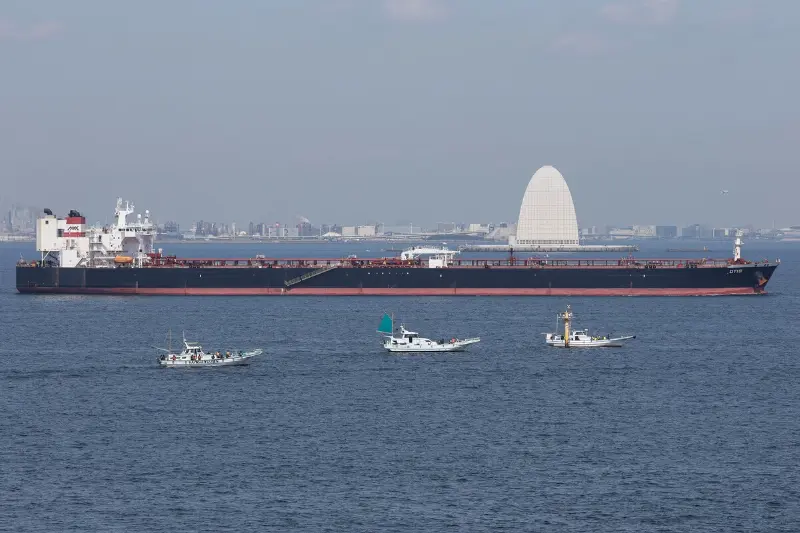


US shipments bound for Japan have surged, with Panama and Cape of Good Hope routes used as Hormuz disruption pushes Tokyo toward alternative supplies.
- Japan is sharply increasing its crude oil imports from the United States due to a de facto blockade of the Strait of Hormuz.
- The number of US crude tankers heading to Japan has surged from three to 13 in the last month.
- These tankers are taking longer alternative routes, such as via the Panama Canal or around the Cape of Good Hope, to bypass the Middle East.
- The increased US oil supply is likely based on short-term spot contracts, raising questions about the long-term stability of this procurement.
The flow of crude oil tankers from the United States to Japan has risen sharply as the Strait of Hormuz, a vital channel for oil transport, remains effectively blocked.
By Thursday, 13 tankers heading for Japan had been identified as having left coastal areas of the Gulf of Mexico, a major US crude-loading centre. The total was up from just three about a month earlier, according to Yutaro Nishi, a global analyst at Rakuten Securities Economic Research Institute, who examined data from the global ship-tracking website MarineTraffic.
Japan’s government is treating North America as a possible crude supplier outside the Middle East, where fighting between US-Israeli forces and Iran has resulted in the de facto closure of the Strait of Hormuz.
One of the 13 tankers has already reached Japan after using the Panama Canal. The remaining vessels, including ships travelling around the Cape of Good Hope at the southern tip of Africa, are expected to start arriving next month.
Three of the tankers took the Panama Canal route. Although the 80-kilometre waterway connecting the Atlantic and Pacific oceans charges high tolls and cannot accommodate large vessels because of its narrow width and shallow depth, it shortens the US-Japan journey to roughly 30 days. The Cape of Good Hope route takes about 50 days.
A tanker carrying 910,000 barrels of US crude oil procured by Cosmo Oil Co., a subsidiary of Japan’s Cosmo Energy Holdings Co., arrived in Tokyo Bay on Sunday after a 35-day voyage. A company official said the Panama Canal was selected to prioritise speed and help support a stable domestic oil supply.
The other 10 tankers are expected to sail via the Cape of Good Hope. The first is likely to arrive in early May, while some are projected to reach Japan in June.
“The route is decided based on the needs of the shipper--whether they choose volume over speed, and whether they are willing to pay tolls for speedy delivery,” a shipping industry source said.
Nishi said the US-origin crude was likely arranged through spot contracts rather than long-term deals.
“The crude oil tankers from the United States are believed to be carrying (oil) procured with spot contracts rather than long-term contracts,” Nishi said. “It’s questionable whether Japan can maintain continuous procurement next month and beyond, as it may have to compete for US oil with other Asian countries.”
Separately, four tankers that departed from the Middle East without passing through the Strait of Hormuz, along with four more carrying oil transshipped in Malaysia, were also confirmed to be bound for Japan. Excluding those ships and the 13 tankers from the United States, Nishi found no other crude oil tankers supplying Japan with alternative oil sources.

[Copyright The Jiji Press, Ltd.]
