
Pentagon adds Alibaba, BYD and Baidu to Chinese military-linked list
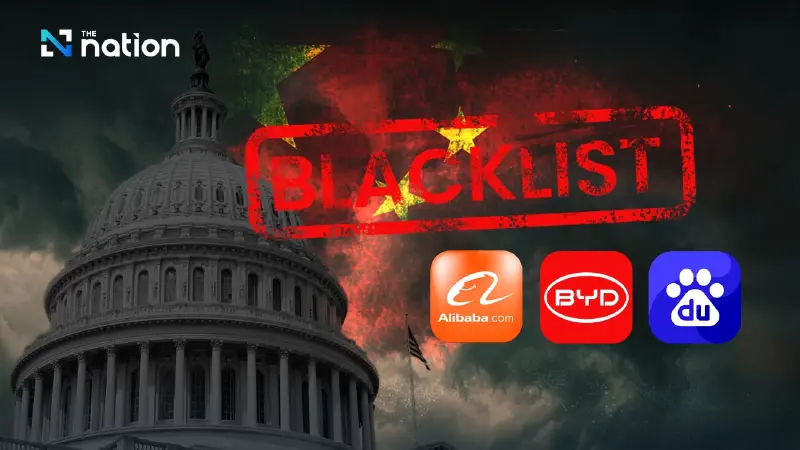


The annual update expands the list to 188 Chinese entities and bars them from US defence procurement consideration by the end of June.
- The Pentagon has added major Chinese companies, including e-commerce giant Alibaba, EV maker BYD, and search engine Baidu, to its "Chinese military companies" blacklist.
- These companies were listed for their alleged support of Beijing’s “Military-Civil Fusion” strategy, which applies civilian technology and research to military development.
- As a result of being blacklisted, the companies will be barred from consideration for any US defense contracts.
- This move represents a significant expansion of the blacklist, which now totals 188 Chinese entities, an increase from 134 in the previous year.
The strategic technology and trade war between the world’s two superpowers has intensified, raising the risk of shaking the global economy again.
The latest report by an international news agency said the Pentagon had announced a major escalation of blacklisting measures, officially adding major Chinese corporate groups, including Alibaba, BYD and Baidu, to the “Chinese military companies” blacklist.
The move marks an expansion of the blacklist into some of the world’s most influential and widely recognised commercial brands.
The Pentagon’s annual update of the list on Monday (June 8, 2026) immediately raised the number of Chinese companies labelled as channels of support for, or supporters of, the People’s Liberation Army (PLA) to 188 from just 134 in 2025.
Those blacklisted companies will be disqualified and “barred from consideration for US defence contracts” in full, with the measure due to take effect officially by the end of June.

Pentagon criteria: tightening controls on Beijing’s “military-civil fusion” strategy
Under the definitions and criteria used by the Pentagon for blacklisting, which were established in 2021, a “Chinese military company” means any legal entity or business organisation owned or controlled by China’s military, or a company involved in and helping to support Beijing’s “Military-Civil Fusion” strategy.
The term refers to China’s security strategy of applying research, technology and innovation from the civilian sector to defence and military work.
A key condition is that such companies must also have operations or a business base in the United States to fall within this screening threshold.
The latest blacklist shocked global business circles because all three companies are among the most powerful civilian leaders in today’s market.
Alibaba is the leading e-commerce giant, Baidu is a search engine and internet-technology powerhouse, while BYD is the electric vehicle (EV) maker with the highest global sales.
The direction of this round of civilian-brand blacklisting follows last year’s US move to blacklist Tencent, the owner of WeChat.
High-tech companies, including RoboSense Technology, a major Shenzhen-based artificial intelligence and robotics company, and Unitree Robotics, were also caught up in this round.

Chinese embassy in Washington condemns US as “discriminatory” and overreaching on security
After news of the blacklist spread, the Chinese embassy in Washington DC issued a statement strongly condemning the White House’s action, calling the measure a grossly “discriminatory” practice and a clear example of the US government trying to “overstretch and distort” the concept of national security to use it as a tool for trade bullying.
“All Chinese companies operating overseas have always strictly observed the laws and regulations of their host countries.
The US side should stop these wrong practices and create a truly fair, just and non-discriminatory business environment for Chinese companies,” the Chinese embassy spokesperson said in a strongly worded statement.
In the broader picture of global politics, the expanded blacklist came less than a month after US President Donald Trump had just completed a two-day bilateral summit with President Xi Jinping in Beijing.
At that time, both sides had signalled efforts to mend rifts in the hope of lowering the temperature in a trade and technology war that had dragged on for years.
The Pentagon’s move today has therefore become a new storm that wholly undermines the behind-the-scenes diplomatic process.
Former CIA expert criticises US tactic, calling it “performative”
Dennis Wilder, a national security expert who formerly served as a senior official handling China at the Central Intelligence Agency (CIA) and the White House National Security Council, voiced a negative view and openly questioned whether the measure could be enforced in practice.
He said a broad-brush blacklist of this kind could not succeed in economic practice.
“Although this measure may make some American companies more wary of signing contracts with business organisations that have been marked with a warning, in reality, many US companies have had deep and long-rooted commercial ties with these Chinese giants for years. They will certainly not give up those business interests unless the US government is prepared to impose genuinely heavy fines. Sanctions that sweep so broadly across every civilian brand in this way are ineffective, and as long as the US does not dare to break supply chains decisively away from the Chinese economy, or decouple, these sanctions are merely ‘performative’ and aimed at domestic political gain,” Wilder said.
