
Typhoon Maysak prompts top flood alert in Nanning amid extreme rain
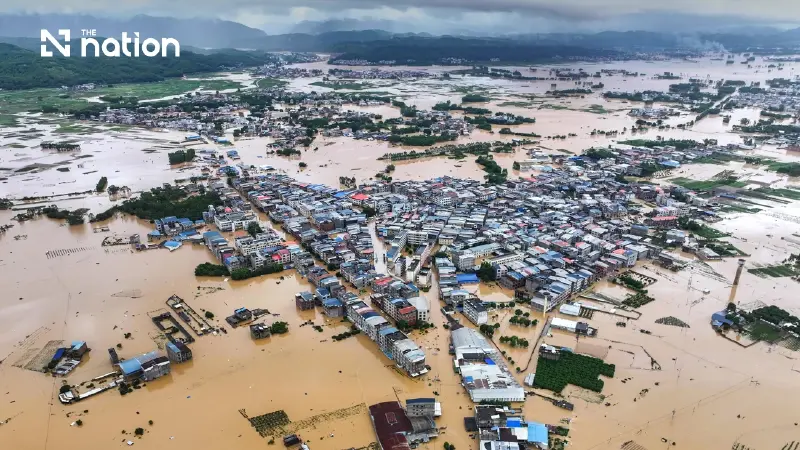


Authorities in Guangxi raised the emergency response to the top level after Typhoon Maysak swelled rivers and reservoirs, with eastern China now bracing for Bavi.
- Typhoon Maysak has caused extreme rainfall in Nanning, prompting authorities to issue the highest-level flood alert.
- The resulting floods have killed at least two people and affected approximately 55,000 residents in the southern Chinese city.
- Nanning is under severe pressure from swollen rivers and overflowing reservoirs, with some breaking through their barriers.
Floods triggered by Typhoon Maysak have killed at least two people in Nanning, as swollen rivers and reservoirs put the southern Chinese city under severe pressure and prompted warnings of worsening conditions.
Deputy Mayor Wei Jiang said late on Monday (July 6) that around 55,000 people in Nanning, the capital of Guangxi, had already been affected.
At three reservoirs, water was either spilling over barriers or breaking through them, as authorities lifted the flood-control emergency response to its highest level because of “extremely heavy rain” that could further complicate rescue work.
Maysak battered Vietnam and China’s island province of Hainan over the weekend before weakening and moving inland.
Meteorologists said the system would release moisture gathered during its passage across the South China Sea, bringing further downpours as it pushed deeper into land.
In Guigang, roughly 270 kilometres (170 miles) away, a Reuters-verified video posted on Douyin showed floodwater turning a broad road into a lake, leaving cars submerged and sending muddy torrents down a hillside into a construction site.

The Ministry of Water Resources said the water level at Guigang Hydrological Station had climbed to 42 metres by 12.30pm (0430 GMT).
Further south, in Fangchenggang, another verified video showed a small car being swept along a street.
Floodwater reached the height of another car’s steering wheel, while a man was seen struggling to stop his electric scooter from being carried away.
China is also monitoring Super Typhoon Bavi, which is moving across the Pacific Ocean towards Taiwan.
The US National Weather Service said Bavi was carrying winds of up to 180 miles per hour as it passed Guam, Tinian, Saipan and Rota on Monday.
Weather authorities warned, according to state agency Xinhua, that Bavi is expected to bring strong winds and heavy rain to eastern China from Thursday.
China, the world’s second-largest economy, is facing increasing risks from extreme weather, which meteorologists link to climate change.
Analysts say weather-related disruption could wipe out tens of billions of dollars in commercial activity each year as cities flood, factories stall, and crops are submerged or washed away.

Maysak first made landfall in Hainan on Friday, becoming the first tropical cyclone to reach the Chinese mainland this year, before making a second landfall in Vietnam on Sunday.
Vietnam shares a border with Guangxi, and state media reported that the storm brought down trees and ripped metal roofs from buildings in the border town of Mong Cai as it moved into China.
Chinese meteorologists expect heavy rain across Guangxi, Guizhou, Hunan and other regions in the coming days.
Guangxi, Guizhou and Hunan together are home to more than 150 million people, a population larger than Russia’s.
After the disaster, China’s state planner released 100 million yuan (US$14.72 million) for relief work in Guangxi.
The finance ministry and emergency management authorities also provided 160 million yuan to support flood and typhoon response efforts across six provincial-level regions, including Guangxi.
The exchange rate cited was US$1 to 6.7957 Chinese yuan renminbi.
Source: Reuters,
