
Oil climbs as stalled US-Iran talks keep Asian markets on edge
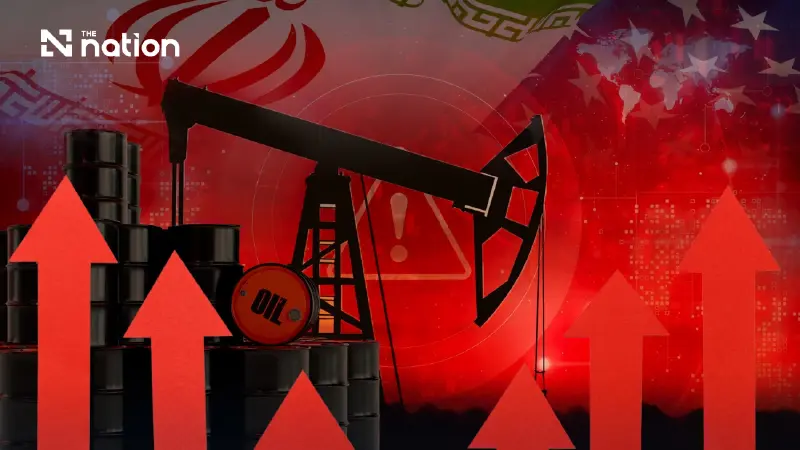


Oil reached its highest since July 31 as stalled US-Iran talks, inflation risks and a fragile yen kept Asian investors cautious.
- Oil prices rose to their highest levels in nearly two weeks, with Brent crude reaching US$88 a barrel, after negotiations between the United States and Iran reached an impasse.
- The talks stalled following an escalation in rhetoric, including a U.S. demand for compensation from Iran, complicating diplomatic efforts to reopen the strategically important Strait of Hormuz.
- The geopolitical tensions and resulting rise in energy costs have made Asian equity markets cautious, with investors concerned about the impact on global inflation.
Oil prices rose to their highest levels in nearly two weeks on Tuesday (August 11) after negotiations between the United States and Iran over a peace agreement and the reopening of the Strait of Hormuz reached an impasse, while Asian stock markets traded cautiously ahead of key US inflation data.
Brent crude futures climbed to US$88 a barrel, while US crude futures rose to US$82.45. Both benchmarks reached their highest levels since July 31 after surging by about 5% on Monday.
The latest increase followed a further escalation in rhetoric between Washington and Tehran. US President Donald Trump responded on Monday to Iran’s conditions for an agreement by demanding compensation for people killed in previous wars, attacks and protests, complicating diplomatic efforts to reopen the strategically important waterway.
Tony Sycamore, a market analyst at IG, described the negotiations as a “Mexican standoff” that could develop into a “war of attrition”, with neither side appearing ready to make the first concession.
He said oil could remain within a broad range of US$75 to US$95 a barrel while markets waited for signs that either Washington or Tehran was prepared to change its position.

Higher oil prices add to inflation concerns
The renewed rise in energy costs increased the importance of the US consumer price index report for July, due to be released on Wednesday.
Economists expect the headline CPI to increase by 0.1% from the previous month, while the core measure, which excludes food and energy, is forecast to rise by 0.2%.
A stronger-than-expected reading could revive expectations that the US Federal Reserve will raise interest rates at its next policy meeting. Markets were assigning roughly equal probabilities to an increase and no change.
Jonas Goltermann, chief markets economist at Capital Economics, said the risks were weighted towards a higher inflation reading, which could push interest-rate expectations upwards and renew fears that the US economy might face persistently high inflation alongside weaker growth.
Capital Economics assessed the US economy as running hotter than conditions consistent with a balanced “Goldilocks” scenario, suggesting that interest rates might have to remain higher.
Trading in cash US Treasury securities was closed during Asian hours because of a public holiday in Japan. Treasury futures nevertheless edged lower, indicating that yields could rise when cash trading resumed.
Investors were also awaiting the Reserve Bank of Australia’s policy decision later on Tuesday. The central bank was widely expected to leave interest rates unchanged.
Asian shares make limited gains
Asian equity markets moved between gains and losses as renewed Gulf tensions and uncertainty over global inflation kept investors cautious.
MSCI’s broadest index of Asia-Pacific shares outside Japan was last up 0.2%, while South Korea’s Kospi gained 0.3%.
US stock-index futures also advanced modestly after Wall Street ended Monday’s cash session lower. Nasdaq futures rose by 0.28%, while S&P 500 futures added 0.1%.
European market signals were more subdued. Euro Stoxx 50 futures slipped by 0.05%, while futures linked to Britain’s FTSE and Germany’s DAX were largely unchanged.
Nvidia outlines US$500bn AI financing push
Technology shares remained in focus after Nvidia announced partnerships with six major financial institutions to establish computing-finance platforms.
The initiative is intended to raise more than US$500 billion in third-party capital for artificial-intelligence infrastructure, illustrating the scale of investment flowing into the AI sector.
Sycamore said the announcement left him wondering whether the rapid development of such financing resembled the early expansion of subprime mortgages before the global financial crisis.
His comparison reflected concerns that the increasingly complex financing structures surrounding the AI investment boom could warrant closer attention, even as demand for computing infrastructure continues to grow.
Yen remains weak despite suspected intervention
In foreign-exchange markets, the Japanese yen remained under pressure, trading on the weaker side of 159 to the US dollar.
The currency was well below its high of 155.20 reached the previous week following several suspected rounds of market intervention, including one believed to have been conducted jointly by Japan and the United States.
Nomura analysts said traders were likely to remain alert to the possibility of further coordinated yen-buying intervention, making an immediate rise in the dollar above 160 yen less likely.
However, recent trading indicated strong demand to buy the dollar against the yen following declines in the currency pair towards the 156–157 range, levels not seen since May.
The US dollar received a modest lift from rising oil prices. The euro traded at US$1.1546, moving away from a one-and-a-half-month high, while sterling eased from Monday’s one-month peak to US$1.3512.
Gold also advanced as geopolitical and inflation concerns supported demand for the precious metal. Spot gold rose by 0.5% to US$4,409.81 an ounce.
Source: Reuters
