
Beijing Envoy: The Gulf's War Is Now Southeast Asia's Problem
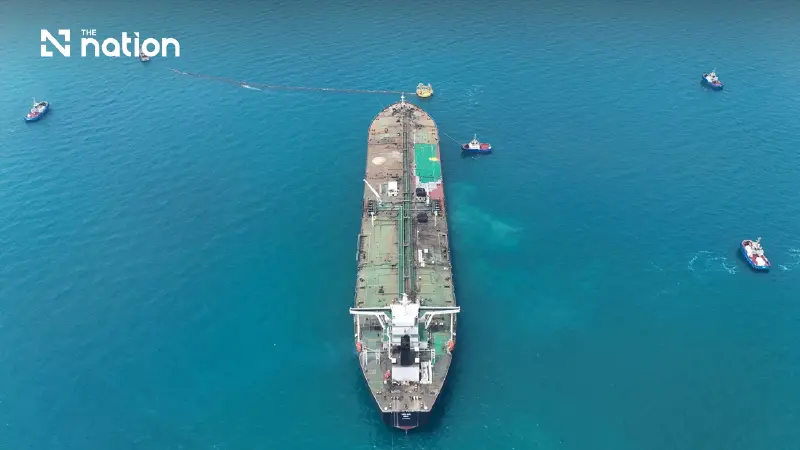


Brent at $106, a fuel fund 62 billion baht in deficit and a strait still shut. Zhai Jun told Singapore the Gulf's war has become Southeast Asia's problem.
- Chinese envoy Zhai Jun has declared that the conflict in the Gulf is no longer a regional issue but has become a direct "economic emergency" for Southeast Asia.
- The crisis stems from the effective closure of the Strait of Hormuz, which has crippled oil exports, tripled freight rates, and caused a major spike in global oil prices.
- Southeast Asian nations are experiencing the economic fallout through higher fuel, food, and fertilizer costs, leading to inflation and severe strain on national budgets like Thailand's Oil Fuel Fund.
- In response, the envoy outlined Beijing's proposal for a new Middle East security framework based on regional autonomy and protecting the vital shipping corridors on which Asian economies rely.
Brent at $106, a fuel fund with 62 billion baht in deficit and a strait still shut. Zhai Jun told Singapore the Gulf's war has become Southeast Asia's problem.
Some 6,000 kilometres separate the anchorage off Hormuz from a petrol station forecourt in Nonthaburi. In 2026, that distance has counted for very little.
On Friday, 25 September, Zhai Jun, Special Envoy of the Chinese Government on Middle East Issues, stood before delegates at the 17th FutureChina Global Forum and made the connection explicit. The conflict convulsing the Gulf, he argued, is no longer a regional security file.
It is a Southeast Asian economic emergency arriving by sea, in the form of freight invoices, insurance premiums and pump prices.
"The rippling effect is far beyond the Middle East, and other regions and economies like Southeast Asia are impacted," Zhai told the forum. "How to seek security through consensus and increase resilience via security is an important topic to be jointly discussed."
Speaking under the forum's theme of Strengthening Resilience, Rebuilding Trust, the envoy set out Beijing's blueprint for a new regional security architecture — one built on strategic autonomy, United Nations-led multilateralism and the protection of the shipping corridors on which Asian manufacturing depends.

A chokepoint that has not reopened
The backdrop to his remarks is stark. The Strait of Hormuz has been effectively closed to normal commercial traffic since late February, following US and Israeli strikes on Iran and Tehran's retaliatory blockade — a closure that stranded more than 1,500 vessels and tripled freight rates on affected lanes.
Crossings fell by more than 90 per cent from pre-conflict levels, with Gulf crude and product exports collapsing from roughly 18 million barrels a day in February to around 2.3 million in March.
Seven months on, there is talk but no settlement. As delegates gathered in Singapore, Brent crude closed at $106.60 a barrel — up almost 22 per cent in a month and more than 55 per cent year on year — having spiked above $108 after Saudi forces intercepted six Houthi ballistic missiles.
Prices eased only on reports that US and Iranian negotiators in New York were discussing a phased reopening in exchange for an end to the American naval blockade.
Zhai described a crisis that has reached deadlock on multiple fronts at once — the Red Sea littoral, the Palestinian-Israeli conflict and hostilities between Lebanon and Israel.
No country, he said, can expect to remain insulated from it. The damage to maritime shipping lanes has struck at global trade, industrial supply chains and energy security simultaneously, with the resulting rise in logistics, freight and resource costs transmitting directly into household budgets far from the Gulf.

The bill arriving in Southeast Asia
That transmission is now measurable across ASEAN. Regional economic ministers warned earlier this year that supply disruptions were "leading to higher freight, insurance, and logistics costs and contribute to inflationary pressures on energy, food, and other essential goods", cautioning that a prolonged conflict could hit the livelihoods of millions.
Thailand sits among the most exposed.
The kingdom sourced 51 per cent of its crude from the Middle East in 2025 and consumes roughly 1.3 million barrels a day.
Retail fuel prices rose by around 34 per cent on average between January and May, while domestic urea fertiliser prices surged by 50 to 75 per cent — a direct hit to the agricultural sector, given that the Persian Gulf accounts for roughly 30 to 35 per cent of global urea exports. Headline consumer inflation reached 2.4 per cent year on year in June, with producer prices up 7.2 per cent.
The fiscal strain is plainer still. Thailand's Oil Fuel Fund, briefly back in surplus in February, slid into deficit on 8 March and had widened to 62.4 billion baht by late April.
Energy economist Praipol Koomsup has since warned that maintaining blanket subsidies could drive the shortfall towards 100 billion baht, urging Bangkok to shift to targeted support for vulnerable households.
Across the region the pattern repeats with local variations: the Philippines and Singapore are most reliant on imported energy overall, Vietnam is heavily dependent on Gulf crude amid rapid industrial expansion, and Indonesia is a commodity exporter yet still a net oil importer. Governments have reached for excise cuts, subsidies, anti-hoarding rules and adjusted public-sector working day.
In May, the ASEAN summit in Cebu was itself scaled back because of the energy crisis.

Four points, one argument
Against that backdrop, Zhai set out President Xi Jinping's Four-Point Proposal on Common Security for the Middle East, framed around what Beijing describes as "common, comprehensive, cooperative and sustainable security".
Strategic autonomy first. The people of the Middle East are the true masters of their region, Zhai said, arguing that external interference has repeatedly failed to meet core security needs and that arrangements dependent on outside powers carry inherent flaws when systemic risk arrives.
He detected a growing regional appetite for strategic autonomy and strength through unity — a reading that sits uneasily alongside the continued reliance of several Gulf states on US security guarantees and the American naval presence currently central to the blockade stand-off.
A comprehensive approach, with Palestine at its core. Describing the region's flashpoints as deeply interconnected, Zhai identified the Palestinian question as the issue on which international justice and fairness ultimately turn — a position Beijing has held consistently, and one not universally shared among governments that treat Iranian capability or Red Sea shipping attacks as the more immediate driver.
He restated China's four-point principle on Palestine: implementation of a genuine two-state solution, adherence to the principle of "Palestinians governing Palestine", and urgent delivery of international humanitarian relief.
Security through development. This passage spoke most directly to the Singapore audience. Treating security as the precondition for economic resilience rather than its rival, Zhai called for closer integration between the Middle East and Southeast Asia as two components of the Global South and urged joint action to protect international trade lanes—securing the Strait of Hormuz and preventing tensions from spilling further into the Red Sea.
He did not specify what form such joint action might take or which navies would undertake it.
The UN as the channel. Any durable framework must respect sovereignty and territorial integrity while adhering to the UN Charter and international law, Zhai said.
China rejects unilateral sanctions, long-arm jurisdiction, self-serving geopolitical calculation and bloc confrontation, he added, favouring the United Nations as the primary venue for building dialogue platforms between warring parties.
The Security Council has been deadlocked on the conflict for much of the year, with permanent members including China exercising or threatening the veto on competing texts.

Watching Washington
Zhai closed on the register of a mediator rather than a partisan.
"A tranquil Middle East means a more peaceful world," he said. "China will firmly stand on the side of peace, justice, and the right side of history… promoting the building of a bridge of understanding and trust to inject more stability and certainty into the whole world."
It is a proposition that will be tested by events rather than by rhetoric. Beijing remains the largest single buyer of Gulf crude and has the commercial standing to press for a reopening; it has also, to date, declined to join naval escort arrangements in the Red Sea.
Whether strategic autonomy and UN-centred dialogue amount to a workable mechanism or a statement of preference is a question the next round of talks will answer more convincingly than a conference hall can. What is not in question is the cost of waiting.
Subsidy funds across the region are being drawn down in months rather than years, and no security architecture — whoever designs it — will reopen the strait in time for the next budget cycle. Until the tankers move freely again, the meter keeps running, and the bill is being settled a long way from the Gulf.
