
Thai PM returns on Sept 27 to coordinate flood response
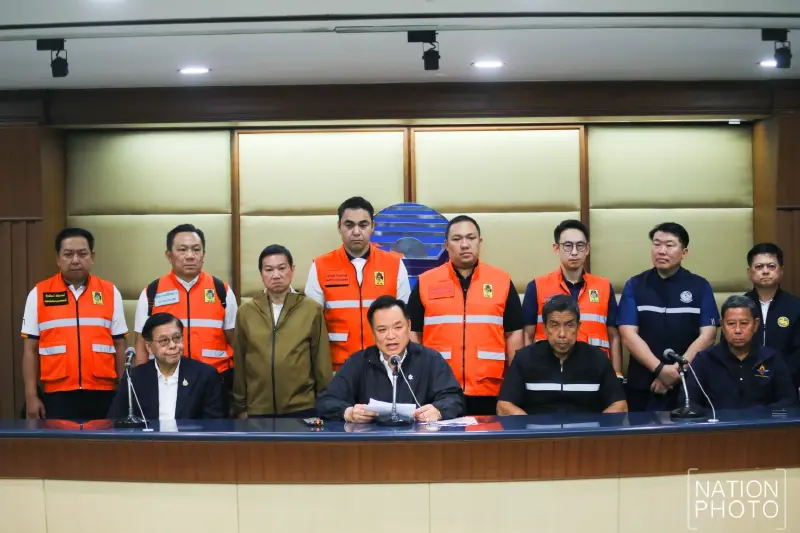


Thai PM Anutin plans to suspend ministers’ overseas travel and bring a drainage project for central Thailand to Cabinet on September 29.
- Prime Minister Anutin Charnvirakul returned to Thailand on September 27, cutting short an overseas trip to personally coordinate the response to widespread flooding.
- Upon arrival, he announced immediate measures including suspending ministers' foreign travel, accelerating assistance, and ordering better coordination between Bangkok agencies.
- The Prime Minister plans to propose a long-term Chai Nat–Pa Sak drainage project to the Cabinet to prevent future severe flooding in central Thailand.
- He will conduct personal inspections of flood-hit areas in Bangkok and other provinces to oversee relief operations and hear directly from residents.
Prime Minister Anutin Charnvirakul returned to Thailand on Sunday (September 27, 2026) after cancelling remaining overseas engagements to coordinate the response to flooding across the country. Speaking in Bangkok, Anutin announced plans to suspend ministers’ foreign travel, accelerate assistance and take a long-term drainage proposal to Cabinet.
Anutin, who also serves as interior minister, arrived at Don Mueang Airport at 10.19am following overseas duties in Japan, the United States and Britain between September 20 and 27. Ministers, Bangkok officials and water-management agencies briefed the prime minister before inspections of flood-affected communities.
Throughout the overseas trip, Anutin said, he had received updates from deputy prime ministers assigned responsibility for flooding in different regions, alongside Cabinet members and relevant agencies. Anutin had also held online meetings to coordinate the flood response, discuss operational details and issue instructions before deciding to cancel his remaining engagements abroad.
Anutin said he would instruct every minister to suspend overseas travel for any purpose during the emergency response. The prime minister would also cancel his own scheduled foreign trips over the following two to three weeks to remain in Thailand and oversee operations.
Bangkok agencies told to share data and resources
Anutin instructed all agencies responding to Bangkok’s floods to work from a single shared set of information, with public safety and the protection of property taking priority. Bangkok’s special administrative status must not become a dividing line between agencies, the prime minister stressed.
Bangkok had already been declared a disaster-affected area, Anutin noted, and required support from every relevant government body. The capital’s role as an economic, education and transport centre made coordinated action essential.
Anutin attributed the flooding primarily to widespread, persistent heavy rain that had exceeded local drainage capacity. The Royal Irrigation Department was managing northern water through what he described as a “fishbone” drainage system to prevent additional flows from compounding Bangkok’s problems, while regulating releases from dams to minimise disruption downstream.
The Defence Ministry and the Ministry of Agriculture and Cooperatives had sent machinery, pumps, trucks and inflatable boats to reinforce assistance in Bangkok, according to Anutin. The prime minister said he remained in regular contact with Bangkok Governor Chadchart Sittipunt and was receiving continuing situation reports.
Shelters had been established for displaced residents, while bedridden patients, older people, vulnerable groups and others requiring care had been moved to hospitals and medical facilities, Anutin reported.
The Government Spokesperson’s Office was instructed to gather information from the agencies involved, with the Public Relations Department and state broadcaster MCOT providing regular, timely public updates. Anutin assigned Supamas Isarabhakdi, minister attached to the Prime Minister’s Office, to oversee coordination between the government agencies and the information services.
Governors told to speed up flood relief and recovery
Anutin instructed the Interior Ministry’s permanent secretary to coordinate the response in Bangkok’s surrounding provinces and other affected areas, ensuring governors could make operational decisions promptly.
Deputy Prime Minister and Finance Minister Ekniti Nitithanprapas, who was overseeing the disaster response in the Central region, had informed Anutin that emergency funding ceilings had been increased for provinces declaring disaster emergencies. Anutin said the change would allow governors to authorise spending and address local needs immediately.
Every affected province must submit daily reports to the Interior Ministry’s permanent secretary, covering assistance already delivered, additional government support required and obstacles delaying operations, Anutin said. Reports must also explain the causes of those difficulties so that further instructions could address them.
The Interior Ministry was instructed to compile household-level lists and assess damage to identify flood victims eligible for assistance under the legal framework. The Department of Disaster Prevention and Mitigation (DDPM) and the Department of Local Administration would coordinate efforts to accelerate approval of relief and compensation.
Recovery planning must begin wherever floodwater recedes, rather than waiting for an entire town or city to dry out, Anutin stressed. The Interior Ministry’s permanent secretary would oversee damage surveys, while governors would prepare recovery plans for individual areas and begin compensation procedures without delay.
Hat Yai lessons to guide recovery and insurance claims
The government would apply lessons from the 2025 floods in Hat Yai to help affected communities return to normal life as quickly as possible, Anutin said.
For damage to homes, other property and vehicles, Anutin said he would instruct the Office of Insurance Commission (OIC) to coordinate with insurers and make claims handling faster and more convenient. Payments would remain subject to the terms of each policy.
Anutin cited the OIC’s coordination during the Hat Yai floods, saying the regulator had helped insured property owners receive their entitlements. Similar coordination would be used to support claims arising from the current flooding.
Cabinet would continue monitoring conditions, adjusting operations and maintaining the highest level of preparedness until the situation returned to normal, Anutin added. The stated objectives were to enable people to resume work and trade, allow children to return to school, restore safe travel and protect public health.
Chai Nat–Pa Sak drainage proposal due before Cabinet
Anutin said he would put the Chai Nat–Pa Sak–Gulf of Thailand drainage project before Cabinet on Tuesday (September 29), with the aim of securing approval for a long-term response to flooding in central Thailand. The proposed route would run in parallel with the Chao Phraya River.
After taking office as prime minister, Anutin had asked the secretary-general of the National Economic and Social Development Council (NESDC) to examine the project’s readiness. According to Anutin, the secretary-general reported on Thursday (September 24) that the council considered the scheme worthwhile and necessary.
Anutin said the NESDC assessment found that the project would improve drainage from the upper part of the country and help prevent floodwater from spreading into the Central region, Bangkok and surrounding provinces. The council had already requested opinions from relevant government agencies in preparation for Cabinet consideration.
The Budget Bureau had informed Anutin that funding had been set aside in the fiscal 2027 budget for the project, the prime minister said. Anutin intended to use his authority to accelerate implementation and complete the scheme during his time leading the government, with the goal of reducing repeated severe flooding.
Anutin prepares inspections in flood-hit provinces
Anutin said he would inspect flooding in Bangkok and prepare visits to provinces where conditions were causing concern, including Sa Kaeo, Prachin Buri, Nakhon Nayok, Ayutthaya and Pathum Thani.
The planned provincial inspections would allow Anutin to hear directly from residents, governors and frontline personnel about conditions and operational obstacles. The prime minister also intended to check that instructions were being implemented promptly.
Ministers attending the Don Mueang briefing included Deputy Prime Minister and Foreign Minister Sihasak Phuangketkeow; Defence Minister Lt Gen Adul Boonthamcharoen; Deputy Interior Ministers Polapee Suwanchawee, Jeseth Thaiseth and Worasit Liangprasit; and Deputy Transport Minister Siripong Angkasakulkiat.
The officials briefing Anutin also included Deputy Permanent Secretary for Interior Nirat Pongsitthithavorn; Bangkok Governor Chadchart Sittipunt; Chayan Muangsong, secretary-general of the Office of the National Water Resources; Witthaya Kaewmee, director-general of the Royal Irrigation Department; and Teerapat Kachamat, director-general of the DDPM.
Anutin expressed concern for flood-affected residents and thanked the public for cooperating with officials and rescue teams. The prime minister also acknowledged the work of civil servants, government employees, rescuers and volunteers, promising government support for their efforts.
“We will do everything within our power to resolve the situation and restore normal life for the public as quickly as possible,” Anutin said.
A briefing on Anutin’s overseas engagements would be postponed until Monday (September 28), the prime minister announced, allowing Sunday to be devoted to the flood response.
After the airport briefing, Anutin boarded a DDPM evacuation vehicle and travelled to the shelter at Bang Khen (Waisali Anuson) School in Talat Bang Khen subdistrict, Lak Si district, Bangkok, where he met flood-affected residents and distributed relief bags.
