
Turkey: Influencing the Arab Spring and Mideast freedom
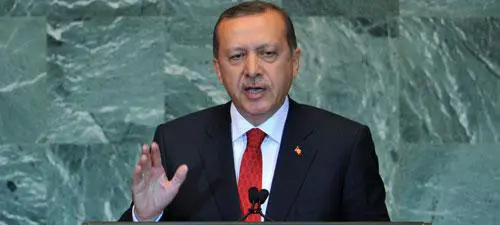


Turkish Prime Minister Recep Tayyip Erdogan and his Justice and Development Party (Adalet ve Kalkinma Partisi) or AKP, founded in 2001, represent a new breed of Turkish politician and a species of Muslim Democrat who have not appeared in the Muslim world
Post Second World War politicians in the Muslim world were comprised mostly of tribal kings, socialists, military dictators, kings and the Islamists of both the moderate and extremist type.
As a party of Muslim democrats, AKP is similar to the Christian Democratic Union of Germany (CDU), a Christian democratic conservative political party, practicing an ideology based on the principles of Christian democracy, emphasising the “Christian understanding of humans and their responsibility toward God”. Such religion inspired democrat parties around the world and their forming of governments, either singularly or in coalition, with secular parties, or vice-versa, representing a contemporary character of political formations as seen in Germany, Israel, Lebanon, Pakistan, Indonesia and India.
Military general and the founder of modern Turkey, Mustafa Kemal Ataturk, abolished the Islamic caliphate in 1924. He removed Islam from Turkish political and social life, supported secularism by separating religious and secular laws, and replacing Arabic with Turkish as the religious language. Since then political competition between pro-Islam and pro-secular forces has been an ongoing process in Turkish political history. Religious revivalists like Said Nursi campaigned for reformist Islam, leaving considerable influence on Turkish Muslim thought, which continues today. Contemporary Turkish Muslim pacifist Fethlullah Gulen, currently in exile, claiming to be one of the heirs of Nursi, started the movement for educational reform, dialogue and peace, which has spread to not only Muslim but also non-Muslim countries.
Since Turkey’s entrance into the multi-party era in 1945, Muslim political parties have contested for space. For example, Necmettin Erbakan, the founder of many Islam-based political parties, became prime minister in 1996. Muslim reformist leader Turgut Ozal, the leader of the Motherland Party, served as prime minister from 1983 to 1989, and as president from 1989 to 1993. Meanwhile, as the contest between the military, secularists and pro-Islam parties continued, political Islam acquired a new face in Turkey. The current ruling AKP continues the political legacy of Ozal; it represents reformist and moderate Islam. In power since 2002, AKP respects the rules of political competition and the secular values of modern Turkey.
Yet, the tension between AKP and Turkish secular forces continues in the political arena. The Turkish democratic political practice and its economic success under AKP, unlike the politico-economic situations in the two other leading Middle-Eastern countries, namely Saudi Arabia and Iran, has won for Turkey admiration among the disgruntled Arab populace and has been an inspiration behind the “Arab Spring”.
The recent visits by Prime Minister Erdogan to Egypt, Tunisia and Libya in support of democratic transition, and the withdrawal of support for Mu’ammar Gadhafi and Syrian leader Assad illustrates the realistic, pragmatic and pro-democracy role of Turkey in the Middle East. Turkey not only practices democracy but also supports the same in the Muslim world. Speaking to the Arab League in Cairo, Erdogan expressed Turkey’s support for the Palestinian bid for statehood at the UN. He not only criticised Israel over its attack on the Turkish flotilla carrying supplies to blockaded Gaza, but also asked Israel to compensate the families of the victims, otherwise it would be difficult to normalise relations between Turkey and Israel.
In Tripoli, Erdogan remarked that repression is wrong and that repressive regimes will collapse in the face of people power. This was a clarion call whose relevance applies to the whole of the Middle East. He also called upon outsiders not to interfere in the making of a new Libya and other countries.
As the head of secular Turkey, Erdogan also preaches secularism to the Arab Middle East, saying that secularism does not mean atheism. The term secularism is commonly translated in Arabic as “diniya” – a non-religious system – hence its rejection. Erdogan emphasised that secularism is not against Islam, rather it means equal respect for all religions and even the non-religious. In secularism the state has an equidistant relation to all religions. Erdogan was saying that there is not one but many types of secularism, which are different from French Jacobinism.
Thus the emerging Arab democracies will have to come up with their own model of how to manage political and religious affairs. Turkey manages its religious affairs through the Diyanet – the Religious Affairs Directorate. In Southeast Asian countries, state-religion affairs are managed either through a ministry of religious affairs (Indonesia and Brunei), a prime minister’s department (Malaysia), or a ministry of culture (Thailand). Arab democracies will have to develop new Islamic political theory on the state and religion. In fact, Erdogan is promoting secularism as a future model for the Arab Middle East.
This new message will find positive support amongst the emerging and changing democratic Muslim leaders, while it unnerves the Islamist parties and also the theocratic regimes in the region. Erdogan’s remarks enchanted thousands of youth and the masses clamouring for economic and political freedoms. After all, it is the economic factor that triggered the revolts, and Turkey as an economically successful country can serve as model for the future Middle East. Of course, this is going not to be easy, for it will require the growth of internal and regional markets, and a financial industry in the era of a global financial crisis.
Similarly, the challenge in the post-Islamist age of sectarian, religious and ethnic pluralism in the Middle East requires a new mechanism both from within and outside the Islamic framework. For example, the recognition of the Kurdish minorities in Turkey, Iran, Syria and Iraq still remains unresolved.
As a democratic country with a strong economy, Turkey has good credentials and an appeal to the current Arab youth and elder leaders as they seek to decide the future of their countries – but they have their own contextual situations which demand native solutions. The admiration for Turkey in the Arab world, central Asia and the larger Muslim world, within such a short time under Erdogan, Foreign Minister Ahmed Davutoglu and AKP, has utterly frustrated their political opponents who could not achieve the same success for Turkey over decades.
Imtiyaz Yusuf is professor of Islamics and religion at the Graduate School of Philosophy and Religion Assumption University, Bangkok.
