
What's behind Abhisit's olive branch to Yingluck?


Play
Frankly, I don't really get it. But political logic has apparently turned upside down with the ongoing flood crisis.
Premier Yingluck Shinawatra has thanked opposition leader Abhisit Vejjajiva for publicly advising her not to resign over problems related to the management of the flood disaster.
This came after calls from some quarters – especially a group of Chulalongkorn University lecturers, collecting signatures – demanding that the prime minister show her sense of responsibility by handing in her resignation. They charged that she had failed in the management of the crisis and that the inundation should have been handled in a more efficient way. In other words, they were accusing her of lacking the ability to govern, especially in a crisis.
Of course, one would have expected her political rivals to take the initiative and call for her resignation. But that’s not the case. A group of senators who are known to be her critics came up with an interesting creative strategy: They were in agreement that the prime minister wasn’t up to the task; “But she can’t resign because, by quitting, she would be shirking her responsibility.”
It wasn’t too long ago that a politician would step down in order to take responsibility for what the public considered to be his or her blunder, inefficiency or misstep. But in this particular case, that “common practice” doesn’t apply. Her political detractors say she must show responsibility by staying on. If she is allowed to go, these senators argue, it would be tantamount to allowing a prime minister to be let off the hook too easily.
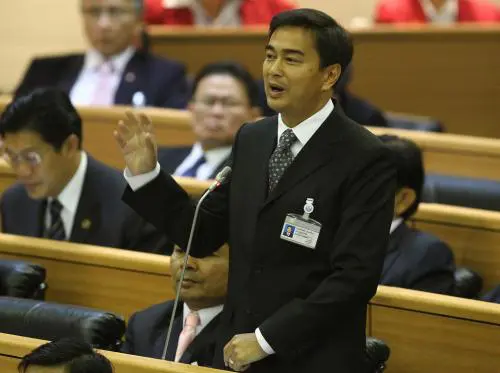
Abhisit’s stand was even more intriguing. Soon after some academics and senators issued public calls for Yingluck’s ouster, the opposition leader, who had kept pressure on the government every step of the way, went on the record as saying: “No, the prime minister should not resign while the situation remains fluid.”
Whether Yingluck was taken aback by this unexpected statement from Abhisit or not, she was quick to express her public appreciation. “I must thank the opposition leader for his constructive attitude. We should be working together to overcome the crisis the country is facing.”
Then came Deputy Premier and Interior Minister Yongyuth Wichaidit, who publicly thanked Abhisit for his cooperation with the government. “Khun Abhisit is a good example of constructive politics. Whenever he encountered a problem in the flood relief effort in any part of the country, he would call to inform us about the obstacle so that we could fix the problem,” he reported.
Abhisit’s apparent cosy relationship with Yingluck, however, hasn’t been reflected in the working relationship beween the premier and Bangkok Governor MR Sukhumbhand Paribatra, who of course is a key member of the opposition Democrat Party. The central government and Bangkok administration have yet to overcome the barriers that have kept them apart, thereby contributing to the deterioration of the flood situation in the capital.
In fact, there were even rumblings within Yingluck’s Pheu Thai Party that if the governor persisted in his “stubborn hubris”, the premier could well exercise her right under the law to sack him. However, the leaked discussion of this sore point didn’t push the governor or the Democrat leader into a fury, as would have been the case under normal circumstances. Governor Sukhumbhand, in fact, took it in stride, so much so that he even joked about it.
Asked by a reporter whether that threat represented an attempt to “saw off the legs of [his] chair” – a Thai political expression meaning an attempt to oust him from power – the governor responded with a light-hearted answer: “I don’t mind. If they sawed off the legs of my chair, I could always work sitting on the floor.”
Did Abhisit’s friendly gesture to Premier Yingluck stem from the fact that even if he could engineer a move to oust her, his Democrat Party doesn’t have enough votes in Parliament to return him as prime minister anyway?
That may be a partial answer to the puzzling reaction. But a more credible answer may be in what a political pundit suggested, not exactly in jest: “Abhisit wants Yingluck to remain prime minister because he knows that her possible replacement could be much worse for the opposition.”
That’s real enlightenment for me.
