
Both United States and Burma should change


Play
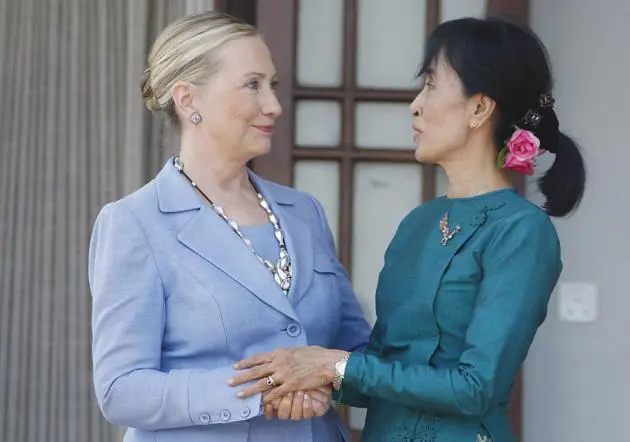
US Secretary of State Hillary Clinton made a historical visit to Burma on Thursday and Friday.
Exactly 50 years after John Foster Dulles went to Burma and just after Asean leaders let the country chair the Association of Southeast Asian Nations in 2014, Clinton’s visit should not only help Burma make political progress but also create momentum to change US policy towards the Asian nation.
“Every Asean member state supports Myanmar’s [Burma’s] chairmanship [bid]. But please don’t misunderstand this support to mean that development in Myanmar’s [democracy] is now 100 per cent perfect, because it isn’t. The process is still ongoing,” Indonesian Foreign Minister Marty Natalegawa said after the Asean Ministerial Meeting in Nusa Dua, Bali, the week before last. This message is important not only for Burma but also the US government.
US President Barack Obama and all leaders gathering in Bali for the East Asia Summit expressed in their EAS chairman’s statement strong support for the current progress in Burma.
The leaders welcomed the significant positive development in that country throughout 2011 and underscored the importance of maintaining strong momentum and continued progress.
Clinton’s visit, therefore, should mark strong US-Asean and US-Burmese relations. In the past few months there have been a flurry of visits of US officials to Burma, like US Deputy Assistant Secretary of State Joseph Yun (May), US Senator John McCain (June), US Special Envoy Derek Mitchell (September, October and last month) and Michael H Posner, assistant secretary of the Bureau of Democracy, Human Rights and Labour (last month).
However, the US Congress insisted in September on extending trade sanctions against Burma by one more year in view of the Burmese government’s continued human rights violations and suppression of political opposition.
This unfair decision will potentially bottleneck efforts to accelerate the new spirit of US-Asean relations.
On November 18, the National League for Democracy (NLD), the main opposition group led by Aung San Suu Kyi, decided to register and rejoin the political process.
Not only should Burma change, it is fair to say that it is timely for the US also to shift its policy on Burma.
The US should lift all kinds of sanctions and economic embargo slapped on the Southeast Asian nation. Asean ministers last January in Lombok asked for the withdrawal of sanctions against Burma because the isolationist approach was proved to bring no changes to the country. Instead it aggravated the suffering of people there at the grass-roots level.
The US should not play out its own agenda in Burma simply to satisfy members of Congress. Again this only shows to the world the US’s inconsistency, vested interests and miscalculations.
“Relations between our two governments will be eased greatly if we see significant progress in these areas [the release of political prisoners, participation by opposition parties in the political life and on conflicts in ethnic areas]… We look forward to being able to play a more active and supportive role in the Burmese people’s aspirations for human rights and democracy … We will need to see much more concrete steps in order to lift the sanctions,” said Posner in Rangoon a month ago.
Burma has proved its domestic consolidation and gradual political changes. But why doesn’t the US want to lift its sanctions against the country?
The new US engagement policy in the Southeast Asia region must calculate a policy of fairness.
Fairness is the new spirit and supported foundation to win the hearts and minds of the Southeast Asian people. Fair treatment, as against “double standards”, is social capital for the US to utilise in its role in the region.
A superior approach, as expressed through “acting like a colonial master” to dictate its will on others, will be no longer be helpful and sounds obsolete.
The US needs a smart, new foreign policy formula. It has to build smart public diplomacy to help accelerate public support in the region.
The US should be highly sensitive to the development of a wider East Asian community, and its policy should not only deal with governments but the people in the region.
People-centred, people-driven and people-oriented Asean sends an important message to the world that people in the region have freedom and the right to respond and interpret what is understood as fair and unfair as appropriate to them.
Yes, Burma still has a lot of homework to do, but if we want to make things fair enough, the US government should also change its policy of sanctions.
Lift the sanctions against Burma without delay. Retaining this policy will not only undermine US credibility among Asean members, but people in the region as well.
