
When will we learn the lessons of road carnage?


Play
The govt and police must clamp down on drunk and dangerous driving; enforce the law and punish the guilty
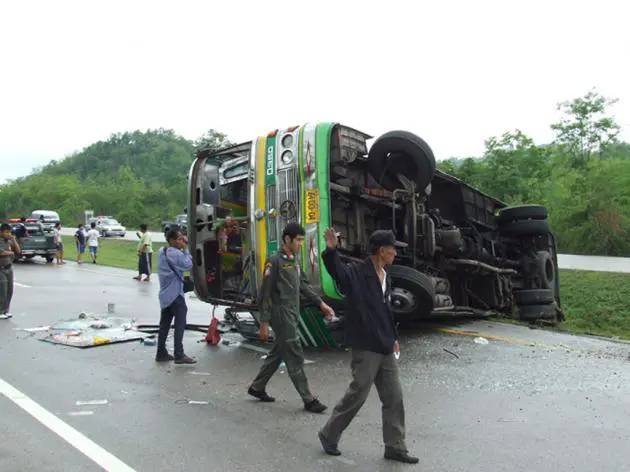
The long New Year holiday often brings a reminder of road carnage that takes hundreds of lives nationwide on both highways and country roads. Last year’s road accidents during the week-long New Year holiday period killed 350 people, with 3,750 more injured, according to the Don’t Drive Drunk Foundation, which, through government support, spearheads a campaign against road fatalities over the New Year and Songkran holidays.
The year before last, the figure stood at 347 killed and 3,827 injured. Generally nationwide, road fatalities number between 345 and 470 annually for the same period.
The government’s recently launched “New Year Zero Dead” campaign serves as a timely wake-up call to motorists planning trips over the holiday. This year’s slogan is “Drink Not Drive, Drive Not Phone”. While a similar campaign is put in place every year, still the number of road deaths has never gone below the 300 mark. But figures show a downward trend over the past four years, from 401 to 350.
What’s shocking is that around 12,000 Thais are killed on the roads per year, or about two persons per hour. In other words, every day, approximately 50 people who leave home for work, school or shopping never return because of road accidents.
To address the problem in the holiday season, Prime Minister Yingluck Shinawatra recommends that everyone should celebrate the occasion not recklessly but mindfully. “We should not celebrate the New Year with alcohol. But if you cannot avoid drinking, then don’t drive.”
Her message is about responsible driving, which seems absent come the New Year holiday. The point is that most of these road causalities involve young motorcyclists, their failure to wear a helmet, and drunk driving. Other factors contribute, such as speeding, jumping red lights, distracted driving, reckless driving, unsafe lane changes, driving under the influence of drugs, and fatigue. But these are overwhelmed by the impact of alcohol consumption.
To reduce the fatality rate effectively, Thailand simply needs tougher road safety measures and a review of existing measures, to improve their efficiency, especially on drunk driving.
The rate of road accidents caused by alcohol consumption is shocking in Thailand. This makes the success of existing measures and campaigns against drunk driving by different concerned agencies questionable. The most controversial measure is the banning of alcoholic drink advertisements on TV and radio. Nevertheless, the impact of this long-term measure on road accident alleviation is unclear and yet to be examined.
The rate of road accidents caused by intoxication has never gone down. With the high death rate resulting from alcohol consumption, fingers are pointed at law-enforcement personnel. In a way, the police are partially to blame for their half-hearted attempts to crack down on drunk driving in districts that host nightclubs and restaurants run by deep-pocketed, well-connected proprietors.
We all know about high-profile drunk-driving cases involving celebrities causing fatalities. But we never see them going to jail. These cases are mostly settled out of court, or they face light penalties like community service.
In truth, the police suffer a lack of breath-alcohol analyser devices to legally detect blood-alcohol levels of drivers. Some police stations do not have these devices, nor do they have sufficient financial support.
Worse still, under Thai law, drunk drivers can be prosecuted only if there is sufficient evidence indicating an alcohol level over the legal limit. However, an ordinary breath analyser that can only detect the blood-alcohol level but does not give an immediate printout result cannot be used to prosecute drunk drivers according to the law.
Amidst legal loopholes, motorcycles, the most popular mode of transport for the masses, continue to be a substantial part of the overall death toll. We must mitigate this problem, even as it seems impossible to control their numbers. Existing measures seem inadequate at best. Apart from the compulsory use of helmets, motorcyclists are required to turn on their headlights all day and night.
We think it’s necessary to adjust or lower the legal blood-alcohol limit for motorcyclists, and young riders in particular. Manufacturers of motorcycles should consider supplying every buyer with a free helmet. A responsible parental role is also integral in reducing traffic accidents involving young motorcyclists. Parents should not allow their teenagers to own a motorbike or even ride one to school.
But then there are many traffic accidents involving bigger vehicles, which add to the fatality statistics. But accidents will result more from drunk driving than reckless driving. The government must get serious about the safe driving campaign. It’s time to invest in road safety measures, get tough on offenders, and make the law more sacred. Let’s hope that this year’s campaign will work better than last year’s.
