
America's military machine makes Asia Pacific new priority


Play
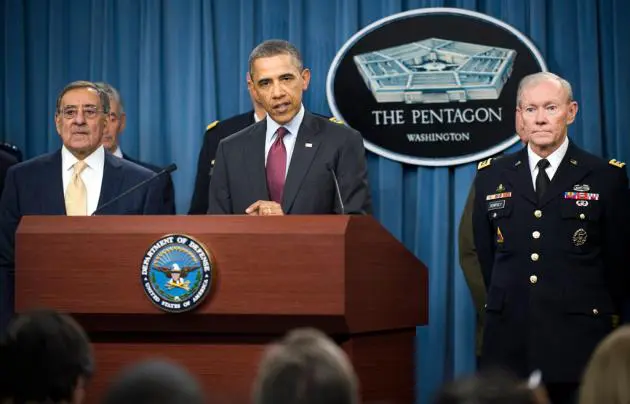
The revamped military strategy announced by President Barack Obama at the Pentagon on Thursday signals a major change in America's long-established defence strategy and lays the foundation for a shift in focus for its slimmed-down military from Europe to
The strategic shift has been forced on the US by its fiscal crisis, as US Defence Secretary Leon Panetta acknowledged in his introduction to the strategy review.
The administration of former president George W Bush launched a diplomatic and military offensive against terrorism following the September 11 terrorist attacks in 2001. However, the wars in Afghanistan and Iraq have exhausted the US’s military and fiscal resources, resulting in its decision to push for a complete troop withdrawal from Iraq and a phased withdrawal from Afghanistan.
Together with the troop withdrawal from the Middle East, the newly announced defence strategy is an indication of Washington’s intention of ending its world-wide anti-terror campaign. It also reflects Washington’s attempt to strike a balance between its flagging economy and its mounting military expenditure.
US defence spending has skyrocketed to a record high over the past decade. The ever-growing military outlay, together with the adoption of tax cuts for many years, has caused America’s national debt to rise to more than $15 trillion. The US has such a huge deficit that Panetta believed that “serious deficit and debt problems are themselves a national security risk”. The US military has exceeded the capacity of the economy to support it and hefty cuts in military spending are desperately needed.
Washington plans to achieve a leaner military with around $489 billion in spending cuts over the next decade. But while it will reduce its ground forces, the emphasis will be on “capabilities critical to its future success” and “prevailing in all domains, including cyber”.
“The US is going to maintain our military superiority with armed forces that are agile, flexible and ready for the full range of contingencies and threats,” Obama declared.
Instead of its long-standing doctrine of maintaining the capability to fight two major wars simultaneously, the US intends to have the capacity to fight one major war while deterring a second confrontation.
The strategic review also indicates Washington’s intention of reconsidering its global presence.
Panetta listed the five priority challenges for the US: extremism, the proliferation of weapons of mass destruction and their materials, misdeeds by some countries, the rise of some emerging countries in Asia, and the changes in the Middle East. Among them, Panetta believed, Asia-Pacific and the Middle East will pose the two biggest challenges to the US in the future.
Many in the US believe that the country has paid excessive attention to the Middle East over the past decade while ignoring other regions, especially Asia.
Obama stressed that the US will continue to strengthen its presence in Asia-Pacific and that the “budget reduction will not come at the expense of that critical region”. Such remarks are an indication of the eastward shift of the US defence focus and its unconcealed intention to check and counter-balance China’s growing influence in the region.
During George W Bush’s presidency, unilateralism remained prevalent and there were those in the US who believed that it could do whatever it wanted, either alone or with allies. However, Obama stressed that Washington will “strengthen its key alliances to build partnerships and to develop innovative ways to sustain the US presence elsewhere in the world”.
Past events show that the US is strong enough to overthrow regimes in small countries, but it remains impotent to maintain a stable political order in targeted countries. It has become increasingly obvious that the US needs the cooperation of its allies to succeed with any of its global objectives, as indicated by Washington’s policy on Libya. Similarly, the US calls for a bigger role for Nato in Europe and plans to “use innovative methods” to sustain the US presence in Latin America and Africa.
As part of its full strategic transformation, the new defence strategy, however, will not affect the US’s long-cherished strategy of maintaining the strongest military in the world. It merely reveals Washington’s intention of maintaining its world leadership status at cheaper cost.
Tao Wenzhao is a researcher at the Institute of American Studies, Chinese Academy of Social Sciences.
