
A dilemma for a country and a people


Play
In one history class in Taiwan, school students were asked: "What is the longest river in our country?"
One confused student raised his hand and asked the teacher: “Ma’am, what do you mean by ‘our country’? Is it the whole of China or just Taiwan?”
This story was related to Asia News Network by Hsieh Huai-hui, deputy director of the international affairs department of the Democratic Progressive Party (DPP), whose niece was in that class. The answer could either be the Yangtze River (China) or Zhuoshui River (Taiwan).
Hsieh, who has been working with DPP for 15 years, said this confusion is created by the ambiguity that is common in Taiwan’s history textbooks. The growing awareness among people in Taiwan of their identity as “Taiwanese” has naturally given rise to questions like this.
The “national identity” issue is a recurring topic that is especially given attention during elections and used by some to determine whether one was blue (Kuomintang Party/KMT) or green (DPP).
Numerous recent polls, Hsieh pointed out, have shown a trend toward a growing Taiwanese identity. A poll conducted by the CommonWealth magazine in 2009 showed that 62 per cent considered themselves Taiwanese, 22 per cent said they were both Taiwanese and Chinese, and only 8 per cent said they were Chinese.
In another poll by the National Chengchi University, national identity has been increasing steadily in the last 18 years. In 1992, 17.6 per cent identified themselves as Taiwanese and by 2010 it was a historic high of 52.4 per cent.
However, there are those who feel that the national identity issue, first raised in the 2000 elections, has been politicised.
One of them is Nancy Yu, a housewife in her late 40s and volunteer guide at the Office of the President. “Some evil local politicians have intentionally divided our society by grouping people whether they are Taiwanese, aborigine or mainlander, for their political interests,” Yu said.
Taiwan has a complicated history manifested not only in its culture, architecture or geopolitics, but in daily life, like the languages used in Taipei’s metro rail transit system: Mandarin, Hokkien, Hakka and English. This shows that the identity of Taiwan nationals is not just as simple as whether one is blue or green, pro-independence or against it, even pro- or anti-China.
“Some people insist that we are Chinese and we have to keep the Chinese history because it’s so long and so rich – 5,000 years. They feel very proud to be part of it. But most people especially for the young, we have our own history. Yes it’s only 400 years but rich enough. There are so many elements and it’s so diverse and you can see more connection with the region and the world,” Hsieh said.
The more relaxed relations between Taiwan and China have allowed for more flexibility, at least among tourists to travel between the two sides of the strait. This is one of the benefits brought about by the cross-strait air transport agreement. It was signed in July 2008, allowing for direct air links between the two sides. As of August 2011, nearly 14 million people have travelled between China and Taiwan.
Long-lost relatives separated in 1949 after the Chinese Civil War were reunited. Chinese tourists flocked to Taiwan, with the National Palace Museum – where more than 670,000 pieces of ancient Chinese artifacts and artworks encompassing 8,000 years of Chinese history are displayed – topping the list of their must-see destinations. People from China were keen in connecting with the culture and history that they share with the other side.
It worked both ways. People from Taiwan welcomed the chance to travel to China without having to change flights in Hong Kong, for instance.
One of them is Chiang Yu-shan, 24, who wanted to discover her Chinese roots. “I’ve been to China several times: Hong Kong, Harbin, Shanghai and Beijing,” she said. “Of course I have my roots in Taiwan but I don’t deny that there are some more in China. For me, we share the same language, the same culture ... although there are still many differences between us.”
Author June Yip said in her book, Envisioning Taiwan – published in 2004 – that in carving out the national identity of the Taiwanese, one has to understand the complex history of Taiwan’s colonisation.
She said Taiwan’s colonial history cannot be simplified merely as a struggle for China to “recover” Taiwan, which it considers as a dissident province.
The first settlers of the island on the southeast of China were Austronesians. “Beginning in the centuries before Christ, these peoples – now referred to as the island’s aborigines – drifted north from the South Seas through Southeast Asia to the island that Portuguese merchants, arriving in the 16th century, dubbed Ilha Formosa, the Beautiful Islae,” Yip said.
She noted that while Chinese authorities knew of the island’s existence centuries before the European explorers arrived, they made no attempt to chart its coasts, establish trade with the inhabitants or take steps to make it officially part of China.
So it was the Dutch that opened Taiwan to outside trade and established governance and educational systems. It was under this rule that the island became known as Taiwan. In 1662, the Dutch were forced to abandon the flourishing colony when a pirate named Cheng Cheng-kung invaded Taiwan and ruled it as an independent territory until 1683. Cheng’s buccaneering raids on the nearby Fukien coast prompted the Chinese authorities to assert control over the island in order to reign in Cheng, but it was merely declared as a “dependency” of Fukien province, according to Yip.
A significant number of Chinese immigrants began to arrive in Taiwan in the late 17th century, composed mostly of shadowy characters like bandits, pirates, itinerant seamen and those fleeing persecution in China. It was for this reason, and the revolts that people on the island launched against China, that prompted mainland authorities to view the island as remote and uncivilised.
“China’s noncommittal attitude toward Taiwan was evidenced by its refusal, until 1875, to take any official responsibility for the island and its inhabitants,” Yip said. “When China finally declared Taiwan a full-fledged province in 1887, it was only because Japanese, English and French forces were threatening to occupy the island.”
But even then, Yip said, China viewed Taiwan more as a liability and it was not a surprise when it ceded the island to Japan in 1895 under the Treaty of Shimonoseki. The move led many inhabitants to feel betrayed over China’s actions, a historical relation, Yip said, that was not taken into account when the victorious Allied forces decreed in 1945 that Taiwan be taken from the Japanese and restored to Chiang Kai-shek’s Republic of China (ROC).
On the international stage, Taiwan is known officially as the ROC, but some political factions have been pushing the use of "Taiwan”. This has resulted in several very public tug-of-wars, such as in international sports meets or film festivals, where Taiwan is not allowed to use that name to represent itself and neither can its flag be raised. This only goes to show that despite “warmer” relations between China and Taiwan on the surface, there is still a lot of tension over unresolved political issues underneath.
Last year, Taiwan celebrated its centennial, and there have been discussions about where it should go in this next century, including whether there is a possibility of signing a peace accord with China.
But James Shi Chu, director-general of Hong Kong and Macau affairs under the Mainland Affairs Council (MAC), sees this as an impossibility, at least in the short term.
The MAC is a cabinet-level agency under Taiwan’s Executive Yuan and is responsible for policies between the island and China, including Macau and Hong Kong.
“I see no possibility of that in the short term. I don’t think both sides will want to touch that, although that doesn’t exclude the exchange of views by civil society especially scholars and academe. They are free to talk about a peace accord,” Chu told Asia News Network.
“But for the government, I see no possibility that it will initiate a peace accord. Within Taiwan, domestically, any political relationship with China is very polarised. So without a high degree of domestic consensus, the government won’t be in a position to negotiate any political agreements, including a peace accord. It is still premature (to talk about that).”
Chu emphasised that the government’s policy is to iron out economic issues first and tackle political concerns later. “We believe that with the good results from the economic agreements that can benefit and help people’s well-being, we can develop mutual trust. And only with sufficient mutual trust can we enter into any political discussion. That will take years.
“But we’ve got plenty of time. Taiwan and China have already been separated for 62 years. If we can have political negotiations in the next decade, that actually is too soon. We should take a very pragmatic, cautious approach,” Chu said.
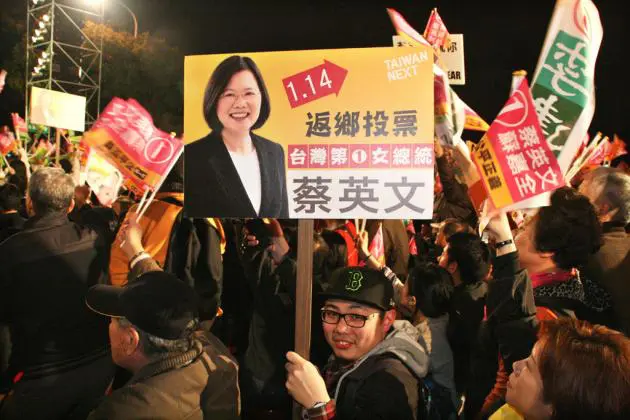
There are those who believe that should the KMT’s Ma Ying-jeou be re-elected as president in this weekend’s elections, the gains of the last three years economically and politically, especially when it comes to dealing with China, will continue. On the other hand, there are fears that if the DPP’s Tsai Ing-wen wins, it will be a step backward for Taiwan. The DPP is known for its aggressive stance toward independence, something that Beijing has frowned over and caused cross-strait relations to be strained when the party was in power from 2000 to 2008.
Taiwan’s shipping tycoon, Chang Yung-fa, who heads the Evergreen Group – the company that includes EVA Air and Evergreen Marine Corp – has spoken up about his support for the “1992 Consensus”.
The 1992 Consensus refers to a tacit agreement between China and Taiwan that there is only one China, with each side free to have their own interpretation.
He noted that this tacit agreement has paved the way for both China and Taiwan to have healthy economies. He warned that disregarding the consensus could affect Taiwan’s economic climate.
Ma Ying-jeou has also touted the 1992 Consensus in his campaign, saying that it has allowed both sides to focus on more important matters. “This is called mutual existence,” he told businessmen in Nantou county last week.
The DPP, however, has a different way of looking at it, at least according to Hsieh.
“Taiwan is in a very unique situation. We have a very strong and huge neighbour,” Hsieh said, referring to China. “Taiwanese people enjoy their freedom and democracy ... so they demand more for their country’s sovereignty. Like for instance, many youngsters attend international competitions. They are so happy when they win and they want to raise the national flag but they cannot because the country is not recognised by the international community due to Chinese pressure; so they feel disappointed. Or like what happened in 2003 during the outbreak of SARS. We have a good medical system and we wanted to contribute to international society but we couldn’t, again, because of Chinese pressure.”
Hsieh acknowledged that the relationship between China and Taiwan was so bad during the term of Chen Shui-bian, who is now serving a 20-year jail term for embezzlement, bribery and money laundering.
Hsieh said Beijing did not understand Taiwan’s democratic process, at the same time adding that the Ma administration lacked transparency in its dealings with China, particularly on the Economic Cooperation Framework Agreement (ECFA) signed in 2010. The ECFA is the agreement that aims to reduce tariffs and commercial barriers between China and Taiwan.
“The KMT claims it has done a lot of negotiations, but many don’t feel this way. What’s the price? Are we going to lose our sovereignty to Beijing in the future? People have this mistrust in them,” Hsieh said.
But more than political issues, young voters believe there are other more pressing problems that Taiwan’s government should focus on. As of October 2011, Taiwan’s unemployment rate was at 4.3 per cent.
Reports have noted a growing frustration particularly among middle- and low-income earners, who feel that the Ma administration’s economic policy towards China only benefits the rich. This sector of the population thinks that the ECFA did not deliver on its promises to spur growth and attract Chinese investments.
Chiang Yu-shan, about to finish a degree in international relations and will soon be entering the job market, shares the view that it is getting more difficult to look for work. “Maybe the government can offer more opportunities and jobs for the youth, and have a more global perspective,” she said.
She added that most young people like her are not really interested in politics because it only means trouble, although she hopes that there will be no change in the ruling party, otherwise “it will be chaos again”.
She said addressing the unemployment problem tops the party’s priorities. “The domestic policy is most important. If your unemployment rate goes up to more than 5 per cent, that would be very bad. Young people here can’t find decent jobs compared to those in South Korea, for example. New graduates can’t get a higher salary.
She noted that many local industries have lost their competitiveness to Vietnam, which offers cheaper labour and resources.
“We want to keep people in their localities and export their products abroad. We would like to create more possibilities for these industries to prosper.”
She raised the issue of Taiwan as an ageing society too, with most married couples preferring to have one child or none, out of fear they won’t be able to support them.
“That will be a problem for the country’s future performance. If you have less people, that means you have a small market and small scale of labour source, and that’s not ideal for a country’s future,” she said.
Taiwan’s population as of last year was almost 23 million, and 10 per cent belonged to the age 65 and older bracket. Taiwan had the lowest birth rate in the world in 2010, and the government has come up with tax exemptions and subsidies to encourage more childbirth.
Hsieh further pointed out that Taiwan is a small island that is not rich in natural resources, particularly in oil, and relies heavily on trade.
“The biggest challenge in the next decade is competition not only from China ... but how to keep our competitiveness in the region and the world. We have to strengthen ties with main democracies like the US and Japan, and our Southeast Asian neighbours.”
She disagreed with the Ma administration’s claims that ties between Taiwan and China have become rosy with the signing of the economic agreements. “We still have 1,500 missiles pointed at us. I mean, if Beijing won’t give up its arms in dealing with Taiwan, there is no guaranteed peace.”
James Shi Chu of the MAC, on the other hand, said he sees challenges, but not threats. “I see lots of challenges. Our direction is quite clear. I see no possibility whatsoever to go into martial law or a military junta, or have a party-dominant government. People won’t accept those kinds of arrangements,” Chu said.
“We see no other option but democracy. But in the process of democratisation, I see many challenges just like any country.”
Chu said that what sets Taiwan apart from China is its democratic system. “Democracy is our biggest achievement. Taiwan is a full-fledged democracy, although we are young.”
In a poll conducted by the Taiwan Think Tank in October last year, 78 per cent thought that the most significant difference between Taiwan and China is democracy.
At least on the democratic aspect, the KMT and DPP have a consensus: that what sets Taiwan apart from China is “freedom”.
“Democracy is the new identity of our people,” Hsieh said. “I think most Taiwanese are very realistic. We are very good business people. And from the surveys, the key message is that they want peace. But not unification. They don’t want war, they want to do business. They want to enjoy prosperity.”
A public opinion survey by the MAC in September 2011 showed that 33.6 per cent of Taiwanese want to preserve the political status quo and decide later whether they want independence or unification. Only 5.6 per cent supported independence, and 1.4 per cent for unification as soon as possible.
“As a politician, what’s going to be your choice?” Chu asked. “Your choice is very simple. You choose the status quo.
“But no matter what the outcome of the election is, the people have the right and free will to choose their own leaders. No matter what the result.
