
Pheu Thai wants more than just charter change


Play
Wattana Muangsuk, the Pheu Thai Party's party-list MP and vice chairman of the House Committee on National Reconciliation, suggested that the role of the Supreme Court on criminal offences by political office-holders should be reviewed.
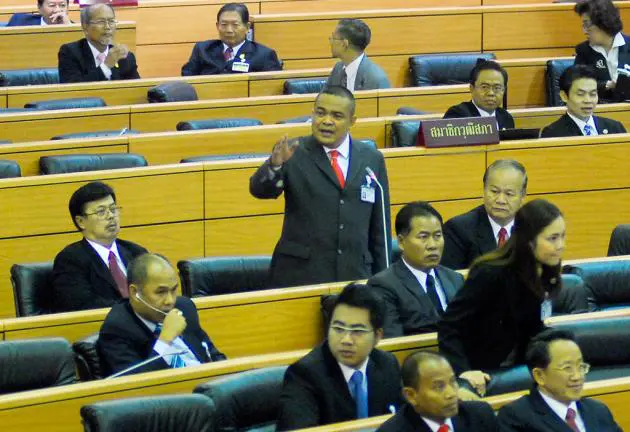
He made the remark during yesterday’s joint session of Parliament, during which the charter amendment motion was debated.
According to Wattana, there is currently no check and balance in the judicial review process, which is enshrined in the current Constitution.
The ruling Pheu Thai Party wants to amend the 2007 charter, which it claims is undemocratic because it was promulgated following the 2006 coup that overthrew the Thaksin government.
In the past several years, the Supreme Court on criminal offences by political office-holders has delivered many crucial rulings, including imprisonment for serious offenses, such as the two-year jail term for fugitive ex-premier Thaksin Shinawatra on abuse of power while in office.
In fact, the Supreme Court’s role is aimed at serving as another check-and-balance mechanism. The Court’s role, which is not completely isolated, is similar to that of the Constitution Court, which has jurisdiction over constitutional issues; and the Supreme Administrative Court, which has jurisdiction over governance issues.
Such a judicial review process is also similar to the roles played by independent bodies such as the National Counter Corruption Commission and the Election Commission among others.
However, Wattana, a close aide of Thaksin, argued that the country needs a new balance in the legislative, executive and judicial branches. In his opinion, the executive – the government – is checked and balanced by the legislative, the MPs and senators.
The mechanisms include the set-up of House committees and no-confidence debates as well as dissolution of the House if the government can longer function, he said.
Wattana also claimed that the role of Supreme Court on criminal offences by political office holders may run counter to the International Covenant on Civil and Political Rights (ICCPR).
Parliament has spent more than 25 hours over the past few days debating amendments to the current charter as sought by Pheu Thai and its coalition partners.
There are three separate bills on charter amendment. The legislation is aimed at first amending Article 291 of the Constitution to pave the way for the set-up of a new charter-drafting assembly.
Government MPs, opposition MPs and senators got the same quota of eight hours each in debating the pros and cons of the three bills over the past two days.
The government will need at least 325 votes out of the joint session’s 650 members to approve one of the bills to change the charter. With a combined 300 government MPs, Pheu Thai needs at least another 25 senators to pass the bill.
In response to the government’s move, leaders of the People’s Alliance for Democracy (PAD), said they would stage a mass rally on March 10 to oppose the whose process, which they say will be tantamount to a constitutional coup to whitewash fugitive ex-premier Thaksin.
A recent poll the by the National Institute of Development Administration (Nida) shows that 58.4 per cent of respondents are against the move to amend the charter, as they believe it will benefit only certain people. Another 45.1 per cent of respondents said charter amendment must be participated in by a wide range of people from all walks of life.
The charter amendment move has also hit the private sector’s confidence due to the looming political confrontation, which could hurt the economy and the export sector.
