
Enjoyable learning through hands-on lessons


To students, a classroom is boring if they have to sit silently and listen only to their lecturers. To educational experts, such classrooms give little to students who otherwise could learn a lot if they were engaged in an active learning process and were
Believing that my students should be taught to actively integrate their knowledge for practical results, I have included an inspiring project, “ZIIB – Zero Impact Interactive Billboard”, in my Interactive Computing in Museum- Exhibition course and the outcome has been impressive.
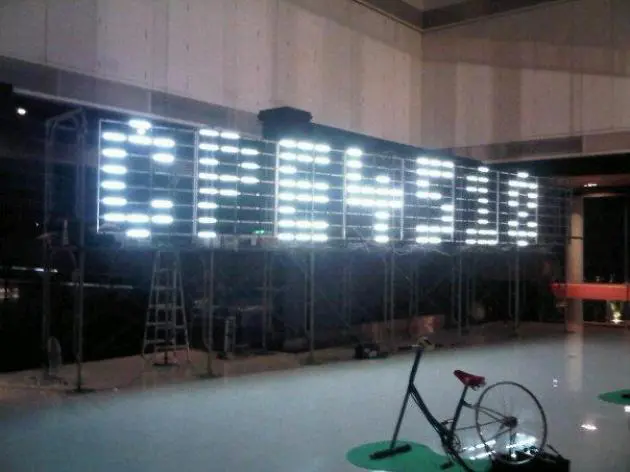
Shown at an event entitled “Playground of Imagination” last weekend was a colourful advertising billboard from my course, my students’ participation, and of course the eco-energy ZIIB project. Linked to an ecofriendly energy source, the billboard serves to remind visitors of the need to embrace eco-efficiency and creativity.
During the course, my students and I worked very hard on the ZIIB project for months designing the LED (light-emitting diode) display and its circuit. The current supply of ZIIB is natural energy like solar power and a bikepower generator.
At the end, each LED module will be de-constructed and transformed into a reading lamp for the remote hilltribe village, OmKoi district.
The course – Interactive Computing in Museum-Exhibition – aims to empower students with a knowledge of interactivity and physical computing.
To achieve this goal, my students had to learn how to design the digital technologies in the museum and how to integrate computers, digital technologies and interactive software into the exhibition.
In this course, my students learned the museum design process and explored the computing applications that enhance interactivity between digital media technologies and human beings.
The learning approach in this subject is a hands-on project and class discussion. I designed the pedagogical activities in class through collaborative working.
On the other hand, the ZIIB is a co-project among the Computer Engineering Department (CPE), Learning Institute (LI) and School of Architecture and Design (SoAD) at KMUTT.
While lecturers from SoAD designed the typeface and font pattern for the LED display, the researchers, lecturers and students from CPE and LI constructed the circuit board, micro-controller and web -server programme to control the movement of LED light.
Concerning computer engineering knowledge, students had to recall the basic understanding of logic gate and circuit design, then integrated them to hardware -software interface design.
During the event last weekend, visitors could interact with the LED display by submitting words on to the ZIIB server. Another team of students had to create the webpage and design a database to get the input text from audiences.
As a consequence, through ZIIB, students recalled all the subjects they had learned since they were in firstyear. It was the integration of knowledge relating to logic gate, digital circuit, hardwaresoftware interface design, database, web programming and so on. Moreover, the ZIIB project -based learning has given the students problemsolving skills.
At the site, we faced many unexpected problems even though we had already test-run all circuit boards and LED in the lab. As the problems emerged, brainstorming quickly took place to find solutions.
Along the way, students learned by themselves about teamwork and delegation of duties.
Thanks to the ZIIB project- based course, my students and I have successfully implemented the concept of learning by doing. My students were exposed to an inspiring situation in which they could learn a lot, including academic matters.
Through situation learning, my students have gained from direct experience with the devices they worked on, tackled problems that arose, and found solutions along the way.
Through hands-on assignments, students have also practised writing programmes and learned concepts of interactive software design (in the form of graphic, games and simulation) and hardware control (in the form of electronic signals, basic circuit, sensors and simple microcontrollers).
A lecture on all these subjects might bore students to death. However, when they are combined and taught through creative and fun-to-try activities like ZIIB, students are very cooperative, attentive and active. I, therefore, would like to encourage my peers to try integrating knowledge from various foundation subjects into their classes.
PRIYAKORN PUSAWIRO
Learning scientist,Computer Engineering Department
