
Abolishing independent agencies smacks of a hidden agenda
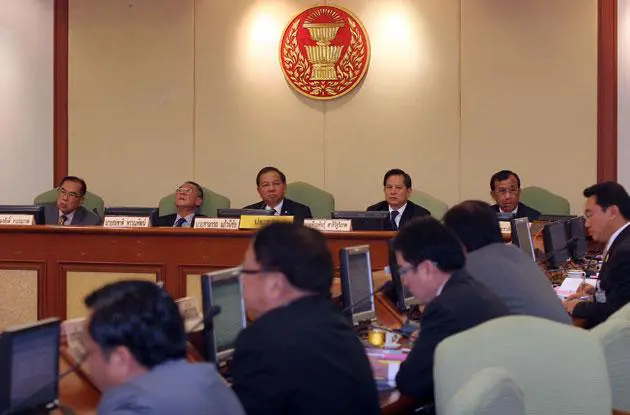


Nobody is quite sure who is behind the move to get rid of independent agencies in the process of rewriting the Constitution. But it's clear that it's high on the agenda of those seeking to remove the "poisonous fruit of the poisonous tree".
Divergent views over what the new constitution should look like are, of course, natural. But the logic of a group of politicians with links to the ruling Pheu Thai Party, about doing away with the current forms of the Constitutional Court and Administration Court, seems somewhat bizarre.
For one thing, the concept of establishing independent agencies to create checks and balances against possible power abuse, especially by the executive group, was incorporated in the 1997 Constitution, not the current one that was put into force after the 2006 coup.
The pro-Thaksin elements have always maintained that the 1997 charter is the country’s best ever. There were even earlier attempts to simply replace the current charter with the 1997 version, without having to go through the long, painful and expensive process of forming a constitution drafting assembly through elections, as is being contemplated.
The call for the abolition of the Constitutional and Administration courts has therefore raised doubts over what the real intent of the whole exercise of rewriting the charter is. In fact, some of the proposals raised by the ruling party and its associates have deepened the suspicion that the move is aimed simply at helping fugitive former premier Thaksin Shinawatra to return to Thailand as a free man. That, unfortunately, will inevitably pit the opponents against the advocates, leading to another round of political confrontation that could mean more street violence.
The existence of independent agencies in previous years has proved to be beneficial in many ways. For the first time, the common people could seek judicial help from the Administrative Court when they couldn’t hope to get redress from government agencies.
In fact, several landmark verdicts by the Administrative Court have underscored the importance of an independent judicial body that can rule on such vital social issues as environmental hazards and deep-rooted social injustices.
Without the judicial support of an administrative court, the little people would have remained under the mercy of a severe bureaucracy and political establishment that could ignore with impunity the plight of the disadvantaged and underprivileged.
The Constitutional Court has likewise proved to be independent and effective, despite the fact that the judges have come under enormous pressure from politicians with vested interests – and who have tried every possible means to wriggle out of their roles plagued by conflicts of interest.
The role of independent agencies is indispensable if the country is to move along a democratic system that puts emphasis on preventing and suppressing corruption and abuse of power. This is especially important when the charter grants the ruling party, for the sake of political stability, a high degree of authority, so much so that at one point the accusation of “parliamentary dictatorship” was not just a wild, baseless charge.
If absolute power corrupts absolutely, a charter offering the prime minister and the ruling party even more power must also ensure checks and balances in the form of independent bodies that can monitor the way power is exercised by the powers-that-be. If the majority rules, the rights of the minority must be guaranteed.
As Thammasat University’s rector Somkid Lertpaitoon, who once headed a constitution drafting panel, recently argued: “If we believe that the Constitutional or Administrative Court should be abolished simply because a certain verdict isn’t up to standard, then we will have to do away with the whole system of electing MPs if some people’s representatives are found to have misbehaved.”
In other words, genuine democracy must be able to withstand the harsh and unrelenting scrutiny of any independent agency trusted by the public.
