
North Korea faces further isolation after rocket launch


Play
The pariah state yesterday test-launched its long-range missile, thus dashing any hope of a last-minute cancellation
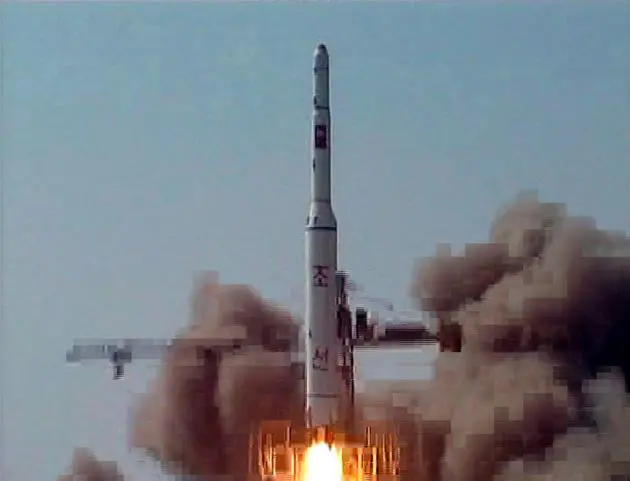
North Korea yesterday went ahead with the launch of its controversial “earth satellite” into orbit, drawing condemnation from the world leaders who said the “provocative” act threatened regional security. The pariah state is likely to be further isolated by the international community via additional sanctions. It is imperative that Pyongyang reconsiders its stance while there is a small window of opportunity to avert a looming crisis.
When the country’s young leader, Kim Jong-un, took over late last year from the late Kim Jong-il, there was a glimmer of hope that he would be a different leader from his father. His education in the West and his friends there could help him govern North Korea with a new attitude, making it less of a pariah state. However, that has turned out to be a pipe dream, because over the past several months, North Korea has done nothing to prove that it is changing for the better. Instead, the young leader is following in his father’s footsteps, using military might, threats and intimidation to hold the Korean peninsula hostage.
Kim Jong-un initially planned to use the 100th anniversary of his grandfather Kim Il-sung’s birthday to test launch what Western countries believe is a long-range missile. It is an open secret that Pyongyang has spent a huge sum of money to celebrate the anniversary of the country’s founder and to launch the “satellite”. One estimate puts the cost at US$850 million, which is sufficient to purchase rice and other staple foods for the country’s entire population for a year. And yet North Korea’s leadership continues on its belligerent path without thinking of ongoing food shortages and, in some areas, famine.
North Korea has invited thousands of foreign guests to come for the celebrations this weekend. The regime wants to show off to the outside world that everything inside the country is fine and dandy. But the reality speaks otherwise. It is doubtful if the foreign guests attending the commemoration will be able to see the real North Korea.
At the recent Asean summit in Phnom Penh, the grouping’s leaders also called on North Korea’s leaders to abandon the satellite launch, as it would destabilise the region. The Philippine leader, President Benigno Aquino III, was very vocal, saying that the long-range missiles tested by North Korea can travel 7,000 kilometres, which covers the Philippines and much of Southeast Asia. However, the Asean request fell on deaf ears.
Asean has extremely high expectations of North Korea following its signing of the Treaty of Amity and Cooperation (TAC) in 2008, under which it would contribute to peace and stability on the Korean peninsula. It has turned out to be one of the most disappointing developments for all the TAC signatories, who now number 28 countries.
It is important that North Korea listens, at least to the voices and views from the South, which genuinely wants to end its truculent neighbour’s international isolation. Asean has been trying to engage North Korean diplomats since they joined the region-wide discussion group known as the Asean Regional Forum. But somehow, perhaps not surprisingly, Pyongyang has not played an active role.
Still, Asean wants to see a peaceful and prosperous North Korea – which is the same aspiration constantly pledged by the new North Korean leader.
