
Thanks for the ride, but now I'll go my own way


Play
Thaksin Shinawatra wants peace, seemingly at least.
Well, there’s nothing new there. He also has proclaimed his undying love for the monarchy. That’s not news, either. What about his burning desire to return home? It’s probably the oldest piece of information.
So, what made his latest phone-in to the red shirts so special then? Of course, he talked at length, but he had done it before a few times, when the connections were good. That the Democrat Party took his speech and turned it into self-serving babbling, and that Noppadol Pattama has had to clean up after his boss are anything but a surprise. Most elements of Thaksin’s red-shirt address on Saturday are kind of “been there, done that”.
What raised eyebrows was his suggestion on who stands between Thailand and reconciliation, or between him and the road home. He was expressing deep gratitude to the red shirts, all right, but the way he did it also looked like a sad farewell. If you did not hear it, imagine the romantic “thank you” in the movie when the hero and heroine are about to break up.
“We have come as far as we possibly could together” was the apparent message. Unless you can come up with another interpretation for “You are the boatman who has taken me to the shore. It will be a new journey for me from now on, and you can’t simply carry me and your boat up the mountain”, that is.
The Democrats were quick to say to the red shirts, “We told you so”. Noppadol was quick to call that an old, dirty trick to pit Thaksin against his own supporters. ASTV website was quick to ask why Thaksin never talked reconciliation when troops were getting restless, red shirts belligerent and Ratchaprasong mall-owners were becoming nervous about possible arson. Giles Ungphakorn was quick to brand Thaksin an egomaniac.
Are the red shirts, or the extremists in their ranks to be exact, becoming the liability obstructing Thaksin’s attempt to get amnesty and return home a free man? This ASTV question may irk many people in the multi-layered movement, but the long faces among red-shirt leaders listening to the phone-in were a tell-tale sign that ASTV was not the only one doing the irking.
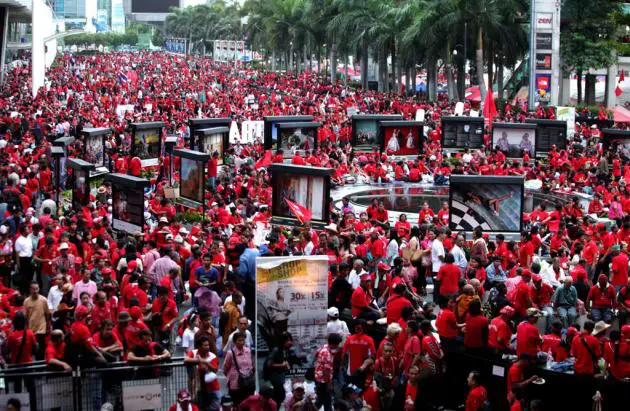
The red shirts have landed Thaksin on the shore. After an uprising in 2010, they gave his party a landslide election victory last year and installed his youngest sister as Thailand’s first female prime minister. The journey from the beach head to the mountain does not require tens of thousands of protesters camped in a business district or relentless social media demonisation of the “elite”.
In fact, the journey up the mountain requires the exact opposite. If Thai politics remains volatile, any amnesty formula that Thaksin could benefit from will be labelled hypocritically detrimental to the government’s proclaimed reconciliation agenda. Thaksin must have realised that his amnesty plan and real peace must go hand in hand. While he may have been wrong about many things, he is right about that.
As far as Thaksin is concerned, though, it’s no longer a question of right or wrong. It’s now a question whether his U-turn has come too late. When so many people have been killed, buildings burnt and prejudice against “the other side” runs stronger and stronger and deeper and deeper, he can’t simply tell his supporters to just drop it. And this is only half of the problem.
In his strongly-worded statement, Giles insisted that Thaksin is not democracy; in other words, not something the majority of Thai people have been fighting for. That is what many on the other side have been trying to say, but coming from him it may carry more weight. What is democracy? What constitutes justice? Giles is bringing out this subtext to the Thai political crisis loud and clear.
It has been a weird mix from the start – one of Thailand’s richest men declaring himself a champion of the poor, and a politician who flouted democracy in many ways becoming a symbol of the clamour for greater political freedom. He moulded the red shirts, and they in return moulded him, and thanks to some common interests, they blended and became a logic-defying political phenomenon.
Now, Thaksin wants out of this marriage. The logic he uses may be the most mind-boggling of all. I want to repay you, he told the red shirts on Saturday, but I can’t do that by being so far away. Only when Thailand has real peace can I return home, and only then shall you receive my full gratitude. For the country to achieve reconciliation, we need your help. Please help me so I can help you.
No, these are not the words of a selfish man, Noppadol insisted. Of course, they are, the Democrats maintained. Of course, he is egoistic, Giles said, in unthinkable agreement with the Democrats. If Thaksin on the war path is controversial, him seeking peace is apparently a lot more so.
