
China and Russia aiming to lead a new world order


Play
In their own self-interest the two superpowers are putting differences aside to create a united front on certain issues that will benefit both
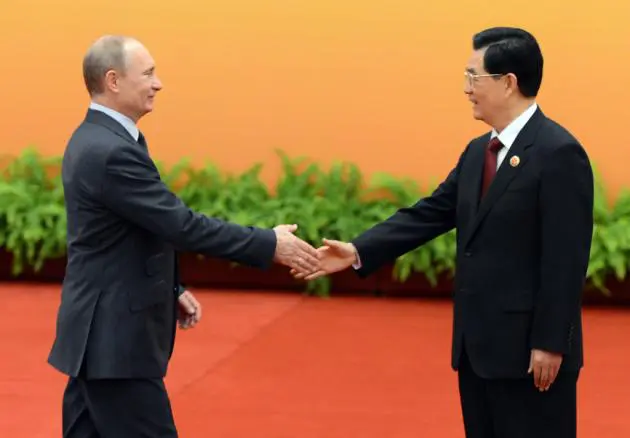
To watch presidents Vladimir Putin of Russia and Hu Jintao of China walking together in the Great Hall in Beijing is to see a new world order in the making. The two superpowers are coming back with vigour and are manoeuvring to strengthen their bilateral relations and gain an advantageous position from which to engage the rest of the world. Despite protests against him, Putin remains powerful as a third-time president, and Hu is the head of the world’s second-largest economy. Together they want to create a new world order that they see as being fair and unbiased. Whether they can accomplish this remains to be seen.
After two days of talks they issued a call for support for the Syrian peace plan of former UN secretary-general Kofi Annan, a plan that Western countries are saying is now dead because the conflicting parties in the war-torn country will not respect a ceasefire. The Syrian government and the resistance forces are fighting non-stop, killing thousands of innocent civilians who cannot escape the bloodshed. Over the past year, more than 10,000 people in Syria have fallen victim to atrocities committed by various armed groups.
In Beijing, Putin and Hu were still reading from the same script, saying regime change in Syria would spell trouble for the future of the Middle East. Since the “Arab Spring”, the political and security landscape in the volatile region has changed. China and Russia share the fear that the political uprisings there will become have a ripple effect in their own countries. Of course, what they do not say is that the defeat of Syrian President Bashar al-Assad would also mean losses for Russia and China as well. The former has a naval base there, while the latter maintains vital energy links with the regime to support its economic growth.
It is interesting that the two nations, tentative allies during the Cold War who later split up, are now trying to hide their differences on other matters. The fact remains that the two powers are competing for spheres of influence in the world. Russia has been losing ground to China in both economic and political terms. With the return of Putin, Russia will now be more assertive in its external relations near and far. On issues that the two countries can cooperate upon, they will take measures to raise their profile so the world will take notice. Other sensitive issues will be put on the backburner for the time being.
Since Russia and China are faced with the US’s much-heralded “pivot to Asia”, they are consulting on how to coordinate their policies. Both are members of the East Asia Summit (EAS), the Asean-led leaders’ initiative. In November China and Russia, along with the US, will attend an EAS gathering in Phnom Penh. They will want to make sure they speak with one voice on issues that affect their security, in order to show their solidarity and render support for Asean.
It remains to be seen whether the two superpowers can forge a new world order that other countries will want to join. One caveat is in order: it is fine for them to go against the US and the West on certain issues, but it is equally important to demonstrate some higher moral standards that will be acknowledged by the international community at large.
