
Freedom of choice


Play
More and more employees are using personal devices to get work done, and this has dual benefits according to Dr Chawapol Jariyawiroj, VMware manager in Thailand
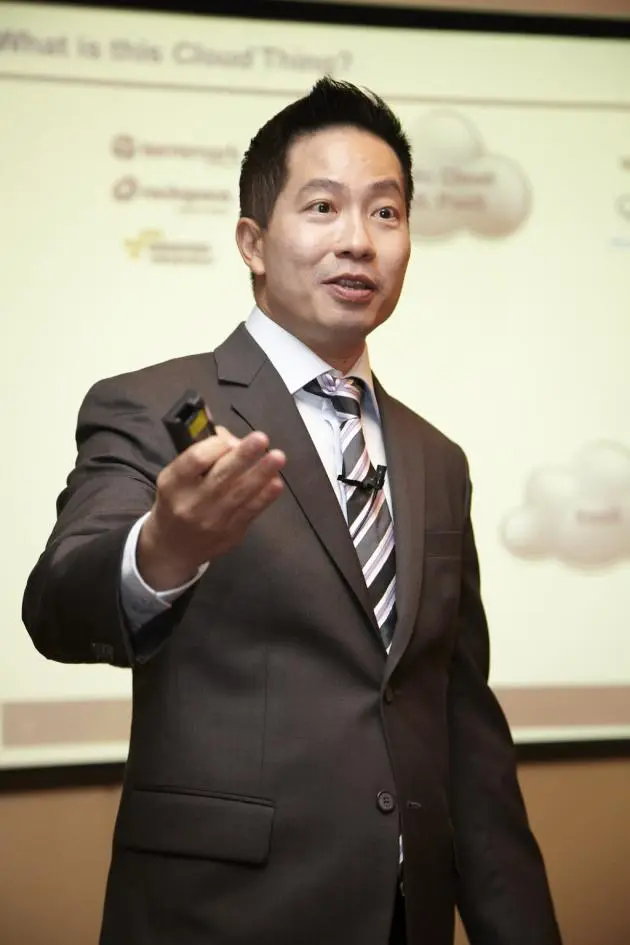
Dr Chawapol Jariyawiroj, the VMware country manager for Thailand and Indochina, is bullish on the prospects of workers bringing their own devices to the workplace.
According to a recent VMware study on the new way of working, covering 10 Asia-Pacific countries including Thailand, mobility and flexibility are now key aspects of any organisation’s IT policy due to the Bring Your Own Device (BYOD) trend, especially among younger employees.
Based on this study, Thailand currently has the third highest incidence of BYOD among the ten countries in the study – Singapore, Malaysia, China, South Korea, Japan, India, Taiwan, Australia Hong Kong and Thailand.
Respondents in the survey worked in companies with more than 1,000 staff globally, worked at least 15 hours or more a week, and used their computers both at work and at home.
In the so-called post-PC era, in which sales of tablet computers have outgrown those of PCs, it has been found that employees in Thailand, for example, are turning to personal technologies to get their work done. As a result, BYOD is more than just preference, as it affects employee satisfaction, retention and productivity.
In the study, it was found that Thailand’s incidence of BYOD is as high as 90 per cent, compared to South Korea’s 96 per cent and China’s 94 per cent. This means 9 out of ten workers here bring their own device to work, and half use the device for work-related purposes.
A total of 56 per cent of Thai employees say their personal devices are more personalised and familiar to use, while 41 per cent say they offer more functions.
Overall, respondents share the opinion that restrictive IT policies are a barrier to productivity, as 55 per cent of workers say they work for seven hours or longer hours per day, with 3.3 hours spent working outside the office on average.
Thus, they believe that IT freedom is beneficial, and when they bring their own device to work, they are happier, more productive, faster in responding to change and more efficient in completing given tasks.
A total of 68 per cent of respondents also say they will save money for the company if they are able to use their own choice of web-based, customised software or apps at work.
In the end, the solution for companies is to rewrite IT policies and keep an open mind as employees re-imagine the workplace. Ttechnologies such as virtualisation and cloud computing can help companies adapt, be more competitive and give employees more choice.
“The reality today is that employees want to be in control over the personal hardware and software they use to get the job done, whether their companies agree with them or not.
“Customers are coming to us to empower employees with the tools to be productive and happy without compromising the security of company data,” he says.
Now, a growing number of organisations have turned to the use of satellite offices due to the need to be mobile and flexible. For example, when a new employee arrives at the office on the first day, he or she will be sent a user name and password in the form of an SMS from the IT department, in order to get access to a common desktop screen at one of the satellite offices.
Any employee can use these desktops, whose software is, however, pre-loaded and designated according to individual employees.
