
The bigger picture


Play
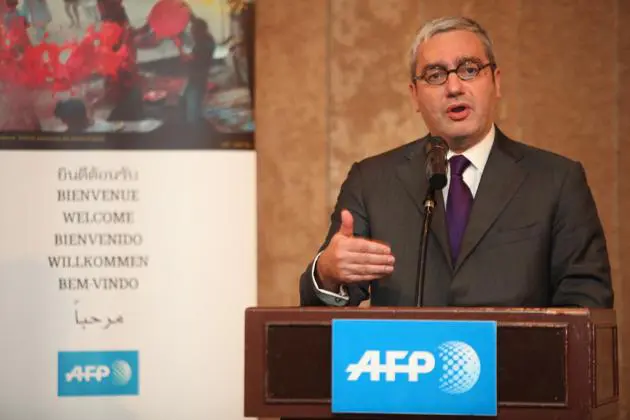
Agence France-Presse chairman Emmanuel Hoog says the venerable news agency is branching out into new sources of information provision as technology dictates content
For Emmanuel Hoog, chairman of Agence France-Presse (AFP), the French news agency, videos have become king in the world of multimedia news content, which also includes text, photos and graphics.
Two years ago, AFP, established in 1835, making it the world’s oldest news agency, shot an average of 20 videos worldwide. Today, it’s a daily 150 videos on average, and the number will rise to around 200 later this year.
“We have about 2,000 journalists and 200 bureaus around the world, in 165 countries, with an annual revenue of 300 million euros. Originally, we were created in a world in which information [transmission] was very poor. There was no information decades and decades ago. Now, information is everywhere.
“To a certain extent, we have lost the monopoly on breaking news. We are now facing two big challenges. First is the speed of the circulation of information. Second is the reliability of information.
“As you know, there are lots of rumours and noises around, but not so much verifiable information. AFP is a place where professionals go to get reliable information.
“Our portfolio of clients increases every day. This includes the clients of past years, like newspapers. But now we also have clients in the new media such as websites, telecom companies and so on.
“In terms of products, we’ve vastly diversified. We started by producing text only in French. Now we produce in six languages. In Asia our policy is to produce more in local languages in the form of news wires in Pakistani languages, Bahasa (Indonesia), Vietnamese, Chinese, Japanese and Thai.
“So we’ll be looking for a good partner in Thailand to produce the news wires in Thai. In terms of texts and photos, we just received our first Pulitzer Prize.
“We’ve also been increasing the production of videos. All media, old and new, need videos and images. By the end of this year, we expect to produce a total of 200 videos each day.
“That’s a big challenge as we move into the era of multimedia news production that combines text, photos, videos and graphics.
“Because information is everywhere now, the news content produced by AFP should also be everywhere, so we have partnerships with YouTube, Yahoo and other new media to distribute these videos and related content.
“We also have Ipad and smart phone applications in English. We’re also the most important news agency for sports, as at least 30-40 per cent of our content in texts and photos is dedicated to sports.
“We see ourselves as one of the important providers of news for text and photos, and for video it should be the same, as video information is crucial for us. We will continue to be the one-stop shop for information from all over the world.
“Asia is growing fast in terms of our revenue. The Thai and Veitnamese markets are important. In Myanmar, which is opening up to the rest of world, we’ve created a new bureau in Yangon for videos and photos.
“Thailand now has the fourth biggest AFP bureau in Asia after China, Japan and India.
“A recent study shows that about two billion people in the world get our information every day,” he says.
