
Oblivion may be where the truth belongs


Play
The most comprehensive report on the political violence of 2010 can do anything but speak volumes.
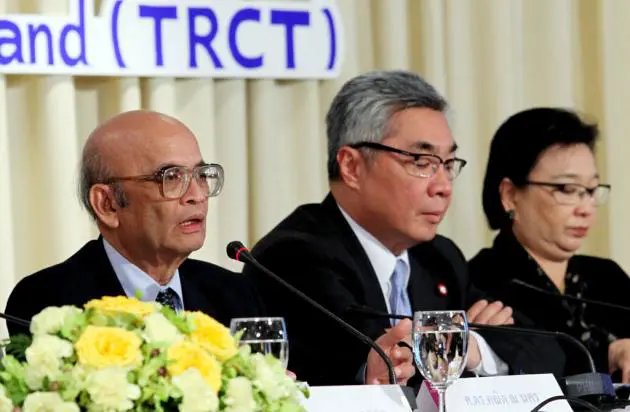
It will most likely turn out to be the Truth for Reconciliation Commission of Thailand’s (TRCT) swan song. Nobody can actually benefit from the detailed chronology of events, the added and well-researched witness accounts, the intriguing information picked up by the social media, as well as how the conventional media saw the unfolding violence. The country’s political divide has been romanticised and idealised, so much so that as the TRCT tries to tell the story as it happened, the panel will not be making any friends.
The “men in black” existed, the panel has concluded, and there is strong evidence that they were linked to at least some red-shirt leaders. The men in black played a crucial role in the Kok Wua Intersection bloodbath on April 10, 2010, as heavy fire rained down on troops deployed to push back red-shirt protesters from prohibited zones. After the Kok Wua incident, the men in black re-emerged several times and were involved in incidents leading up to the infamous May 19 crackdown, according to the TRCT report.
As for the Abhisit government and the command centre set up to deal with the protesters, the TRCT also pulls no punches. Soldiers shouldn’t have been tasked with restoring order in that kind of political situation, the panel says. There were cases of misjudgement or stereotyping, leading to blanket negativity toward the red-shirt protesters and their eventual suppression. The commission calls for “restorative justice”, or total leniency toward protesters who may have broken national security laws during the political confrontation. It also denounces the 2006 coup in no uncertain terms, and gives the Thai judiciary a strong caution that its role can either be a solution to the problem or help prolong the political suffering.
The Yingluck administration is not spared either. In what arguably is the most significant message in its report, the TRCT expresses its absolute disapproval of the move to rush through what it suggests are conspicuous amnesty programmes. Reconciliation can’t be forced upon a nation by the party that controls the majority in Parliament, the commission says. Meaningful steps toward peace need time and consensus, and unilateral moves carry the danger of generating the opposite results – in other words, deeper divide and greater hostility, it says.
The TRCT lectures the media on how not to add fuel to volatile political situations, and reminds all protesters of the need to differentiate between exercising democratic liberty and provoking the authorities through armed activities and the violation of other people’s rights. The military must stay away from politics no matter what, and Article 112, or the “lese majeste law”, must be neither taunted nor abused. Thailand needs to address the evolution of the monarchy with the utmost sincerity, and with only one united agenda, which is to protect the institution to the country’s best interests.
The commission will fade away after this, as the Yingluck government isn’t much interested in a fact-finding mechanism created by the previous government. The panel, however, has been true to a “balance of perspectives” format up to the last minute. In a previous report, the panel gave both the armed forces and Thaksin Shinawatra a strong rebuke. As the commissioners see it, if the 2006 coup sent Thailand down a slippery slope, there is no doubt about who brought it to the precipice.
The truth, they say, often upsets people. The commission, chaired by Kanit na Nakorn, has presented possibilities on how historians should tackle the past decade of Thailand politically. The red shirts have their own version, so do the yellow shirts, the Pheu Thai Party, the Democrat Party, the Army and so on. Different from their versions is the commission’s obvious attempt to see the Thai political world as grey, not black or white.
And that’s probably how the truth is supposed to be told. Most tragedies result from a juxtaposition of factors, and sometimes they lead to greater tragedies because all those involved do is deflect blame to others. The commission’s ultimate message is that everybody played a part, big or small, in bringing Thailand to this sad impasse, and that reconciliation can never happen unless this is realised by all.
The TRCT’s swan song blends realism and idealism. The panel tried to be realistic in presenting accounts of events without political bias, in analysing everyone’s motives and actions. It is idealistic in assuming that everyone will accept, or at least understand, the report and its calls for reason.
