
Popular model makes waves


Play
Isuzu sales executive Hiroshi Nakagawa says demand for the company's new pick-up trucks is outstripping production capacity and the market will stay buoyant
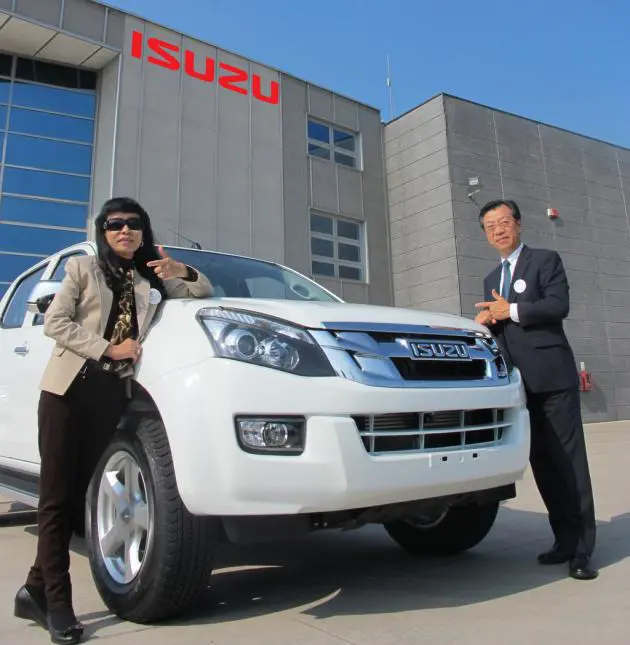
Hiroshi Nakagawa, president of Tri-Petch Isuzu Sales Co, believes that three factors are behind the company’s latest success in launching the all-new Isuzu D-Max pickup trucks and related models.
Over the past year since the October 2011 launch, the demand for these one-tonne commercial vehicle models has exceeded Isuzu’s production capacity, resulting in long queues for both Thai and overseas customers. For Thai customers, the waiting time for delivery of the new models is currently 3-4 months. Overseas customers also have to wait for months to get the new models, according to Nakagawa and Senior Vice-President Panatda Chennavasin.
“In fact, we introduced the D-Max models here amid Thailand’s flood crisis last year. These vehicles were completely new and very attractive, with versatile uses, including the capability to be used on moderately-flooded roads,” Nakagawa says.
“As a result, the demand has been overwhelming. The third reason for our record sales is the government’s policy to promote the purchase of cars and trucks among first-time buyers.
“This policy grants an excise tax break of up to Bt100,000 per unit for all first-time buyers, resulting in the additional demand for all Isuzu models. In other words, we cannot produce enough units for our customers right now.
“Our first year’s sales plus back orders for these models have broken all previous records, totalling 200,000 units so far. Previously our record was about 160,000 units, back in 2005. Regarding exports, we’re just starting to introduce the new models in several foreign markets worldwide.
“Thailand is our production base for global sales. We will export to around 100 countries in Europe, the Middle East, Africa and elsewhere. In Europe our shipments are still not enough to meet the demand despite the euro-zone economic crisis.
In response to this huge domestic and export demand, Japanese-based Isuzu has decided to invest in a new factory at the Gateway industrial estate (on the Eastern Seaboard), to boost our production capacity.
“When combined with the capacity of our plant in Samrong district in Samut Prakarn province, the total capacity for pick-up trucks and related models will rise to an annual 400,000 units in 2013, for both CBUs and CKDs. In addition we will have a total production capacity for 30,000 medium and larger trucks.
“Thailand’s domestic demand is large, so we need to allocate a large portion of capacity for Thai customers. The ratio is currently 60 per cent for domestic sales and 40 per cent for export sales.
“In the near future we will adjust the ratio to 50:50. However, the waiting period for Thai customers is quite long, averaging 3-4 months. In terms of technology, the Isuzu ‘insight’ system is something we’re proud of. It’s similar to what is used in aviation, as it helps drivers to adjust their driving behaviour for maximum benefits in terms of fuel economy and safety. Drivers can get a report on various factors affecting the vehicle’s performance. We’re also renowned in terms of engine performance and durability.
“Over the next 2-3 years, the Asean Economic Community, which starts in 2015, will be a major challenge for our group. We see the opportunity to sell more vehicles due to Thailand’s central location in Indochina, where cross-border logistics will get a big boost, needing more pick-ups and larger trucks. Thai logistics operators are quite competitive, so we expect more sales of commercial vehicles.
“On a negative note, the euro-zone crisis is one major concern, while China’s economic slowdown is another potential problem. For Thailand, the economy is still on the uptrend, especially regarding the auto industry. If the political situation is stable, the economy will continue to grow. Now, it’s better than when I first took over the presidency around 2009,” Nakagawa says.
