
Rising star


Play
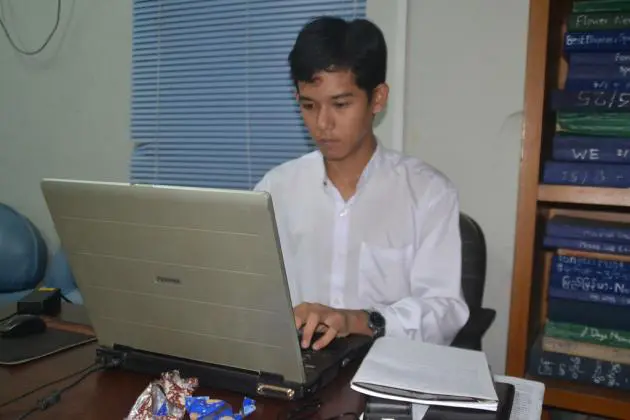
Zayyar Nanda, a young political newspaper editor, is helping to shape the new Myanmar. Pana Janviroj talks to him.
At 18 years of age, Zayyar Nanda must be one of the youngest newspaper editors anyway in the world. His journey is remarkable – perhaps epitomising the emergence and aspirations of Myanmar’s as democratic and reform-minded new generation.
Zayyar was recently appointed editor of political news at Eleven Media Group, Myanmar.
It isn’t difficult to see why Dr Thein Myint, managing director of Eleven Media, has full confidence in the young man. “We like his style, capability and mindset.”
Born in Mandalay and raised in Yangon from the age of one, Zayyar had to flee into exile with his father, an activist, in September 2008, to Mae Sot, Thailand. Between 14-17 years old, he attended classes run by NGOs on the Thai border.
“It was through reading the likes of Time and The Economist magazines, that I gained political knowledge. I learnt English mainly at NGO-run schools. I also met a good teacher who greatly helped to improve my English skills,” recals Zayyar.
His intelligence was noted, and while in Mae Sot, he took a test and won a scholarship to study at Online Education University from Australia. He is still studying political science, a subject still banned in Myanmar, since the time of former junta leader Gen Newin.
Zayyar also admires the writings of Plato, Aristotle, and is keenly interested in world political history.
After the recent elections in Myanmar, his father decided to return to Yangon. Zayyar worked at another media company before being offered an editor’s job at Eleven Media, Myanmar’s largest privately-owned media group.
Asked about the essence and pace of Myanmar’s reform, he expresses confidence that it will be irreversible, but “the government still needs to inform the people what democracy is and the value of democracy”.
“This must come not just from the government but also the political opposition, organisation leaders, and more people need to speak out. The media must also open up,” he adds.
In the process, there will have to be a change to the constitution. “I want to play a role in dispersing information about democracy to the people. It will take time and the media and civil society must be strengthened,” he says.
On peace with the ethnic minorities, for which agreement is still pending with the Kachins, he says all sides need to build trust. “In the past, the people suffered so much and were treated unfairly. Trust and a chance to speak are needed.”
Zayyar admits that the Rakhine conflict is confusing and Islamic extremists have taken advantage of the situation to cause havoc. “The government and MPs must tell the military to protect civilians and take measures against extremists. And I hope the military is not playing behind the scenes.”
On Myanmar’s relations with the superpowers, the young editor says attention now seems to have shifted to the US, although a balance is needed with both the US and China. And it would be dangerous to pick sides, especially if there is wrong intent involved.
Zayyar aspires to see young, outstanding Myanmar people both at home and overseas become active in the development of the country. “Through an open media I can tell people what is happening, and it can quicken the process toward democracy.
“I want to tell young people to try their best, and to aspire to what they want to be.”
Now, with a full time job, Zayyar finds management of his work time and study challenging. He has less time to study – doing two to three hours a day instead of five hours.
The young editor has published two English articles in recent weeks – one on the Rakhine conflict, in response to an article from the former editor of Irrawaddy magazine (www.elevenmyanmar.com/opinion/1151-is-radical-islamic-idea-forming-in-myanmar) and another on US President Obama’s visit (www.elevenmyanmar.com/opinion/1305-questions-on-president-obama-s-historical-visit-to-myanmar).
