
Road ahead for charter reform is a minefield


Things are getting more confusing each day with the Pheu Thai Party's plan to amend the Constitution. Trouble is just around the corner and the political landscape is littered with new time bombs.
As the plan proceeds, the conflict isn’t confined to a confrontation between the government and opposition anymore. Pheu Thai and the Democrats are natural opponents on this, but for Thaksin Shinawatra and Jatuporn Promphan, speaking for the red-shirt movement, to be airing divergent strategies is a sign of further political turbulence.
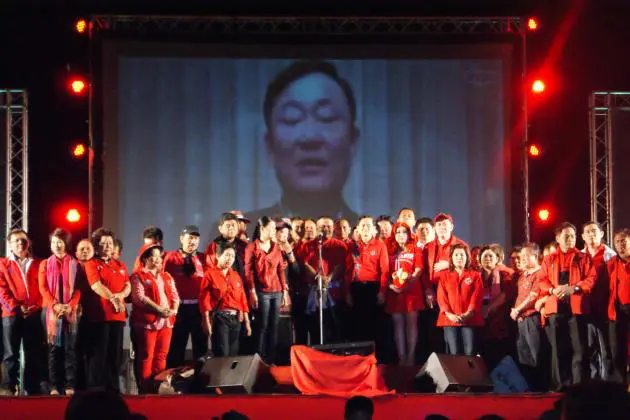
Former premier Thaksin made another “phone-in” on Saturday evening to a huge gathering of red shirts who organised an “anti-coup concert” in Khao Yai, insisting that all effort must be exerted to press ahead with the much-hyped referendum.
He shot down scepticism from some of his own party members and red-shirt leaders that it will be almost impossible to get half of voters to cast “yes” ballots even if half of all eligible voters (estimated at 49 million next year) turned out, as required by the Constitution.
“To get 24.3 million votes in the referendum is a walkover,” Thaksin declared, arguing that Pheu Thai forcing a vote on the third and final reading on the pending charter-amendment bill without a referendum would be too risky. He suggested that the ruling party might not get sufficient votes to pass the bill – and even if that obstacle were overcome, there was still the risk of running afoul of the Constitutional Court’s earlier ruling that a referendum would legitimise the move.
But Jatuporn, one of Thaksin’s closest advocates, is calling for a course of action that runs counter to Thaksin’s tactic. He said going ahead with the referendum would be engaging in a “war we will lose”.
He said Pheu Thai should avoid certain defeat over a referendum and instead move ahead to a decisive end with a vote in Parliament to rewrite the whole charter. In other words, the red-shirt movement is against the referendum, or even an article-by-article amendment, as has been proposed as an alternative by other factions in the ruling party.
Where does Premier Yingluck Shinawatra stand, then? Nobody is quite sure. Perhaps she isn’t certain herself as to what the next step should be. The party is divided. The red shirts are putting pressure on Pheu Thai. The party is supposed to follow Thaksin’s instructions. But the core members are split between caution and going all out.
Officially, a panel set up by the party has vowed to move ahead with the plan to hold a referendum, brushing aside a proposal to amend the charter section by section. That sounds like the official party line. But upon closer scrutiny, that isn’t necessarily the case.
Chalerm Yoobamrung, the deputy premier, is publicly against the referendum. He prefers to seek changes article by article, to avoid a new political stalemate in the face of strong opposition against a total overhaul. He runs against another faction within the party that calls for a total rewrite of the charter.
What a total “overhaul” of the Constitution means is basically to offer a higher degree of influence to the political powers-that-be and to reduce the authority of independent agencies that are supposed to serve as checks and balances against “parliamentary dictatorship” or the “tyranny of the majority”.
Opposition leader Abhisit Vejjajiva of course knows exactly what Thaksin is after. He claims that Pheu Thai’s sole purpose is to alter Article 309 of the 2007 charter, which deals with the actions of the 2006 coup-makers who ousted Thaksin. If this particular stipulation were removed from the new charter, all legal action taken against Thaksin since the coup would be automatically null and void.
And that alone could plunge the country into another period of turmoil. Opponents of the Pheu Thai move could be radicalised and the worst-case scenario would inevitably loom over us once again.
If past behaviour is any indication, Thaksin might yet change his tack. Warnings have emerged from various quarters – not confined to hardcore opponents of the government – that the road ahead for a referendum is shot through with holes, and surviving the political minefield is an uphill task, if not impossible.
Premier Yingluck gave some hints of a possible about-turn on Tuesday when she told reporters that if 24 million voters could be found to vote in favour of a total rewrite of the charter, “We will revert to amending the Constitution article by article.”
A referendum would cost taxpayers an estimated Bt2 billion. But the higher price to pay in case of a failed referendum is another prolonged period of political confrontation. The damage would be incalculable.
