
Remembering a day we learned nothing from


Play
The political violence of three years ago demonstrated that Thais have been unable to reap any benefit from past tragic experiences
There were many days historically associated with our prolonged political crisis. There was the day the yellow shirts scaled the walls of Government House and occupied the compound, and the day they seized Suvanabhumi Airport. There was the day security troops cut some of them down. There were also the days Thaksin Shinawatra was acquitted of share concealment, and when he sold his telecom empire to Singapore’s Temasek without paying any taxes.
However, April 10, 2010, stands out above all. Three years ago this week, Thailand’s political strife went past the point of no return. It was the day we realised we had been just kidding ourselves in the belief that previous political bloodletting had taught us valuable lessons.
Many will argue that May 19 the same year, when security forces opened fire on red-shirt protesters and arsonists burned down commercial buildings, was the most significant date thus far in our continuing political crisis. It, too, was tragic, but it followed the tipping point on April 10 that left Thailand at the bottom of the slippery slope. May 19 was arguably the day we saw how people at the bottom behave.
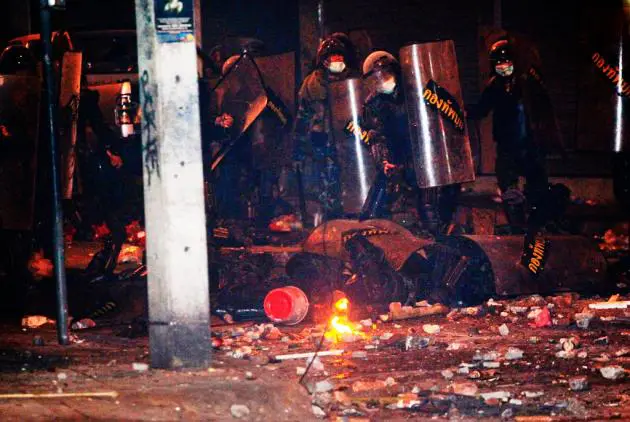
Before April 10, the political divide seemed contained, if barely. The clash between troops and still-unidentified “men in black” among the red-shirt protesters left scores of protesters and soldiers dead – and it changed everything. The saddest part was that the bloodshed was widely expected and many opportunities to prevent it went ignored. In the end, it happened perhaps because of the dark will of those who wanted to see it happen.
The carnage at the Kok Wua intersection set the course for what followed on May 19. The red shirts were furious and so were the armed forces. The Abhisit government grew tougher. It no longer seemed to matter who was right or wrong. The stage was irreversibly set for something worse.
On April 10 a nation that considered itself mature learned in the hardest possible way that it was not. While the violence and the casualty count was lesser than in October 1976 and May 1992, the Kok Wua clash was extraordinary in the way its seeming inevitability exposed a serious national flaw. A better-educated, more politically astute society supposedly ready to embrace democracy did nothing to stop the mayhem.
The tragedy robbed us of a fragile peace and further blackened many damaged souls. The political divide became so deep that foes belittled each other’s deaths. Concepts of justice, vengeance and violence became roiled in a partisan muddle.
On that day many people gave up hoping for better and began fearing the worst. They realised how powerless they were to prevent bloodshed if that’s what a powerful minority wanted. It was a day from which we yearned to learn a lesson, but knew we probably would not.
Some people believe that peace can’t be achieved without war, that chaos must precede order. Before Kok Wua, the prevailing wisdom was that no government could survive if people died in a political uprising. It’s sad if that was the protesters’ theory driving the tumult of 2010, the belief that people had to die to oust the Abhisit administration.
“My red-shirt brothers should not have died,” Thaksin Shinawatra told supporters by phone amid this week’s commemorations of that tragic day. He was right, of course. That some of his brothers did die despite people like him saying so is the whole point of the tragedy of April 10.
