
An unlikely community that lives in the 'hell' of sin city


Play
Even for someone indifferent or downright hostile to religion, Friday prayers at a mosque have a haunting sound and beauty, a quality of spirituality rare in any other faith and hard not to find deeply affecting. At Masjid-e-Tawheed, there is good reason,
For while in one direction from the mosque, the view of barren, rocky mountains shimmering in the desert sunlight could place Masjid-e-Tawheed in any number of locations in the Islamic world, a couple of miles in the opposite direction lies what one would imagine to be the worst place in the world for an even halfway-strict Muslim.
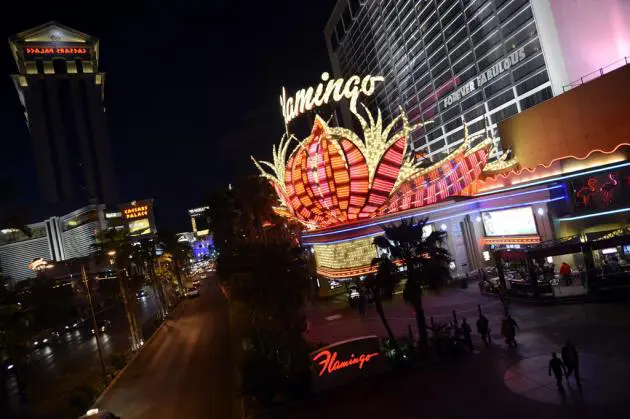
Masjid-e-Tawheed is a 10-minute drive from Las Vegas Boulevard, the famous Strip – undisputed world capital of gambling, fornication, adultery, prostitution, immodesty, licentiousness, drinking, gluttony, vanity, ostentation and not a little taking God’s name in vain when visitors' luck runs out in the gambling halls.
Las Vegas’s hidden Muslim life here is a 10,000-strong community so unlikely that even visiting Muslims are astonished to find it exists.
It goes without saying that the United States is not the easiest place in which to be a Muslim, even though census figures show fractionally more people practising Islam – some 2.6 million – than the more visible Jewish population of 2.3 million.
Despite their love of religion, Americans are still as jittery about Islam as, broadly speaking, Islam is jittery about Americans. In Las Vegas, one would imagine, the locals, not always known for liberality or sophistication, would be hostile – especially when Islam opposes everything Las Vegas does for a living.
Masjid-e-Tawheed’s founder and leader is a charming and charismatic 45-year-old originally from Afghanistan, Ahmadullah Rokai Yusufzai, or Rocky to most non-Muslims he meets. With a Bluetooth headset in his ear and a Mercedes with “Allahu Akbar” – God is great – on its number plates, Yusufzai could win any prize as model immigrant.
Yusufzai, who fought the Soviets with the mujahideen as a teenager, works as a court interpreter, helps train Marine units going to Afghanistan, is a volunteer soccer coach, and has brought up his children to be diligent, patriotic, success-oriented young Americans.
Yet Yusufzai has had a tough time since coming to the US with his parents 30 years ago. He was hounded out of his engineer’s job with a telecommunications company within weeks of 9/11.
Although college educated, he was prepared to try to make it as a cab driver, but found the company requirement to cheat tourists by taking them on unnecessarily long routes more than he could morally accept. He also refused to take rake-offs from strip joints and brothels.
He later saw a modest rental-property business collapse in recession and had all his apartments repossessed. Today, as a successful and respected member of the wider community, he still accepts that his phones are periodically tapped. The FBI visits him regularly to check up on what’s going down at the mosque and if he thinks any of the congregation might be terrorists intent on blowing up the nearest titty bar.
“I always tell the FBI guys that if there were, I’d be calling the FBI myself, but they still come by. We are trying to have a better image of Islam. We’re not going to harbour or support anybody who even thinks about that,” Yusufzai says.
For Muslims, or anyone coming from poor contries, the lure of Vegas tends to be down to a combination of plentiful, if often distasteful, employment, low taxes and a low cost of living. “A job in a hotel can pay for a home and two cars,” says, Yusufzai. “A taxi-driver or a black-jack dealer earning US$60,000 can earn enough for a house, cars and schooling.”
Yet plenty of Muslims gamble. They come, he admits, in the hope of winning big at a casino after studying from the inside how they work. He has not heard of a case of such a plan working out – but he has heard of people who have lost all the money they have earned in the casinos at the same establishments’ tables – and even committing suicide as a result.
He describes pioneer days in the 1980s, when there weren’t enough Muslims to fill one mosque, and to get halal meat. “We would go out of town, go to a farm, buy the animal and sacrifice it ourselves.”
Even today, Masjid-e-Tawheed doesn’t have an imam. “We have two brothers who have learned on their own. They aren’t certified imams,” says Yusufzai. “One is a baker. The other is a courier and a cab-driver.”
“We are criticised by other Muslims. They’ll say, ‘You’re living in Sin City? You must have a gambling problem. You must be doing this and that.’ And we say, no. It’s just suburbia, ordinary families trying to live decent lives. Most Muslims stay well away from the Strip. My house is about 15 miles away and it’s a different world.
“Muslims ask me how I feel about having bartenders and casino workers in our congregation. I tell them, we all go to our own grave. I can’t judge that person.”
Does Yusufzai not worry about young members of his congregation developing a secret life when temptation is a short bus ride away? His own daughter, 11-year-old Medinah, seems thus far immune to the charms of Las Vegas Boulevard. But, as her father admits, “It’s easier to get lost in this city than anywhere else in the world. You get to the Strip, you can get a fake ID and go into any club and do whatever you want. Drinking has become a major thing for teenagers. The parents are mostly in denial.
“Some first- and second-generation women in particular have lost themselves, and they think selling their body in various forms is the best way to make money fast. They’ve taken themselves away from the community, the mosques, the family and used an American name. The saddest part of my job is going to a court and seeing a Muslim family there. It tears me up, whether it’s domestic violence or a young girl doing stupid things.”
He invites me to the Friday service, where I meet some of Las Vegas’s hidden Muslims – though sadly none of the women, whose views on whether the nearby “attractions” of the Strip perhaps even represent some form of liberation, or social progress, would be fascinating.
Muhammad Chakir, from Morocco, works as an assistant manager in one of the biggest casinos. “Other Muslims think it’s crazy that we’re here, but we try really hard to take the time to come to God and get away from all the bad stuff. For me, the diversity of the place makes it easier to be a Muslim, not harder.”
Chakir admits he has gambled, but only when he first visited Vegas. “Once you take that road, once you start putting money into the machines from your pay cheque, you need to leave this city,” he tells me.
Another casino worker, Muhammad Muner, is from Afghanistan. “Vegas is no problem,” he tells me. “This is the United States and we have freedom of religion. They don’t say it for nothing.”
Rashid Mouawia, a kitchen cleaner from Morocco, will happily wear traditional dress on the Strip if he’s in the mood. “You really don’t feel discrimination as much as in other cities. The diversity helps.
“When I started my job, some people had stereotypes about Muslims, that we're all terrorists. But when they get to know you, you get respect. You know, I think a lot of us don’t just tolerate this town, we actually love it.”
