
Again, time to reflect, and be afraid of ourselves


Play
Like October, May is historically a politically significant month in Thailand. They both demonstrate the great volatility and irony of Thai political life. October brought the country's first popular uprising in 1973, only to send many of the "heroes"
Thais under 25 may have a hard time imagining middle-class protesters, equipped with mobile phones (a major luxury in the early 1990s) up in arms against military “dictatorship”. Yes, there was a time when today’s “elite” did not like the men in uniform that much.
The largely one-sided shooting in May 1992 lasted about three days. One famous photo featured a demonstrator being clubbed by the authorities. Another showed cuffed, half-naked “troublemakers” on their knees, crammed together in an open space. The latter was made into a T-shirt with the caption “We lose to win”.
The Suchinda Kraprayoon government crumbled almost immediately after the May 1992 violence. The uprising was against the prime minister, whose administration comprised elected politicians, but he himself was a coup-maker who toppled a democratically-elected government over a year earlier. Of course, there were times when the “elite” of today hated “military intervention” in politics.
One thing led to another. Among the consequences were the setting up of an independent TV station – because state propaganda before and during the May 1992 uprising was resented – and the enactment of the so-called “People’s Constitution” in 1997. It’s fair to say that political shortcomings not related to the May bloodshed also factored into the campaign for that charter. To cut a long story short, society became sick and tired of the vicious circle of corruption-coup-bloodshed, so a constitution that could effectively deter graft and uphold the true spirit of democracy was wanted.
What happened next, most of us know – iTV, the independent TV station, became a political tool; and Chamlong Srimuang, a leader of the May 1992 anti-military uprising, joined a campaign to overthrow the democratically elected government of Thaksin Shinawatra, but not before handing over his now-defunct Palang Dharma Party to the telecom tycoon. Chamlong’s main ally this time was Sondhi Limthongkul, who had, like Chamlong, once been a Thaksin cheerleader.
There was a brief honeymoon between society and the “independent bodies” prescribed in the 1997 “People’s Constitution” as new anti-corruption mechanisms. The Election Commission warded off high-profile vote-buyers and the Constitutional Court banished one of the most politically powerful men, the late Sanan Kachornprasart, who was then secretary-general of the Democrat Party, by giving him a five-year ban.
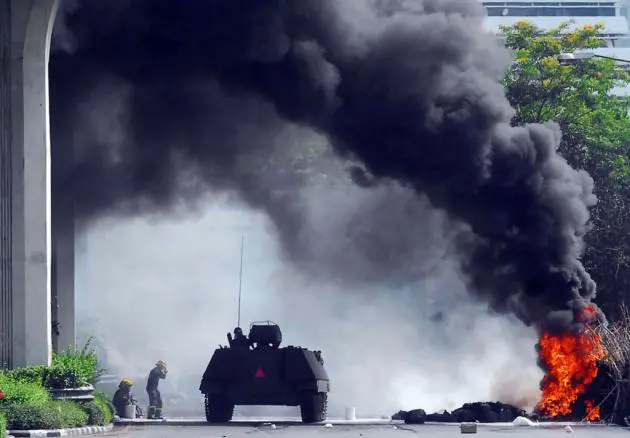
People have different opinions on how much the ownership issue of iTV and the later roles played by the EC and Constitutional Court influenced the coup in 2006. The divide is even deeper when it comes to the question of what caused, or who was responsible for, the May 2010 bloodletting. At that time, everybody was already covered in mud.
Was there military opportunism and manipulation at play between 2006 and 2010? Yes. Had massive corruption by elected politicians provided a spark? Yes. Was the “democratic mandate” being abused? Yes. Was “abuse of the democratic mandate” being abused as well? Probably yes again.
If May 1992 and May 2010 and what happened in between was an ideological evolution, we may find a little comfort. Violence occurs sometimes when people think differently. But what if it all happened not because we are different, but because we are all too alike? What if it all was just a power play disguised as an ideological clash?
Or it could be idealism turning into an old-fashioned power play. Double standards plague both sides of the political divide. Nobody ever admits practicing it, and self-denial only feeds the hypocrisy. Everyone started off fighting for “democracy”, that strange doctrine that is easy to cherish but difficult to foster. Just check the names of most Thai political movements. They all have “democracy” in there somewhere.
Tomorrow, the month of May will come again. Separately, activists will mark “anniversaries” as usual. Candles will be lit, tears shed, “justice” demanded and portraits of “heroes” put on display with the message that their “sacrifices” shall never be forgotten. On the main political stage, the fight will continue over what kind of a constitution the country really needs.
If a constitution means common values, the irony between May 1992 and May 2010 may at least tell us we aren’t ready for an absolute charter yet. Thais remain deeply divided (possibly because we are too alike), so the immediate question should be how to handle the division without destroying ourselves.
We haven’t learned much from our bloody political past, obviously, but at least we now know that in every so-called ideological conflict, something dark always lurks, ready to strike. This “something” is waiting patiently for when people involved in “ideological” clashes go over the line and get ready to do anything to advance their cause.
