
Quality, not quantity, of teachers is key
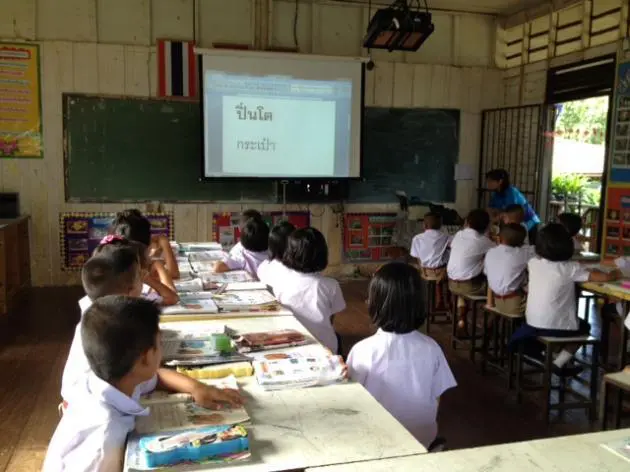


Most educators sigh when asked about Thailand's education system. Why? The list of problems is long, with no effective solution for many issues.
Let’s take a look at one current problem.
In years past, relevant organisations have complained about the shortage of quality teachers and educators. In response, teacher-training institutes began turning out a larger number of qualified teachers. However, this has lead to a new problem. Very soon, Thailand will have an oversupply of teachers.
According to a recent survey, hundreds of thousand of students are studying the five-year programme aimed at producing the so-called new breed of teacher.
In the 2013 academic year, 29,844 students will graduate and look for teaching jobs, and in 2014 academic year, 40,437 will graduate with the same teaching qualifications. In the 2015 academic year, the number of graduates from teacher-training programmes will be even higher – up to 56,382 graduates. In 2016, the number of graduates will reach 71,530 and in 2017, up to 61,329 will graduate from teacher-training programmes.
This means that in the next five years, the country will have a total of 259,522 graduates qualified as teachers.
But how many vacancies will be available?
Last month, the Thailand Education Deans Council commented that the number of students in teacher training was shockingly high. It also said that although up to 100,000 teachers may reach their retirement age in the next five years, the government would likely recruit just 20,000 new teachers to replace them.
So, what do the teacher-training institutes plan to do?
The council says it has already told its members that they should stop recruiting students in fields where there is already an oversupply.
Typically, teacher-training institutes divide their students into sub-programmes based on the students’ interest and aptitude. These sub-programmes also match subjects being taught at schools – such as physical education, primary education, English language, social studies and science.
However, more problems emerge here.
Those fields with a shortage of teachers have attracted just a handful of students. There are now only 12 students following courses in Islamic Studies and 33 students studying Occupational Skills and Technology.
Chinese language will also become an important subject in the near future and the government is aiming to have the majority of schools conducting Chinese-language classes. But in all, teachers-training institutes have only 2,229 students studying Chinese-language.
In the fields of physical education and hygiene, there are up to 54,542 teacher-training students, but such subjects usually only accounted for just a few hours of teaching each week.
On July 9, the Council will convene a meeting to discuss these problems. Among measures being proposed is allowing students to transfer their credit to other faculties; the development of extra skills to enable graduates to teach in other fields; and the development of foreign languages to ensure graduates are qualified to teach at international level.
It remains to be seen if the relevant organisations will be able to find real solutions to these problems.
No one should forget that the current shortage of teachers is mostly to do with the quantity. Yet, relevant authorities have failed to introduce policies that are effective enough to prevent an oversupply.
And what about the quality issue?
To complicate the matter, the Education Ministry has also started efforts to introduce a new curriculum that is going to focus on six main areas, namely, Languages and Cultures; Science, Math and Information Technology; Communications, Life, and Career World; Communication Skills; Society and Humanity; and Asean Community, the Region, and the World.
Thailand Education Deans Council’s chair Surawat Thongbu has warned that the new curriculum could lead to many problems because it does not adhere with the Office of Higher Education Commission’s “Thai Qualifications Framework”, and requirements for teaching licenses.
His concerns are not groundless.
The universities must be aware of their duty to produce quality graduates for the country's educational sector. They must invest in human-resources development to find qualified lecturers for teacher production. Their focus should never be solely on profit making.
