
The need to tear down another wall of division


Play
Industry leaders in Israel and Palestine join activists in calling for a quick, two-state solution to end the violence
While visiting the Berlin Wall in June 1963, John F Kennedy quoted from a Robert Frost poem: “Something there is that doesn’t love a wall.” For decades the Berlin Wall stood as the symbol of a divided world, a barrier to dialogue and an indictment of humanity’s incapacity to cohabit. With great drama, President Ronald Reagan called on the Russian president, “Mr Gorbachev, tear down this wall.” To the jubilation of millions in November 1989, the Wall did come tumbling down.
The collapse of the Berlin Wall marked the end of the 20th century, which historian Eric Hobsbawm described as “the age of extremes”, and heralded a new era of globalisation, what pundits enthused to call “a borderless world”.
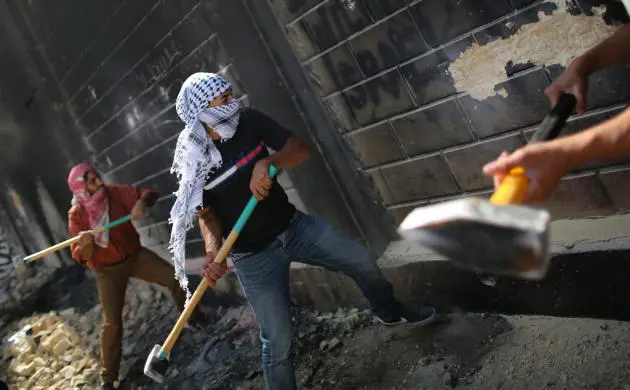
These remarkable developments notwithstanding, while the world may not be divided as it was during the Cold War, there are still a number of walls dividing and indicting humanity, arguably none more so than the Wall erected by the Israeli Occupation in Palestine. Israel claims the Wall – 70 kilometres long, eight meters high, corresponding to 10 per cent of the length of the Israeli West Bank Barrier – was erected for security purposes following terrorist attacks during the Second Intifada. This is an immensely sensitive subject, virtually taboo. Hence, while the world marches on, Palestine and Israel stand still or, worse, take backward steps.
At the 2013 World Economic Forum on the Middle East and North Africa, a meeting was convened of some 300 Israeli and Palestinian business and civic leaders in what’s been termed the “Breaking the Impasse” initiative. The group called for action, instructing political leaders to achieve in the shortest time possible a two-state solution. US Secretary of State John Kerry was present to indicate US support.
The joint leaders of the initiative, Yossi Vardi and Munib R Masri, captains of industry respectively in Israel and Palestine, granted that while scepticism may be in order, cynicism is not. Still, they grapple with a long history.
Europe has a long, ugly history of anti-Semitism, leading to pogroms and persecutions. Jews lived in insecurity and surrounded by hatred. In reaction, in the late 19th century the Zionist movement emerged, which sought security for Jews in what it termed Eretz Israel, or Land of Israel. Palestine at the time was part of the Ottoman Empire, home to Christians, Muslims and Jews. As the Ottoman Empire faced defeat and much of its territory was to pass to the Mandates of Britain and France, issued by the League of Nations, the British government gave recognition to the Jewish quest in the Balfour Declaration (1917):
“His Majesty's government view with favour the establishment in Palestine of a national home for the Jewish people, and will use their best endeavours to facilitate the achievement of this object, it being clearly understood that nothing shall be done which may prejudice the civil and religious rights of existing non-Jewish communities in Palestine, or the rights and political status enjoyed by Jews in any other country.”
The proposal suggested that the Jews were entitled to a homeland, not a state, and that the rights of Palestinians would not be violated. Of course, the Balfour Declaration could not accomplish the protection of the “rights and political status enjoyed by Jews in any other country”, as the Nazi genocide exterminated Jews across Europe. With the defeat of Hitler and the realisation of the horrors perpetrated in Europe, it seemed unthinkable to deny the Jews a state. Palestinians, brutally evicted from their land and homes, were left as distant and powerless proxies to atone for the sins of Europeans.
In the 65 years since the creation of the state of Israel, known to Palestinians as the Nakba, or “catastrophe”, there have been, since 1967, persistent encroachments of Palestinian land through settlements and wars, refugees, terrorism, the intifadas and brutal repression, all escalating hatred. Palestinians today live on about 17 per cent of what was the land of Palestine. The hopes of a settlement raised by the 1993 Oslo Peace Accords were soon doused, and 20 years later Palestinians live with the constant harassments and humiliations of occupation; an offensive wall dividing people and families; and arguably most pernicious the heavy restriction of water allocation to Palestinians in contrast to that amply provided to the Israeli settlements. What’s referred to locally as a “water apartheid policy” is well documented.
Hatred is rising, not diminishing, and future prospects are bleak as the next generations grow up in a new apartheid-like situation, harbouring mistrust and animosity.
As for the Israelis, as one of my Palestinian interlocutors, a professor at Birzeit University put it: “The jailers are becoming the jailed.” This is a land of great misery, human suffering and unhappiness, even though in their daily lives Palestinians continue to show considerable resilience. On the basis of current trends, a just settlement of peace seems increasingly remote, elusive and perhaps impossible.
Hence the initiative to “break the impasse” and the plea forcefully articulated in Varsi’s speech in front of Mahmoud Abbas, president of the Palestinian Authority and Israel’s President Simon Peres, Secretary of State John Kerry and the several hundred WEF participants when he shouted, “Enough!” Israel’s Prime Minister Benjamin Netanyahu was not present, not a good omen.
The situation is complicated. These developments are occurring when the Arab world is in turmoil, when there are some 1.5 million refugees streaming into Jordan from Syria. Within the Palestinian community, deep divisions between Hamas in Gaza and the Palestinian Authority in the West Bank persist, and the world in general is experiencing probably the deepest, most rapid transformations ever, causing great dislocations. President Barack Obama’s stated desire to “pivot” to East Asia to meet the China challenge remains thwarted by the conflicts in West Asia.
Peace between Palestinians and Israelis cannot be abandoned. The conditions prevailing are incompatible not only with growing global integration, but with global justice and, indeed, global civilisation. At the same time, the Israel-West Bank Wall symbolises the barriers to dialogue.
The initiative is courageous and enlightened. However, that notwithstanding, so long as the Wall stands and the Israeli settlers not only remain, but continue to stream in, it’s highly unlikely that Palestinians and Israelis will find a basis for serious, purposeful discussions.
The plight of the Palestinians is not purely a local issue. Indeed, Palestine is a cause that pervades the entire Islamic world. When the expression is used “Islam versus the West”, whether implicitly or explicitly, Palestine is at the core. This is not just true of the Arab countries, but all Islamic countries, including distant ones like Indonesia and Bangladesh.
In 2002 and in 2007, the Arab League proposed and submitted the Arab Peace Initiative. Though Israeli popular opinion seems to favour acceptance of, or at least deliberation on, the Arab Peace Initiative, it’s been repeatedly rejected by Israeli governments. Most Muslim countries have indicated they would establish or, in some cases, re-establish diplomatic relations with Israel should the proposed Arab Peace Initiative be accepted. This would be a great step forward.
Breaking the Impasse is a global issue, requiring global attention and engagement, as its outcome will bear considerable influence on what kind of world evolves in the 21st century. Trends must be reversed. To repeat Yossi Vardi: “Enough.”
Jean-Pierre Lehmann is emeritus professor of international political economy, IMD, Switzerland; founder of the Evian Group; and visiting professor at Hong Kong University.
The Whitney and Betty MacMillan Centre for International and Area Studies at Yale University.
