
Google: Trying to answer questions you have not asked yet


Play
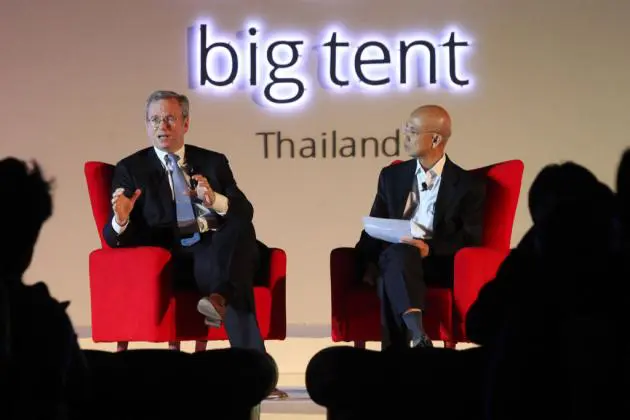
In an interview at Google's Big Tent Thailand 2013 with Nation Multimedia Group chairman Suthichai Yoon, Google executive chairman Eric Schmidt reveals much about the Internet giant's privacy policy
What does user’s privacy mean for Google?
The most important thing about Google is you can control what Google knows about you. People have different needs. We believe in users’ choices. There’s a big crisis in the US over spying. We have talked about this and, with systems that are hard to attack, we do try to keep user’s privacy. We are trying to create security solutions that are much harder to break.
What can you do about the US National Security Agency (NSA) spying on Google? What will you tell President Obama?
It may be illegal. I will complain to the police. The best thing we can do is to make it impossible [for spies] to get your actual data, by using multiple techniques some have called public-private privacy. I think privacy is very important.
Will you sue the government if they spy on you?
We have sued the government to ask them to allow us to be transparent [on data requests made to Google by the US government]. Even the US is not perfect on transparency.
What do you think of Edward Snowden?
When the revelations of Edward Snowden came out, many Americans said he was a traitor to national security. But the revelations in the last months have been so extensive and so concerning to Americans that the reputation of Snowden has changed. You [now] see more whistle-blowers trying to expose something. He clearly broke the law, because when you work for security agencies you need to sign a document that says “I understand that if I reveal secrets I am breaking the law”.
It didn’t involve Google, but it has embarrassed the [US] administration that the [NSA] is spying on the world’s leaders. It is quite a shock to many Americans.
At this moment we are mostly upset that the NSA is visiting us.
You visited North Korea this year. Why?
I believe that everyone can benefit from connectivity, and that includes North Korea. North Korea … is the largest country on the earth that’s not connected [to the global Internet]. It has millions of phones, but no Internet access. There is no music. There’s no iPods. It’s very sad. I believe the citizens and government of North Korea would be better off with more connectivity. The economy would be stronger, citizens would be healthier, the country would be more stable. Most importantly, they would be embraced by the rest of the world. You cannot do business in North Korea if you are American.
How about China?
I have visited China many times. We have been available in China for almost a decade. We opened local operations there seven years ago. After unplugging with the attack by the Chinese on Google servers we decided to move to Hong Kong. Today, we have a small market share in mainland China and a very good market share in Hong Kong.
As a search engine, what responsibility to reflect the truth does Google have?
I wish we had an algorithm that exactly defined truth – and also justice, morality, love and human things. The best we can do is to approximate the truth according to how most people use it. For example, I announce some lies and get great headlines. [But] if there are people who see the lie, [that will translate to our] algorithm ranking, which is working very well.
Will the search engine ever be able to respond to the question, ‘Is this true, Google?’
Actually, we are working on that. We are building something called the semantic knowledge graph. We cannot tell which political party is right or not but we can answer important questions like ones on the capital of Thailand, where did I go for dinner, did they get home in time, and who are my customers.
Will Google ever be able to deliver ‘the truth’ for everyone?
I believe that Google will, in the future, at least be able to summarise the arguments. We are not there yet. But I think we can summarise, because Google will be able to understand enough of the arguments to present all sides.
What will Google look like 10 years from now?
You never know. But we can take a guess at the next three years.
The most important thing that Google can do is to focus on trying to answer questions that you haven’t yet asked. I came [to Google] 15 years ago. What I wanted Google to do when I first arrived was to summarise information, but information personalised to my needs. We cannot do that yet, but it is the direction we want to go.
Sometimes it seems scary that Google knows so much about us.
No, not at all.
