
Looking for an end game in Hong Kong


Play
As the demonstrations continue, how will the tensions between the pro-democracy protesters and the government be resolved?
Democracy protests in Hong Kong look set to continue, with neither the government nor the protesters willing to budge. The Hong Kong government and Beijing’s patient strategy of waiting for the protests to “die a slow death” is being severely tested: while the its momentum has slowed and the number of protesters dwindled, the movement is not at risk of dying anytime soon.
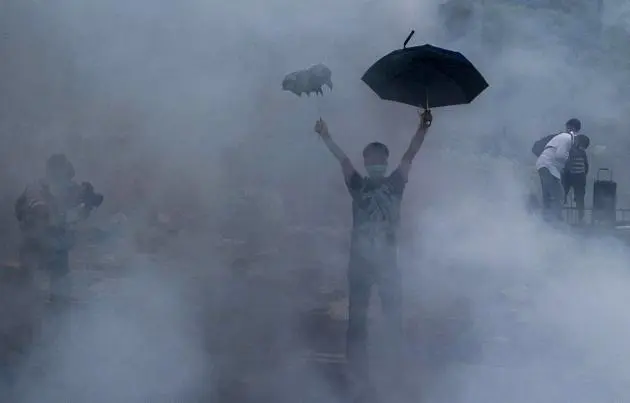
Indications of a rethink in the “slow death” strategy have surfaced in recent days. For example, despite the public backlash against the use of tear gas against unarmed protesters at the onset of the protests, Hong Kong police have, in recent days, been increasingly willing to use force as the protests become increasing entrenched. Footage from October 15 of police officers taking turns to beat an unarmed protester in a secluded spot, with the protester’s arms tied behind his back, is one of the most troubling examples of the new violence being employed.
Why the impasse?
There are three main factors accounting for the current stalemate. The first is the political immaturity of the student-protesters. Fuelled by bleak economic life prospects coupled with over-enthusiastic attraction to liberal democratic ideals, their failure to consolidate their gains and their unrealistic expectation of political change are contributing to the deadlock. The amorphous nature of the movement, once their strength, is becoming their weakness with a fracturing of groups with different motives and goals.
According to the South China Morning Post, some protesters are calling for “self-determination” and even “independence”, a dramatic escalation from calls for genuine universal suffrage. Such disorderliness parallels the general fractiousness of the pro-democracy movement – making it very difficult for the protest to reach any consensus on its future strategy, which in turn makes it difficult for protests to end.
Second, China’s President Xi Jinping does not want to dent his strong image as decisive by giving in to the protests through offering any sort of concession – whether real or merely perceived. This carefully cultivated posture of an immovable leader restricts any compromise, even if a compromise is called for to head off a calamity. This binds Beijing’s options and, as a result, places the onus for solving the problem on the Hong Kong government.
This leads to the third factor – the ineffectual leadership of Chief Executive Leung Chun-ying. Indeed, his indecisiveness and huge unpopularity is working against him and against the prospect of resolving the deadlock. The sudden cancellation of talks, the equally surprising re-opening of talks coupled with the initially restrained use of force – after criticism of the use of tear gas – as well as the recent renewed vigour in the show of force paints an image of government that does not know entirely what to do to.
Possible endings
One possible scenario that would defuse tensions and take protesters off the streets would be the resignation of the Chief Executive. His position seems untenable and the recent leak of a questionable US$6.5-million payment received in a deal with an Australian company is taken by some analysts as evidence of Beijing’s weariness with Leung although Beijing has denied these claims.
Leung himself has stressed repeatedly that he will not resign. So this scenario is highly unlikely unless Beijing consciously decides to remove him, which is also unlikely given that the Chinese government has given him its support several times.
The second possible scenario would be a crackdown sponsored by the central government in Beijing on the protesters. There are already signs that Beijing’s forbearance is waning. The state-sponsored People’s Daily newspaper warned of “unimaginable consequences” if the protests are not stopped. More recently, in a departure from its previous restraint, a Chinese official did not rule out force and said that there is no need to activate the army “so far” and that they hoped “such a scenario will not unfold”.
This scenario, though, appears unlikely (at least for now) as several important events in the Chinese leadership’s calendar such as the Asia-Pacific Economic Cooperation (Apec) summit in Beijing and the Party’s 4th Plenum on “the rule of law” – both in October – are taking up most of the leadership’s attention.
The third and most likely scenario is for the continued gridlock between the protesters and the Hong Kong government and for each side to wait for the other to “blink first”. That said, pro-democracy protesters should start being realistic in their expectation of change; otherwise they risk alienating the general Hong Kong population further or, worse still, giving Beijing a reason to crack down if the protests degenerate further.
Dylan Loh Ming Hui is a research analyst with the S Rajaratnam School of International Studies (RSIS), Nanyang Technological University, Singapore.
