
We're no longer willing to accept that'
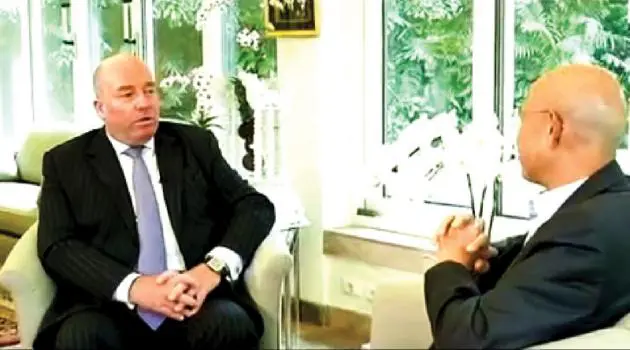


Nation Multimedia Group chairman Suthichai Yoon spoke to German Ambassador to Thailand Rolf Schulze about the fall of the Berlin Wall 25 years ago and its ramifications, both personal and political. Here are excerpts from the interview:
Suthichai: Ambassador Schulze, 25 years ago the Berlin Wall came down - on November 9, 1989. What were you doing on that day and during that historic moment?
Schulze: I still do remember it very vividly 25 years ago. Then I was serving at our headquarters, which were still located in Bonn, the capital after World War II. And of course, we knew on November 9 already that something would be coming. The previous days and weeks
and months there was political movement in the eastern part of Germany and we could feel that we could grasp the historic developments which were about to take place. So in those days we were all sitting in front of our television sets, sitting in front of our radio sets and for 24 hours we were watching developments, live broadcasts.
What was your role then?
I was then at the Department for European Security, European Structures, as a medium management diplomat…In this department it was our operational job to follow developments in the eastern part of Europe but also in eastern Germany.
So what was the thinking then when you saw the pictures live on TV
showing people jumping onto the Wall and trying to break it down? You’re from the West?
I’m from the West [of Germany] but I have a pictured image of divided Germany. My mother’s family [is] from the West… from the Black Forest. My father’s family, up to the present day incidentally [was] from the east. So the division of Germany for my family was always something very personal. It was not only a political, historical phenomenon but a situation which our family experienced every day. It was very difficult to keep up family relations with my aunties, uncles and cousins in the east. And when finally the Wall came down on November 9 we knew this would also mean a family reunion again, that our family would grow together again.
That was Germany, the two parts reuniting but also families reuniting. So there was a strong sense of joy and excitement.
But it was still quite uncertain when you saw the picture, the live pictures of young people jumping up on the Wall. Obviously you didn’t know it was really going to happen, that it might just be a flash of news, then things could go back, right? Or did you think at that time that ‘This is it’, the wall was going to come down?
We thought that was it, because as I said already in previous months there was a very strong civic movement. People took the lead from the streets voicing their opposition to the Stalinist regime in Eastern Germany. People asking for freedom of movement, freedom of opinion and assembly, there was a growing current, civic current, and in a way 9th of November was the crowning moment.
And did you run from Bonn to Berlin?
I did so. I did so. I did so. Not that very night but a couple of days later I took my father who originated from the east and we jumped into our car and we drove across Germany where previously there were border controls… We passed the Wall and it was evident that the consequence would be a reunited Germany.
What did your father say?
Well, he was highly emotional. He was an elderly gentleman then and for him it was a dream come true. A dream come true to see his sister whom he had not met for decades before and to take her to his arms again. So these were very strong feelings.
But for you, it had always been a war, right? When you were born was the Wall there?
I was born with the Wall there, but through my specific family situation, we always knew that East and West Germany, these were not two independent countries like France and Italy, France and Germany. We always had a very strong conviction that these were two entities basically belonging together.
What was the last straw? What was the one big decision or one movement that brought the Wall down?
I think the regime underestimated the will of the people to finally liberate themselves. They [the communist authorities] underestimated the wishes,
the aspirations of very ordinary people to take their destinies into their own hands. For decades, people had been under the authority of a repressive police regime and at the end of the day, people were no longer willing to accept that.
And I think the regime underestimated the strength, the longing, the wish of people for liberty and self-determination.
But it was also a very risky move by those who were campaigning for the end of the wall.
And of course it wasn’t a development limited to Germany alone. In the whole of eastern Europe, in Poland, Hungary, Czechoslovakia, but also what happened in the Soviet Union with Gorbachev introducing a completely new approach to politics – glasnost, transparency, and perestroika, reconstructing. So Germany was in a way fortunate to have that environment where we could decide on our reunification.
Do you think Gorbachev played a role in that?
Gorbachev played a very important and decisive role. Without his agreement, German reunification would not have come about. The United States played a very decisive role. Without their moral support, this process would never have gone ahead.
And as our then Chancellor Helmut Kohl said: German unity and European unity are two sides of the same medal. So the process of German reunification was and is integrated in the process of European cooperation.
Is this a good model for other countries? Korea?
Well, of course, many people have asked us if this could serve
as a role model for Korea. I think you can never do a carbon copy of historical processes. I think the one lesson learnt from German reunification is: if there is a
historic window of opportunity, use it, don’t waste it. Don’t
hesitate.
Despite the price? Despite the economic cost?
Despite the price. You must be willing to shoulder the economic cost and the burden, whether it’s Germany or Korea.
But if the window of opportunity opens – take your chance. It
may not present itself a second time.
So can you say that November 9 was the beginning of the end of the Cold War?
I would say so.
The Wall divided not only Berlin, the Wall divided not only Germany but Europe as a whole. And the whole world in a way… and in the aftermath of the fall of the Berlin Wall, central and eastern European countries became members of the European Union. That’s a wonderful process that today Europe as a continent is united again.
Yes, and I would agree with you that it all originated on the 9th of November.
