
How the military is still fighting democratic transition in Myanmar
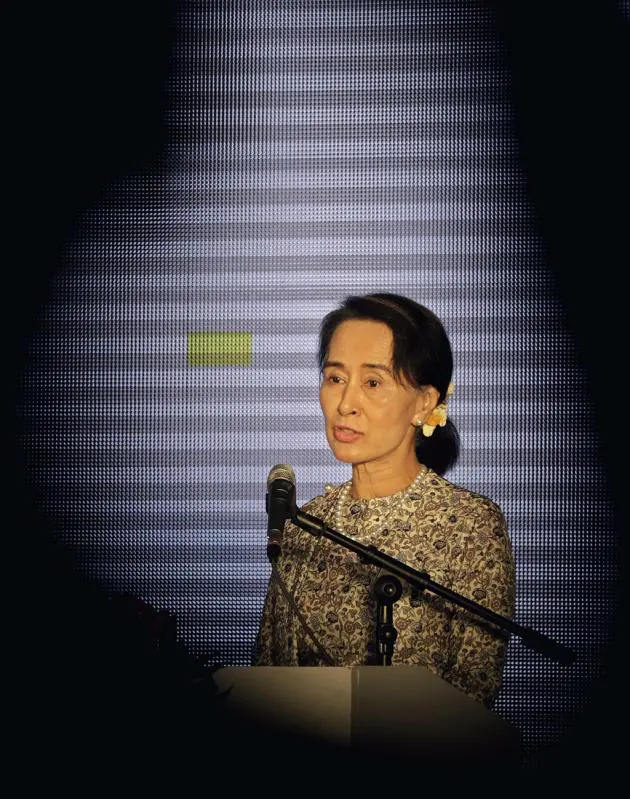


Play
But moves to fortify its power against the will of the people threaten to ignite a popular uprising
Myanmar’s semi-democratic government led by President Thein Sein has been pushing reforms since he took power in 2011. After four years there have been some positive moves as well as some steps back.
The most difficult things to change have been corruption in every ministry and sector, land grabs by army and local authorities, and a judicial system that is not independent. Elsewhere, strong control by the army over civilian administrators has hampered democratic reform. Meanwhile, favouritism and lack of transparency in business continue to plague Myanmar today.
From the bottom up, civil servants take bribes in a bid to make ends meet amid high inflation and low salaries. Efforts to set up electronic-government have failed despite millions of dollars spent. Civil servants still use the 60-year-old paper system rather than accepting online payments and applications, making bribery to speed up the process a common occurrence. Civil servants know e-government would be more efficient, but they don’t want to change the system.
Meanwhile, under military rule from 1988 to 2010, the regime allowed regional commanders to find their own way to fund their regiments’ needs. Commanders started to confiscate land from local people and farmers, who had no power to resist. The farmers must now pay the army men rent to plant crops on their own land. When Thein Sein’s government took power and gave citizens the right to protest without fear of reprisal, farmers came out in their hundreds of thousands to demand the return of their ancestral lands. However, only a few of these cases have been resolved quickly.
The judiciary, meanwhile, remains under the control of the administrative body. Though the government says it wants good governance, judges lack the right to practice their authority under existing laws. Instead, they have to follow instructions on whom to release or whom to put in prison, and how long a jail term should be. The judge’s duty is not to practice laws under the constitution but to follow directions from the government.
There are numerous examples of people punished for not following the regime’s orders, such as former religious affairs minister U San Sint. Another is Ko Htin Kyaw, leader of the Movement for Democracy Current Force, which campaigns against land grabbing and other rights violations.
Charter change
The major problem the nation faces is changing the 2008 constitution into a democratic charter. Last February, the Constitutional Amendment and Preparation Committee was formed with 31 members. The committee has 12 members from the ruling USDP party, seven from the army, two from the NLD and 10 from other parties. Among the 31 members, five wish to change Section 59(f) of the charter, the section which bars opposition leader Aung San Suu Kyi from becoming president. Of the rest, most were hand-picked by the regime and thus object to any change. Governing charter change is Section 436, which says the constitution can only be amended if 75 per cent of elected MPs plus one unelected military MP support the change. This effectively gives non-elected MPs from the military the power of veto over any charter change.
So, even if Suu Kyi’s National League for Democracy wins the election, she has no chance of becoming president.
Army Chief General Min Aung Hlaing told Voice of America that he had no desire to change Section 436 or 59(f). President Thein Sein, meanwhile, told VOA that parliament has full responsibility for constitutional changes. Senior leaders are kicking the ball into the other court and confusing the nation. Some observers say delaying changes to the constitution until after the 2015 election is a tactic of the military.
A crucial feature of Myanmar politics is that the army holds administrative power behind the scenes. Under the constitution, only the army chief can elect the ministers of the interior, defence, and border area. The president has no right to make appointments for those three positions. And above the government is a National Defence and Security Council, similar to the old Soviet politburo. Under this arrangement, the army chief is more powerful than the president.
Further, administrators at the district, division and township levels are appointed by the Interior Ministry, with the minister appointed by the army commander. So civilian administrators have to run their offices under this command structure. Only a quarter of village administrators were elected, and township administrators have the power to hire and fire them. Activists are demanding that administrators be appointed by popular vote, not by the ministry, so that real democracy can take shape. If things stay as they are, military influence will continue to overshadow civilian rule.
Peace talks
The government is trying to forge a peace deal with armed ethnic resistance groups before the election. But reaching an agreement has proved difficult because ethnic groups are demanding a federal union, while the current constitution is a unitary charter and the government is only giving lip service to the possibility of federal rule.
Despite government negotiator Minister Aung Min’s best efforts to reach a peace agreement, only the Karen National Union and a few others among the many ethnic resistance groups are likely to sign a deal.
This year’s election
The Election Commission has said polls will be held sometime in October. Opposition leader Suu Kyi said her party will decide whether to run or not when the exact date is set. Some observers say the election may be postponed if the regime thinks it won’t win. And there have been clear signs that the army fears the NLD will win.
A brief glance at Burmese history reveals that the army abolished the previous two constitutions and drew up new ones. No one is asking for the 2008 constitution to be scrapped, just for its undemocratic parts to be amended. But the army chief is blocking any change, because the constitution as it stands gives the military political control.
But while the military is blocking Suu Kyi from becoming president, the army-backed political party will lose this battle eventually, because people are fed up with the misuse of power by army generals and officials. People want real change and they are ready to fight for it.
The USDP has only one way to win Octobers polls – by getting help from the election committee and cheating. The NLD and ethnic nationality parties will be the genuine winners of this year’s election.
The generals’ road map is to allow civilians limited liberty, such as media freedom and freedom to run small businesses. They want to retain real power over politics and the economy for three or four terms – another 20 years under semi-military rule.
Their aim is to enjoy their wealth and authority without threat or bloodshed until their term is over. When challenged, they say they want to offer freedoms bit by bit, not all at once, so as to avoid the violence and instability faced by countries that shift too quickly from military to civilian rule, such as Egypt.
Meanwhile there is a lack of justice in every sector of society. Appointed judges fail to mete out justice according to the law. There is no appropriate land ownership law. And a scarcity of business opportunities is igniting public anger. If parliament fails to change the constitution, a popular uprising will emerge in the near future. Then we will find out whether the military can retain their control over the people, or whether people power will finally dictate the future of Myanmar.
Htun Aung Gyaw is a former chairman of the All Burma Students Democratic Front who got a Master’s in Asian Studies from Cornell University in New York. He now leads the Civil Society for Myanmar, a non-profit group in Tokyo; [email protected]
