
In Germany, new blood meets old fears


Play
But refugees feel the warmth of ‘Willkommenskultur’ in Schwerin, where residents are greeting them with open arms
Optimism was high in Schwerin when the city received between 2,000 and 3,000 newcomers last year after Germany opened its doors to refugees.
Known for the romantic Schwerin Palace, which crowns an island in the lake, the small northern city is home to an ageing and dwindling populace of around 100,000 people.
As such, many residents see the refugees – whose average age is 25 – as a welcome injection of new blood for the city and its labour market.
“The refugees can also enrich our culture. I’m sure Germany can profit from that. We will learn about each other,” said Andreas Ruhl, deputy mayor and head of the city’s finance, youth and social affairs department.
Schwerin’s attempts to help the newcomers, many of whom have fled war in their homelands, integrate into German society is an impressive illustration of the local “Willkommenskultur”, or welcome culture.
The city has joined hands with charities to forge a warm response to the new arrivals by holding public-relations talks, joint activities between refugees and locals, setting up a refugee-integration unit, and inviting officials to play a positive role.
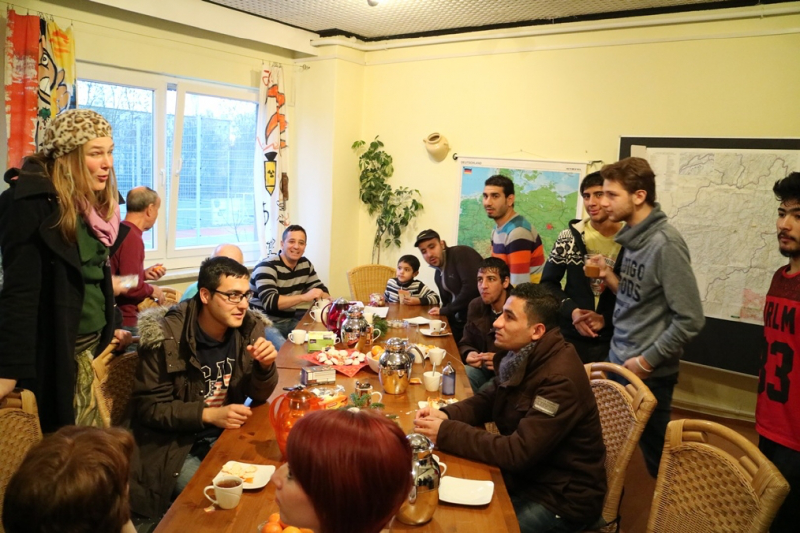
The campaign also features “welcome cafés”, where the refugees can meet and talk with local people and receive information on how and where to register as asylum seekers.
Currently there are six welcome cafés in Schwerin, run by the German Red Cross and other charity organisations.
We got the chance to visit one café on the outskirts of the city on its opening day.
The surrounding area is home to about 8,000 residents from migrant backgrounds, and 80 refugees live nearby, a volunteer says.
The café offers cake, coffee, tea, cold drinks and a recreation room. A world map hanging on the wall gives refugee visitors the chance to orient themselves by locating the position of their home countries and tracing the journeys they made to get here.
Around 10 well-dressed young refugees aged between 17 and 21 sat at one table chatting with local volunteers. Enthusiastic and curious about strangers, the teenaged asylum-seekers were keen to talk with us.
Most were from Afghanistan and Syria and had been in Schwerin for three months. Only a few could speak a little German and none could speak English.
The café is the perfect place to integrate with their new society as it affords refugees the chance to practise the German language and get familiar with the culture.
“It starts with coffee and then leads to a conversation – ‘what do you think about this or that’,” said Claus Oellerking, one of the café’s founders.
Oellerking, who is a life coach and vocational training expert, said the refugees offered new hope for the German labour market. These young people asked for something to do, he said.
The 57-year-old German told the story of a 59-year-old Syrian refugee he encountered at a supermarket. The Syrian spotted that the person manning the checkout had done something wrong with the cash register.
“He is a well-educated guy. He told me he used to be a manager in Syria. I think he will be able to be a trainer here, but the challenge is the [German] language,” he said.
The cafe comes under the umbrella of the Caritas charity and is run by volunteers with the help of thousands of donations from German people.
Vanessa Baum, 15, a student in Schwerin, is volunteering here as a school activity.
Despite lacking a common language, she enjoys organising drinks, snacks and dessert for the refugees and sitting at the table gleaning what she can from their conversations.
“I feel good about being able to help them. My parents are happy about what I’m doing,” she said.
Hanne Luhdo, a charity volunteer, admitted that locals had initially displayed prejudice and fear towards the refugees, especially in the wake of the terrorist attacks in Paris in November. But understanding and sympathy for people who were fighting to escape wars at home had gradually grown.
Deputy Mayor Ruhl said he was impressed with the way citizens had opened their arms to the refugees.
“Our population in Schwerin is 100,000, and 5,000 applied as volunteers and offered donations of clothes and food.”
Some even accompanied refugees in need of medical attention, acting as translators during visits to the doctors.
“That’s amazing. Germans in general can be proud of our [welcome] culture,” he said.
Ruhl pointed out that Germany is a land of refugees. In 1945, Germany coped after 11 million people fled from the east to the west of the country, so it should try to accommodate the current situation, he said.
Integration is key
The initial arrival of refugees in September opened a deep divide among German citizens. Some feared the newcomers, others wanted to help them.
Pride in the welcome culture that had built up through the response to refugee crises in the aftermath of both world wars was now being tested by a new wave of migrants from very different and distant societies.
The key question was whether and how they would adapt to their new society.
“Integration is the challenge and really big task,” said Norbert Seitz, head of Department of Migration at the Interior Ministry.
He noted that some people were comparing today’s situation with the aftermath of World War II, because the number of refugees was similar. In fact the two scenarios were very different.
The post-war crisis featured people who shared the same destiny, whereas this latest wave of refugees came from diverse societies and backgrounds, Seitz pointed out.
Yet Germans’ willingness to reach out a helping hand is still evident today in the number of volunteers who have come forward to assist the refugees, he added.
On the other hand, when small communities of a few thousand people suddenly received 1,000 or more refugees, it naturally provoked local concerns over the influx of large numbers of strangers.
Seitz said that Germany needed to strike a fine and sustainable balance between the number of refugees it accepted and the corresponding concerns of the local population.
“So, a lot of sensitivity is required to deal with the problem, because our welcome culture today may turn into something [different] tomorrow.”
He also admitted that xenophobia had risen in German society over the terrorist attacks in Paris last November and threats against other European cities.
“So it’s important for people who want to stay in Germany to integrate. We need to familiarise them with our culture and language.”
The government also had to understand that some citizens were fearful about the refugee influx and needed reassurance that authorities could cope with the situation, he said.
“If you talk simply and sincerely to these people it will reduce fear and increase trust between people [locals and refugees]. People will open up and welcome the new cultures coming to our country.”
Seitz harbours no illusions over the scale of the challenge, however. To encourage integration simultaneously with the process of admitting and distributing more than a million migrants all over the country last year, was a mammoth task, he said.
In Ruhl’s opinion, getting the refugees into the workforce is the key, though he fears that genuine integration could take years.
Meanwhile though the unemployment rate in Schwerin is a modest 9.9 per cent, it could still prove a problem.
“We believe 9 to 10 per cent of the refugees can get a job within a year or two. But that would leave more than 90 per cent out of work. This is a real challenge for us,” said the vice mayor, adding that authorities are still working to find a solution.
Germany’s Chambers of Commerce and Industry are offering refugees and other immigrants help in their bid to enter the labour market.
One of their main tasks is to provide vocational training for the refugees, which bolsters their skills to meet demand in the labour market.
However, the Department of Migration wants refugees to take up jobs within three months of having their status recognised, Seitz said.
“So it means we need to provide language training at an early stage. We also expect that people who stay longer in our country also want to seek work,” he said.
This is the second part of a two-part article published today and yesterday. The writer made her visit in mid-December at the invitation of the “Refugees/Migration/Integration in Germany” programme organised by the Germany Foreign Ministry.
