
Thai tourism can move up a gear. Here’s how


Play
What did Thailand do to attract nearly 30 million visitor arrivals in 2015?
That figure is a record high.
The year before, tourist revenue contributed Bt1.04 trillion, or 8.6 per cent of gross domestic product, according to the World Travel and Tourism Council (WTTC). Add the ripple effect to other sectors and the total contribution came to Bt2.3 trillion, or 19.3 per cent of GDP. The tourist industry also employed 2.21 million workers in 2014 – 5.8 per cent of workforce.
According to Bank of Thailand statistics, visitor arrivals have been steadily rising, from 7.2 million in 1997 to 24.8 million in 2014 (though that was down 6 per cent from the 26.5 million recorded in 2013).
Throughout 2015, tourism was the only engine driving an economy facing headwinds from public spending, domestic consumption and exports.
This year, the outlook is brighter. The WTTC forecasts that the tourism’s contribution to GDP will rise 6.4 per cent per year, to hit Bt4.497 trillion in 2025. The number of jobs in the industry is also expected to rise in that time, by 4.6 per cent per year, to 3.476 million – a whopping 8.6 per cent of the total workforce.
Based on these forecasts, Thailand is in the global top 20 in terms of long-term growth – ranked 15th among 184 countries.
So what exactly does Thai tourism have to offer?
Two decades ago, it was “sun, sea and sand”. Most tourists knew Thailand for beach resorts like Pattaya and Phuket. As visitors searched for new destinations, the appeal slowly spread to provinces near Pattaya and Phuket.
Promotions that focused on cultural attractions then drew Chiang Mai into the spotlight for its famous Lanna-style festivals. Despite annual smog, the Rose of the North remains a favourite with tourists who arrive for Songkran. Ayutthaya soon came into picture, along with other provinces that boast heritage sites.
Backing this up is hospitality and food that’s famous the world over.
So what’s the next selling point that the Tourism Authority of Thailand can draw on in its bid to attract more than 30 million visitors this year?
The TAT has revealed little about its plans to meet that target. The suspicion is that it came up with the ambitious projection based on figures from its overseas offices. The TAT is endowed with an annual budget of Bt1.5 billion for overseas marketing, but to maintain Thailand’s international status as an attractive destination requires more assistance from other government units.
Among them is the Designated Areas for Sustainable Tourism Administration, which has been tasked with creating “alternative” destinations with a focus on culture and eco-friendliness. Ban Rai Gong Khing in Chiang Mai is one such destination. It earned a nod in the Pacific Asia Travel Association’s inaugural Tourism InSPIRE Awards 2015 for a healthy local lifestyle that has been attracting visitors.
The award, bestowed only a few years after the community opened its doors to outsiders, has inspired other villages in Chiang Mai to replicate the lucrative success.
Among them is the San Lom Joy community, just 3km from the city, which plans to unveil a nature trail and its unique hilltribe culture.
Needless to say, the community needs a lot of help in achieving its vision. The TMB Bank offered its aid in constructing the walking trail, but the village needs more help in selling its hilltribe culture.
The village chief is now proud to show visitors how they brew the local firewater, made from maize and rice. The flavour is good, but promoting this local tipple will be difficult amid a strong anti-drinking sentiment. The hilltribe village itself is small, offering visitors the chance to observe locals drying chillies on their doorsteps and making souvenirs, all amid the lingering but not pungent smell of pig dung.
While this village will have to struggle for fame, other tourist destinations in Chiang Mai are attracting surprising attention through word of mouth.
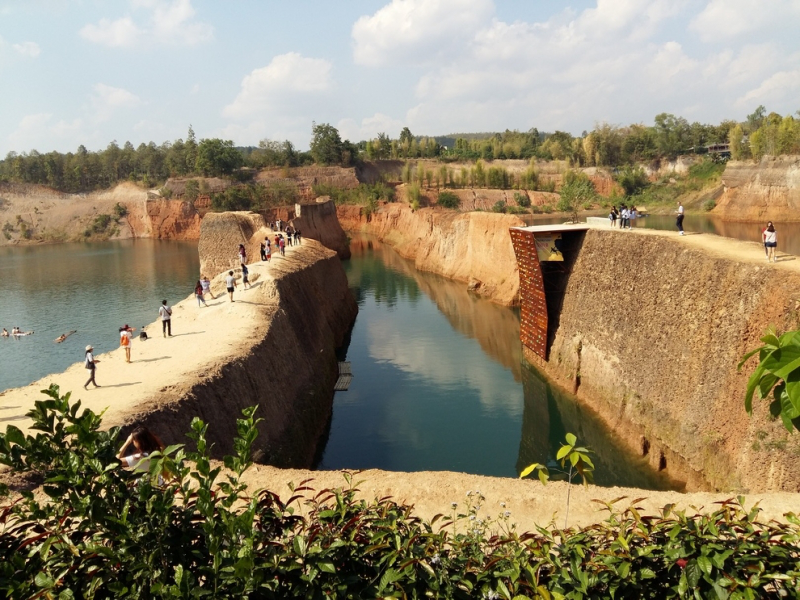
In Nam Phrae, foreign and local visitors flock to witness the “Grand Canyon of Chiang Mai”. The attraction is an old open pit mine, where the digging has left towering columns of earth. The pit gradually filled with water, creating a magical scene. Visitors can now be seen swimming, sunbathing and diving in the artificial lake. On a busy day, the place welcomes about 4,000 visitors, generating about Bt200,000 from an entry fee of Bt50 per adult.
A worrying feature is the lack of lifeguards. Who is responsible if visitors meet with accidents? And could a serious accident tarnish Thailand’s tourism image?
Concerns about the safety of Thai tourist attractions are underscored by frequent reports of incidents. Just last week a Chinese tourist visiting a snake farm was bitten on the nose by a python, which left a wound that required eight stitches. Police then stepped in, vowing to step up safety and security at all animal shows in the province.
Thailand remains easy to sell to international visitors. But we need better management of those selling points if we want to remain an attractive destination in our global village.
